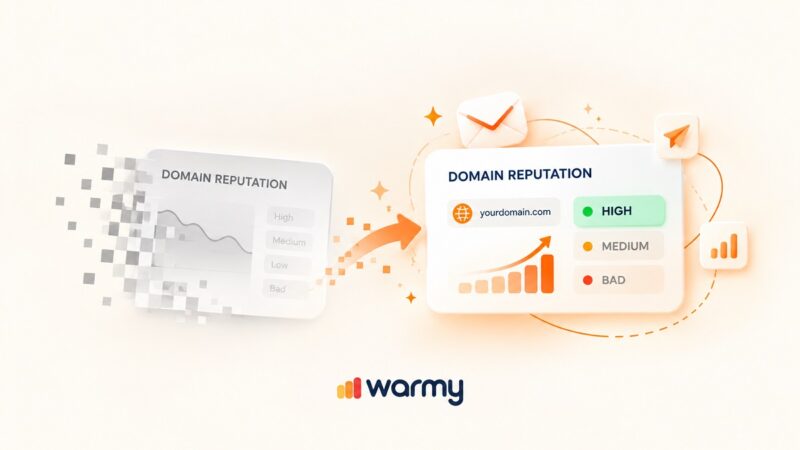


The Validity Heatwave blocklist launched on September 3, 2026, to identify sending domains associated with synthetic reputation warming and, in some cases, subsequent unsolicited outreach. More than 1 million domains were listed at launch, and the list continues to grow. Two important questions remain unanswered: Validity has not published a false-positive rate, and no large-scale independent study has measured how a Heatwave listing affects inbox placement.
What Is Validity’s Heatwave Blocklist?
Validity Heatwave is a domain blocklist, or DBL, launched on September 3, 2026, to flag artificial domain warming and related cold-email practices. According to Validity’s technical documentation, it lists sending domains rather than IP addresses, URLs, domains found only in message content, or DKIM signing domains.
The signal is mirrored into Validity’s DNS reputation zones. Mailbox providers, security providers, and ESPs can use this domain reputation blocklist in filtering, onboarding, and quality decisions. Heatwave is Validity’s “measured opinion based on observed signals”, with final use left to each data consumer.
What Heatwave Is Designed to Detect
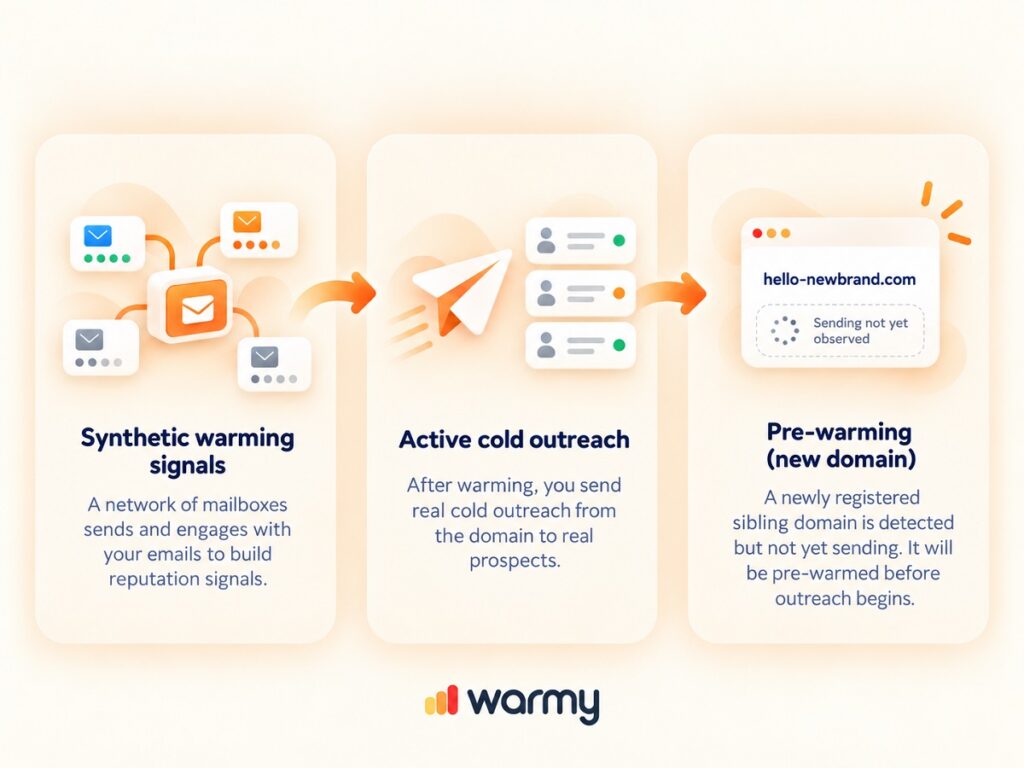
Synthetic domain warming, also called artificial domain warming by Validity, involves automated mailboxes exchanging generated messages and manufacturing engagement through opens, replies, “important” actions, or moving messages out of spam.
Validity’s current guidance distinguishes this from legitimate reputation ramping, which increases volume gradually to real, permissioned recipients and builds sender reputation from genuine engagement. Under M3AAWG’s 2025 definition, cold email is unsolicited email from an identifiable sender seeking a business relationship or other professional benefit from someone with no prior relationship, connection, or consent.
Heatwave’s synthetic engagement detection looks for content patterns, shared-template and persona clustering, freshly registered domains, and known cold-email infrastructure.
The September 3 announcement gave only a broad outline; Validity’s current materials distinguish three stages. Stage 2 means synthetic warming has been observed; stage 3 adds active cold outreach. Stage 4, or pre-warming, can apply to a registered sibling of a known warming family before sending from that domain has been observed.
Validity’s public DNS documentation defines stages 2, 3, and 4. It does not define or explain a Stage 1.
For observed-sending listings, Validity says mail from the domain reached its spam traps and was scored as cold-email infrastructure. Stage 4 is different: official examples show “Observed sending: Not yet observed”. Heatwave is built to detect synthetic messaging marketed as “email warmup,” according to Validity. The exact thresholds are not public.
What’s Verified So Far
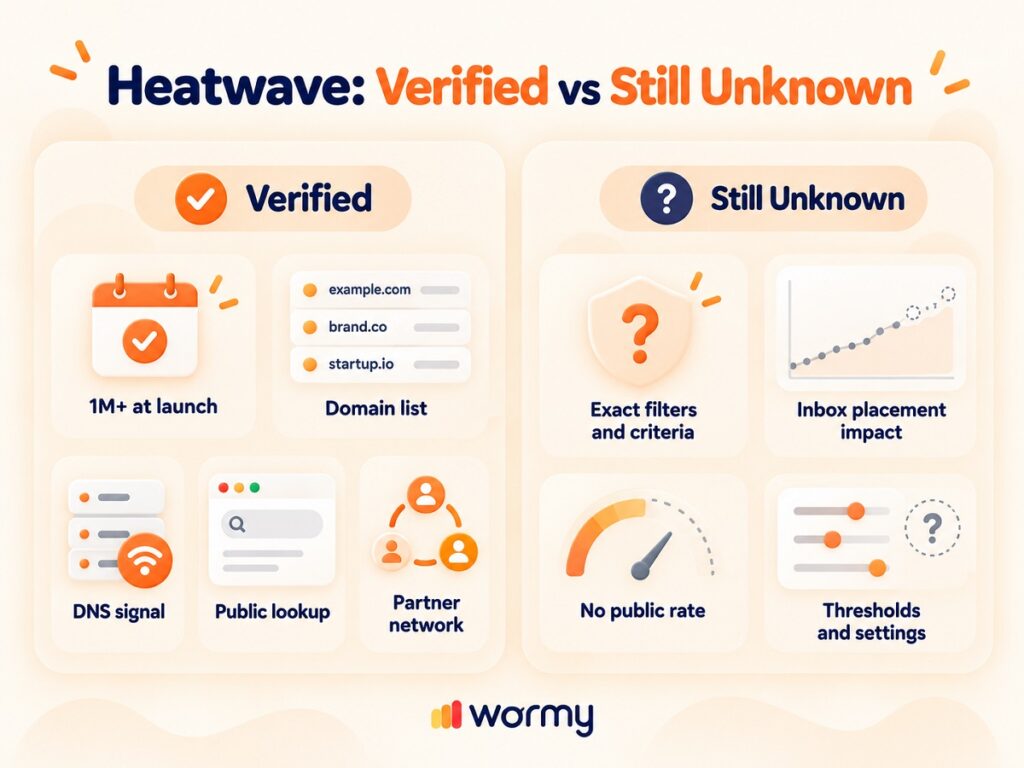
- Heatwave launched on September 3, 2026, with more than 1 million domains already listed; its signal is mirrored into Validity’s DNS reputation infrastructure.
- The public lookup allows 100 free daily checks per IP; bulk and DNS access is available to partners on request.
- Validity said Heatwave was being used or evaluated by Comcast, Proofpoint, Spamhaus, SURBL, ESPs, and other partners. That does not mean every named organization automatically blocks mail from listed domains.
- The lookup can surface similar domains, but Validity calls similarity a lead, not proof of common ownership.
- Validity says senders may be unaware of warming infrastructure run by vendors, agencies, or subcontractors.
- Current documentation describes a pre-warming stage not mentioned at launch. Stage-4 domains can be listed before observed sending and can automatically unlist if the associated family assessment changes.
Independent evidence remains limited. One deliverability consultancy, SH Consulting checked, 1,055 domains from companies that had contacted it about deliverability or reputation problems. It found 917 clean, 127 candidates, and 11 listed. Because the sample was selected rather than random, it cannot establish overall prevalence, accuracy, or false-positive rate.
What’s Still Unknown
- No public false-positive rate has been published. Validity says its process is designed to guard against false positives and offers manual review, but it has not published a measured rate.
- No independent large-scale study has quantified the effect on inbox placement. Validity recommends that mailbox and message-security providers consider filtering listed domains and that ESPs consider the signal in onboarding and outbound-quality reviews. The weight used by each provider and the measurable inbox-placement effect are not public.
- The exact thresholds are not public. Validity names the signal groups it evaluates without disclosing the complete threshold or weighting model.
- There is not enough public evidence to classify every warm-up tool or implementation. Validity distinguishes permissioned reputation ramping from synthetic engagement, but its documentation does not let an outside observer map every product or configuration to a listing outcome.
How Warmy Is Approaching This
Natural, Human-Like Engagement
We built Warmy to create natural, human-like engagement. Timing varies, opens and replies are not uniform, and activity does not follow a single predictable pattern. This is not a system we configure once and leave unchanged – we continuously refine our algorithms as mailbox providers and detection methods evolve.
We are also closely monitoring this specific issue. Validity’s new Heatwave blocklist is designed to identify synthetic engagement patterns, and we are actively researching its real-world impact on sender reputation and email deliverability.
For an email warm-up blocklist focused on synthetic engagement, the key operational questions are how engagement is generated and how sending environments are separated.
Learn more about Warmy’s approach to natural, human-like engagement.
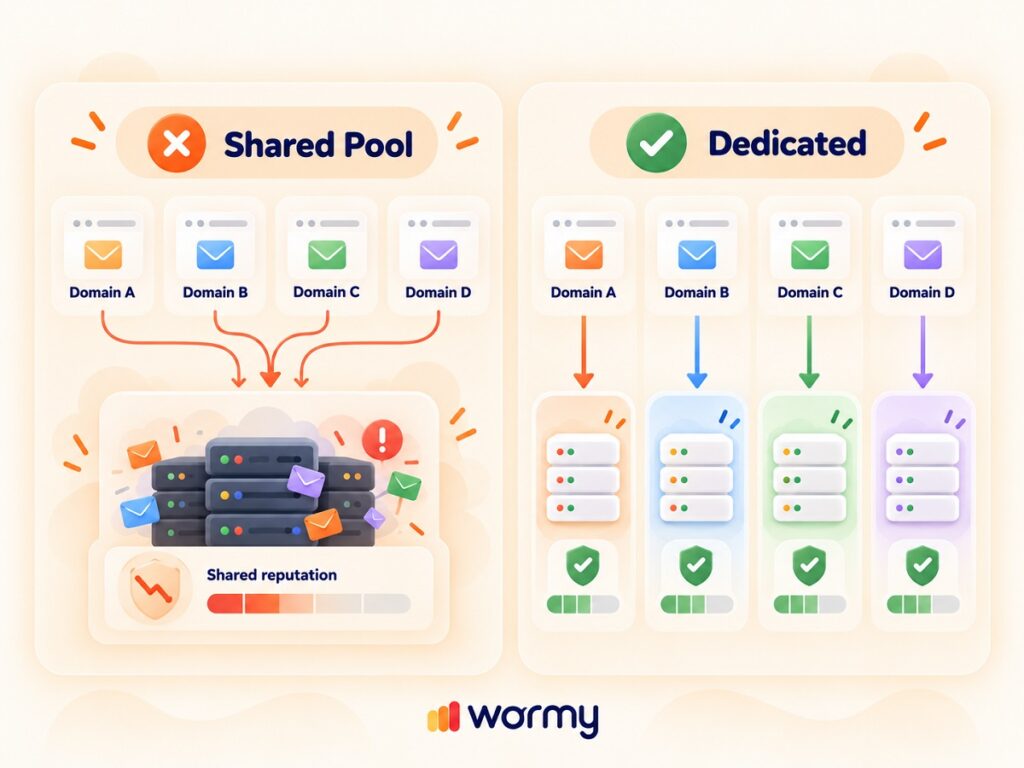
Dedicated Sending Environments
We have moved customers to dedicated sending environments instead of relying on a single shared pool. This creates stronger account separation and significantly reduces the risk of unrelated senders being grouped or affected by another sender’s activity.
Dedicated sending environments
Reputation Building and Continuous Monitoring
Warmy is built to help legitimate, responsible senders establish, protect, and restore the reputation of their domains and IP addresses. Without a structured reputation-building process, recovering a damaged domain or IP can take months, and in some cases, may not happen without corrective action.
Our goal is to accelerate that process responsibly by identifying reputation problems, improving sending behavior, and helping high-quality senders rebuild trust with mailbox providers. We stay on top of industry news, policy changes, filtering technologies, and emerging deliverability risks. Our team attends leading email deliverability conferences and remains closely connected to developments across the industry.
Email deliverability is not simply one of our features – it is our core business, our expertise, and what we work on every day.
See Warmy’s structured reputation-building process.
What Senders Can Do Right Now
Start with the Heatwave lookup Validity provides through its public Heatwave lookup. Check every exact sending domain or subdomain you use: example.com and mail.example.com are separate lookups. Use related-domain matches as investigative leads. Confirm who owns or controls each unfamiliar domain before drawing conclusions. Review registration records and outreach tools, then ask any relevant vendors or agencies whether they operate secondary domains.
Do not read the 1-100 listing score as the probability that a domain is abusive. Validity defines it as a relative severity band compared with recent listings; it is recomputed hourly and does not determine listing status.
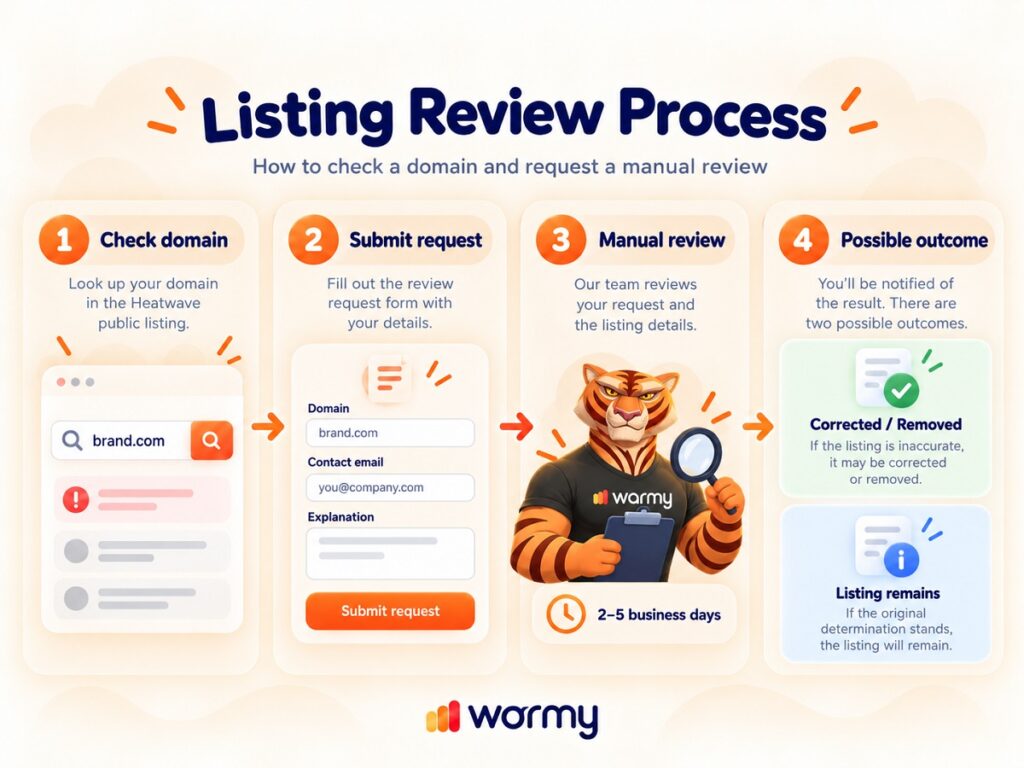
Stopping observed synthetic warming does not automatically remove the record because Validity treats it as a historical observation. If you believe the listing is incorrect, you can request a manual review. Validity says reviews typically take two to five business days. If synthetic warming occurred, Validity recommends stopping it and ramping with real, permissioned recipients instead. Stage-4 pre-warming listings can disappear if the family assessment changes.
Keep watching Validity’s official updates, and do not make broad sending changes based on an unverified related-domain match or assumptions about how a provider uses Heatwave.
You can also run a free check on your domain for broader deliverability signals. For more background, read our full guide to blacklists and how they affect deliverability and see how domain reputation is built over time.
How to Request a Listing Review
If you believe a domain was listed incorrectly, first confirm its status using Validity’s public Heatwave lookup. You can then submit a listing review request for the affected domain and explain why you believe the listing is inaccurate. Validity says review requests are handled manually and typically take two to five business days.
If you use third-party outreach tools, agencies, or vendors, it is also worth checking whether they registered or operated additional sending domains on your behalf. Stopping synthetic warming does not necessarily mean a listing will disappear automatically, so senders who believe a listing is incorrect should use Validity’s review process.
FAQ
What is Validity’s Heatwave blocklist?
Heatwave is a domain blocklist for sending domains associated with synthetic reputation warming and, at stage 3, subsequent active unsolicited outreach.
When did Heatwave launch, and how many domains are currently listed?
It launched on September 3, 2026, with more than 1 million domains listed. Validity’s public lookup dashboard shows the current total, which changes as the list is updated.
How does Heatwave decide if a domain is doing “unethical” warming?
Validity evaluates behavioral and infrastructure signals but has not published the exact threshold model.
Can I check if my domain is on the Heatwave list?
Yes. Use the public Heatwave lookup and check each exact sending domain or subdomain; listings are not inherited between them.
Does using an email warm-up tool automatically put me at risk?
There is not enough public data to say any particular tool automatically leads to a listing. Validity distinguishes permissioned ramping from synthetic mailbox-network activity, but has not published thresholds for every product or implementation.
Has anyone independently verified how accurate Heatwave is?
No large-scale independent accuracy study has been published. SH Consulting’s 1,055-domain selected sample found 11 listed and 127 candidates, but cannot establish overall accuracy or false-positive rate.
How do I request a listing review if I think my domain was listed incorrectly?
Submit a request through Validity’s listing review form with the affected domain, a contact email, and an explanation of why you believe the listing is inaccurate. Validity says reviews are handled manually and typically take two to five business days.
What is Warmy doing in response to Heatwave?
Warmy is closely monitoring Heatwave and actively researching its real-world impact on sender reputation and email deliverability. We continuously refine our algorithms as mailbox providers and detection methods evolve, and we have moved customers to dedicated sending environments instead of relying on a single shared pool.
Where can I get updates as more information becomes available?
Validity’s official Heatwave materials are the primary source for methodology changes. We will update this article as new evidence appears.
Wrapping Up
The Validity Heatwave blocklist is operational and available to email-infrastructure partners. Validity recommends that mailbox and message-security providers consider the signal in filtering and that ESPs consider it in onboarding and outbound-quality decisions, while leaving final use to each data consumer.
Public evidence still does not show how often incorrect listings occur or how much a listing changes deliverability for a sender. Warmy is monitoring the issue and researching its impact. We will update this article as new independent evidence or official clarification becomes available.
For ongoing domain and sender-reputation monitoring, explore Warmy’s deliverability tools.