

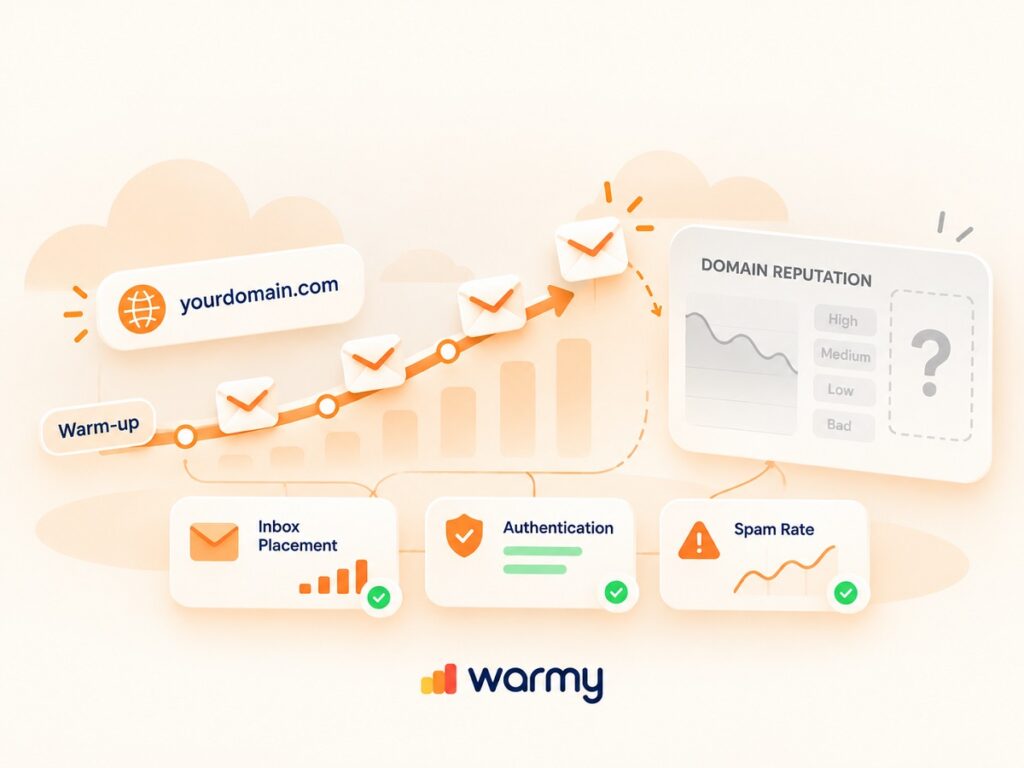
For years, the Domain Reputation chart in Google Postmaster Tools was the first thing many senders checked. One glance told you how Gmail saw your domain: High, Medium, Low, or Bad. If you were warming up a new domain, watching that label climb was how you knew the work was paying off.
That chart is gone. In August 2026, Google stopped showing domain and IP reputation in the Postmaster Tools interface, and in September 2026 it stopped sharing this data through the API. The change is permanent, and every tool that displayed Google’s reputation data, Warmy included, lost it at the same moment.
Your reputation history isn’t lost, though. Everything Warmy collected before Google switched the data off is still available in your dashboard.
We didn’t want to leave that gap open. This article explains what changed, what you can still track today, and how Warmy’s new AI-powered Domain Reputation Score will give you a reputation signal that doesn’t depend on Google.
Key Takeaways
- Google Postmaster Tools no longer provides domain or IP reputation data, and it isn’t coming back.
- If your reputation charts stopped updating, nothing is wrong with your domain. The data source was switched off.
- Spam rate, compliance status, and feedback loop data are still available from Google.
- Warmy is building an AI-powered Domain Reputation Score trained on its own warm-up, placement, and authentication data.
- The score works without a Google Postmaster connection and shows how your domain’s Gmail reputation changes over time.
What happened to domain and IP reputation in Google Postmaster Tools?
Google moved every sender to Postmaster Tools v2 and left two dashboards behind: Domain Reputation and IP Reputation. According to Google’s Postmaster Tools deprecation notice, everything else carried over. The v2 API follows the same rule, so there is no official way left to pull Google domain reputation for your domain.
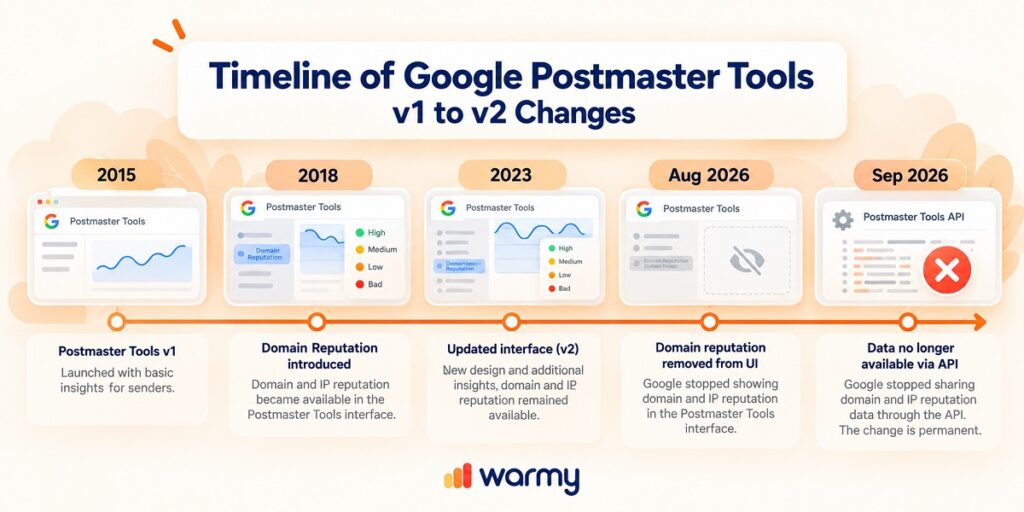
The switch took almost a year, which is why you can still find 2026 guides telling you to check a chart that no longer exists. Here’s how it played out:
| Date | What changed |
|---|---|
| March 2024 | Google adds a Compliance status dashboard to Postmaster Tools alongside the old charts |
| September 30, 2025 | Google announces the retirement of the old interface and starts redirecting senders to v2. The old dashboard stays reachable for months |
| February 3, 2026 | The Postmaster Tools API v2 becomes generally available, without reputation fields (Gmail API release notes) |
| June 2026 | Deliverability analysis appears on the Compliance status page |
| August 2026 | The old interface stops loading and Google stops showing reputation anywhere in Postmaster Tools |
| September 17, 2026 | The last domain reputation data point reaches Warmy through the API |
Google gave two reasons for the change: most senders couldn’t do much with reputation data, and reputation is only one of many factors behind deliverability. We’d add one more from our own experience. The chart moved slowly. During a warm-up you could change your sending pattern on Monday and not see the label react until the following week.
For a full tour of the new interface, read our guide to what changed in Postmaster Tools v2.
Why losing domain reputation hurts most during warm-up
Reputation was never the only deliverability signal, but it was the easiest to read. For anyone warming up a domain, it worked like a progress bar: you started low, you watched it rise, and you increased volume once it reached High.
Say you’re on day 10 of warming a new sending domain. Replies look normal and nothing has bounced. A year ago you’d open Postmaster, see the label move from Low to Medium and add a few more emails per mailbox. Today the same decision means reading spam rate, delivery errors and placement results side by side, and on a young domain most of those stay empty until Gmail sees enough volume
What Google Postmaster Tools v2 still shows
Not everything disappeared. Postmaster Tools v2 (plenty of people still call it Gmail Postmaster Tools) keeps six of the old dashboards, adds a Compliance status page and, since June 2026, a Deliverability analysis verdict. Here’s where each metric stands today:
| Metric | What it shows | Status |
|---|---|---|
| Compliance status | Whether you meet Gmail’s sender requirements, check by check | Available |
| Spam rate | The share of your emails that Gmail users mark as spam | Available |
| Authentication | The share of your mail passing SPF, DKIM and DMARC | Available |
| Encryption | The share of your mail sent over TLS | Available |
| Delivery errors | Rejected and temporarily failed messages, with the reason | Available |
| Feedback loop | Spam complaints broken down by campaign identifier | Available for bulk senders |
| Deliverability analysis | A plain-language verdict on whether recipients want your mail | Available since June 2026 |
| Domain reputation | How much Gmail trusts your domain | Retired by Google. Warmy’s own score coming soon |
| IP reputation | How much Gmail trusts your sending IPs | Retired by Google |
Compliance status runs a separate check for SPF, DKIM, DMARC policy and alignment, message formatting, forward and reverse DNS, TLS, spam rate, one-click unsubscribe and whether unsubscribe requests are honored. Each check shows Compliant, Needs work or No data found. The last one usually means Gmail hasn’t seen enough of your mail yet, which is common for new domains.
Warmy’s Google Postmaster integration brings the metrics that still exist into your dashboard, next to your warm-up and placement data, so you don’t have to check Google’s interface separately.
Deliverability analysis: the closest thing to the old chart
Deliverability analysis sits on the Compliance status page and gives you one sentence about your domain, a short explanation and a recommended action. The verdict can say that users want your mail, that they don’t act on it, that there isn’t enough mail to judge, that your spam rate is above 0.1%, that users don’t want your mail, that you don’t meet sender requirements, or that too many messages hit delivery errors.
It’s the part of v2 that feels most like the old reputation label, with one big difference: it names the cause. A spam rate verdict points at your list and targeting. A compliance verdict points at DNS. Low engagement points at copy and relevance. You can pass every compliance check and still get a negative verdict, because SPF, DKIM and DMARC prove who you are, and only recipients decide whether they wanted the email. We cover how those signals add up in how Gmail decides inbox placement.
Give the verdict time. Compliance checks usually update within a day, while the Deliverability analysis can take a week or more to reflect a change in your sending.
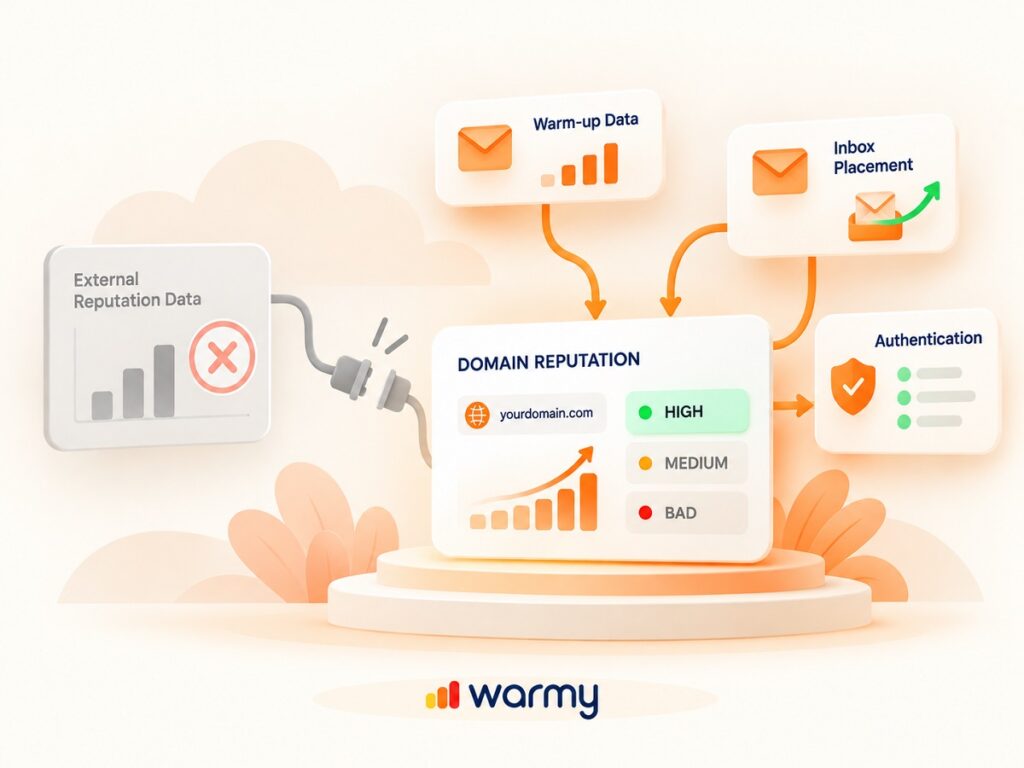
Reputation still shows up in Delivery Errors
When Gmail rejects a message, the Delivery Errors dashboard records why. The list of reasons still includes low domain reputation and low IP reputation, next to blocklisted IPs, spammy content, bad attachments and missing PTR records.
So Gmail still scores your domain. You just hear about it at the moment it costs you a delivery, and there’s no chart left to check every morning. If rejections for low domain reputation start to appear, treat them as a sign your email domain reputation has dropped, the way you used to treat a fall to Low.
Introducing Warmy’s AI-powered Domain Reputation Score
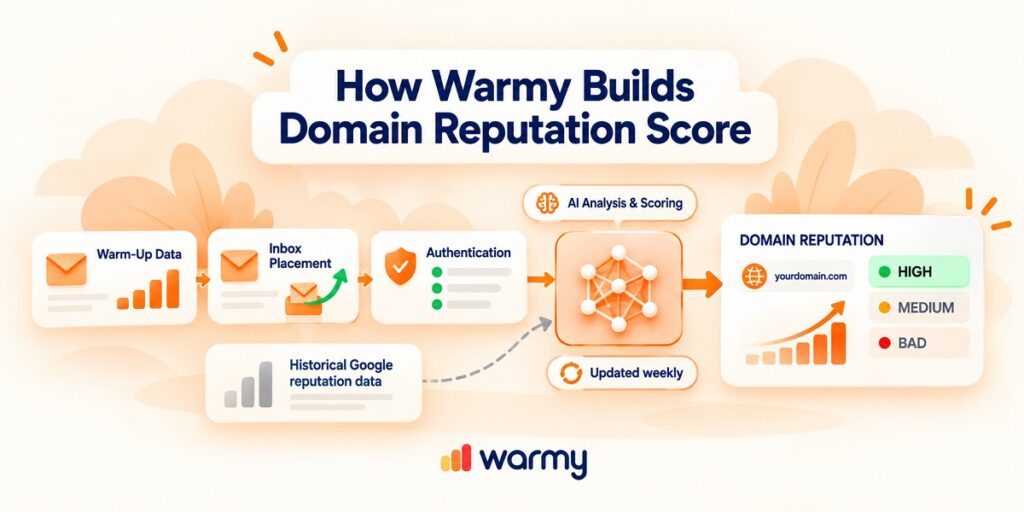
Instead of reselling a metric we don’t control, we’re building our own. Warmy’s Domain Reputation Score is powered by a machine learning model trained on data Warmy already collects across every connected mailbox and domain:
-
- warm-up sending statistics,
-
- inbox placement results,
-
- authentication data.
These are the same kinds of signals reputation was built on in the first place. To make sure the model reads them the way Gmail does, we trained and validated it against Google’s own reputation data while it was still available. The model retrains every week, so it keeps up with how mailbox providers behave now, not how they behaved months ago.
Three levels you can trust
Google used four reputation levels. Our score uses three:
| Warmy score | What it means |
|---|---|
| High | Gmail is likely to trust your domain. |
| Medium | Trust is limited. Keep a close eye on your sending. |
| Bad | High risk of landing in spam. Act now. |
Why three? In our research, Google’s Low and Medium levels couldn’t be told apart reliably enough, so we merged them into a single Medium level. We chose accuracy over granularity: three levels we can stand behind are more useful than four we can’t.
Where you’ll see it
The score will appear at the domain level in Warmy, in the same place you used to see Google’s reputation, with a history so you can watch it change over the course of a warm-up. It will also be available through the Warmy API and will power your Domain Health Score.
You won’t need to connect Google Postmaster to get it. The score is calculated from Warmy’s own data, so it works for every domain you warm up with us.
What makes Warmy’s score different
It’s built on first-party data. The score comes from Warmy’s own warm-up and placement data, not from an external feed that can be switched off without warning.
It keeps working, whatever Google decides next. Your reputation signal no longer depends on what a single provider chooses to publish.
It’s connected to action. A score on its own only tells you something changed. In Warmy, the same platform that shows your reputation also runs your warm-up, tests your placement, and explains what to fix through Adeline AI.
What about IP reputation?
Google no longer provides IP reputation, so that data can’t be updated anywhere. Our new score focuses on domain reputation at Gmail first. To keep an eye on your sending infrastructure in the meantime, combine blacklist monitoring with regular placement tests. If your IP runs into trouble, you’ll see it in where your emails land.
What you can do right now
While the new score rolls out, these steps give you a reliable read on your deliverability:
-
- Run an Inbox Placement Test before major campaigns to see where your emails actually land: inbox, spam, or promotions.
-
- Keep warm-up running, even after launch, to maintain positive engagement.
-
- Watch your spam rate and compliance status for early warning signs.
-
- Check your authentication regularly with DMARC monitoring.
-
- Ask Adeline AI what’s behind any change in your results.
Wrapping Up
Google’s reputation charts made deliverability look simple, and their loss left many senders without their favorite signal. Warmy’s AI-powered Domain Reputation Score brings that signal back, built on our own data and independent of any single provider. Until it lands in your dashboard, placement tests, warm-up, and Adeline AI give you everything you need to stay in the inbox. Start your free trial and be ready when it arrives.