

Google Postmaster Tools has been one of the few official windows Gmail gives senders into how their mail is handled. In June 2026, that window started speaking in plain language. Google Postmaster Tools v2 added a Deliverability analysis section that tells you, in a single sentence, whether Gmail users want your email. The uncomfortable part: you can pass every SPF, DKIM, and DMARC check and still read the verdict “users signal they don’t want your messages.”
When a single provider shapes inbox placement for most of your list, the way Gmail reports on your sending directly drives whether your campaigns get seen. Watching the wrong signal, like a clean spam complaint rate while mail quietly gets filtered, is how senders miss the problem until revenue drops.
The groundwork for this was laid in late 2025, when Google retired the v1 interface along with its High/Medium/Low reputation scores. That retirement drew most of the attention, but it was only the first step.
What replaced it is more revealing: a compliance checklist, and now a layer of verdicts that grade whether people actually want your mail. Here at Warmy.io, we track these changes closely, so this guide covers what v2 shows you today, what the June 2026 verdicts mean, and what to do when every check is green and the mail still lands in spam.
What happened to Google Postmaster Tools v1?
Google originally announced that the v1 API would be shut down by the end of 2025. However, the shutdown did not happen as initially planned. Google later postponed the deprecation, and the v1 API was ultimately shut down in September 2026. As part of the transition, several long-standing features, including domain reputation, IP reputation, and historical reputation, were permanently removed.
What changed in Google Postmaster Tools v2?
Postmaster Tools v2 represents a philosophical shift in how Google expects senders to evaluate email performance. Instead of summarizing sender trust through reputation labels (Low, Medium, High), v2 emphasizes behavioral and compliance-based signals.
Postmaster Tools v2 now prioritizes the following:
- Spam complaint rates.
- Authentication status (SPF, DKIM, DMARC).
- Delivery errors.
- Compliance indicators.
- Batch query support via the new API.
What’s missing is just as important as what remains. There are no longer any direct reputation scores at either the domain or IP level. Google has stated, implicitly through these changes, that reputation scores were often misunderstood, misused, and treated as goals rather than symptoms.
Why Google removed domain and IP reputation scores
Google’s rationale aligns with how Gmail filtering actually works today. Reputation scores created a false sense of control. Many senders optimized toward “keeping reputation high” instead of improving recipient engagement, which is what Gmail’s systems increasingly rely on.
Modern Gmail filtering evaluates whether users open emails, whether they reply, whether they delete without reading, whether they mark messages as spam, and whether sending behavior is consistent and predictable. Static reputation dashboards could not accurately reflect these dynamics, and Google chose to remove them rather than risk misinterpretation.
The practical takeaway: Gmail now weighs how recipients actually respond to your mail more than any single label ever measured.
What Postmaster Tools v2 is good for
Where v2 used to stop was trust. It told you whether Gmail was rejecting you for obvious reasons, not whether Gmail thought recipients wanted your mail. The June 2026 update is what closes that gap.
The June 2026 update: Deliverability analysis and plain-language verdicts
In early June 2026, Google added a Deliverability analysis section to the Compliance Status page. Instead of leaving you to read spam-rate graphs and guess, it states a verdict in plain English, adds a short description, and gives a recommended action. The v2beta API reference exposes seven deliverability states plus a technical REASON_UNSPECIFIED fallback, and in practice they group into three buckets: users want your mail, Gmail sees no clear signal, or users signal they don’t want it.
The distinction that matters: Compliance Status answers “is this configured correctly,” and Deliverability analysis answers “do people actually want this.” Those are graded separately now, and they do not always agree.
One state worth calling out is indifference. USER_FEEDBACK_LOW is a named condition for senders whose recipients neither complain nor engage. Engagement stopped being folklore the moment it showed up as an enum in Google’s own API, sitting one step above “users don’t want your email.”
Every check green, and Gmail still says users don’t want your email
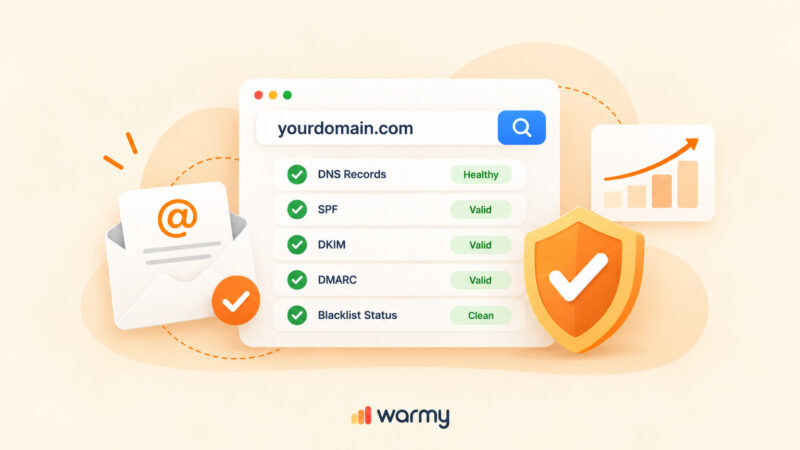
On domains where every Compliance Status item passes, the Deliverability analysis verdict can still read “users signal they don’t want to get your email messages.” SPF, DKIM, and DMARC confirm you are who you claim to be. They say nothing about whether recipients want the mail.
A team looking only at green checkmarks would have no reason to suspect a problem, which is exactly why this verdict is useful: it puts the engagement gap in Google’s own words.
What changed in DMARC in June 2026
Alongside the Postmaster update, DMARC introduced two new parameters in June 2026. The np parameter guards non-existent subdomains against spoofing, and the T parameter replaces the older PCT percentage tag. The p= policy tag is now recommended rather than mandatory. If you set DMARC once and never revisited it, this is the moment to review your record.
How Warmy bridges the Postmaster visibility gap
With the changes to Google Postmaster Tools, email senders need more comprehensive solutions to monitor and improve their deliverability.
Warmy.io offers a powerful integration with Google Postmaster that helps bridge the gap left by the retirement of v1’s reputation dashboards.
Warmy connects to your Google Postmaster account to analyze data and enhance the deliverability of your domains and IPs. By combining data from Google Postmaster with Warmy’s own deliverability intelligence, the platform’s algorithms can adjust and improve deliverability much faster than manual monitoring alone.
Real-time domain reputation monitoring with Domain Health Hub
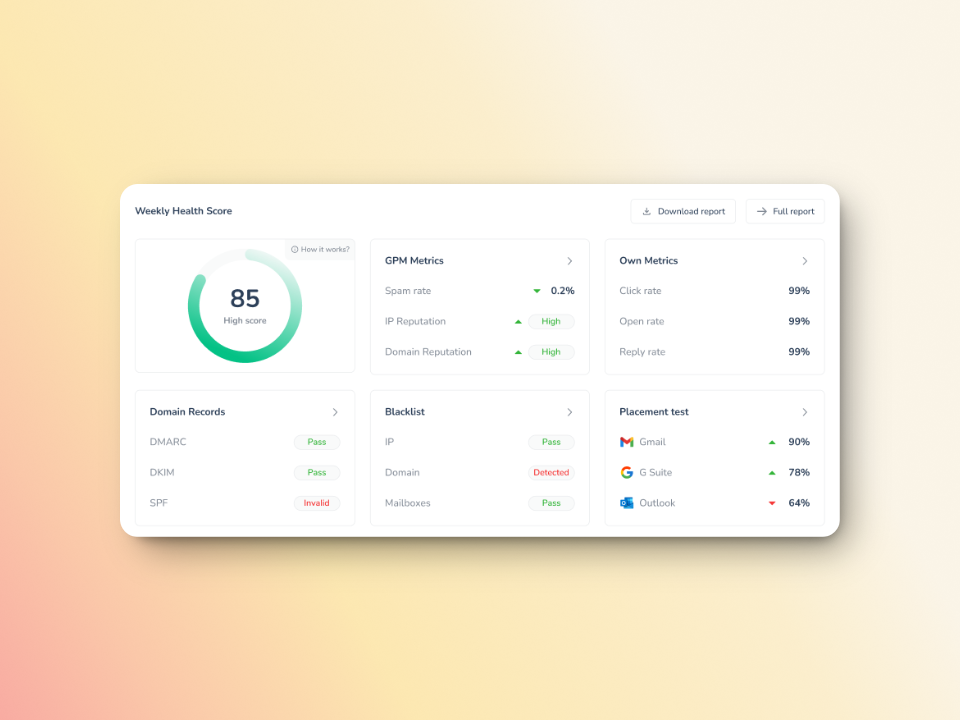
Warmy keeps an eye on your domain reputation through the Domain Health Hub, a domain-level dashboard with the following capabilities or features:
- A domain health score based on factors like authentication, blacklist status, and inbox placement.
- Data for monitoring spam rate trends and overall deliverability performance (weekly and monthly).
- DNS checks for validating SPF, DKIM, and DMARC records for extra security.
- Multi-domain monitoring for convenient tracking of all domains.
- Reports on performance and other health metrics.
Seed-list and placement testing: the reputation proxy v2 removed
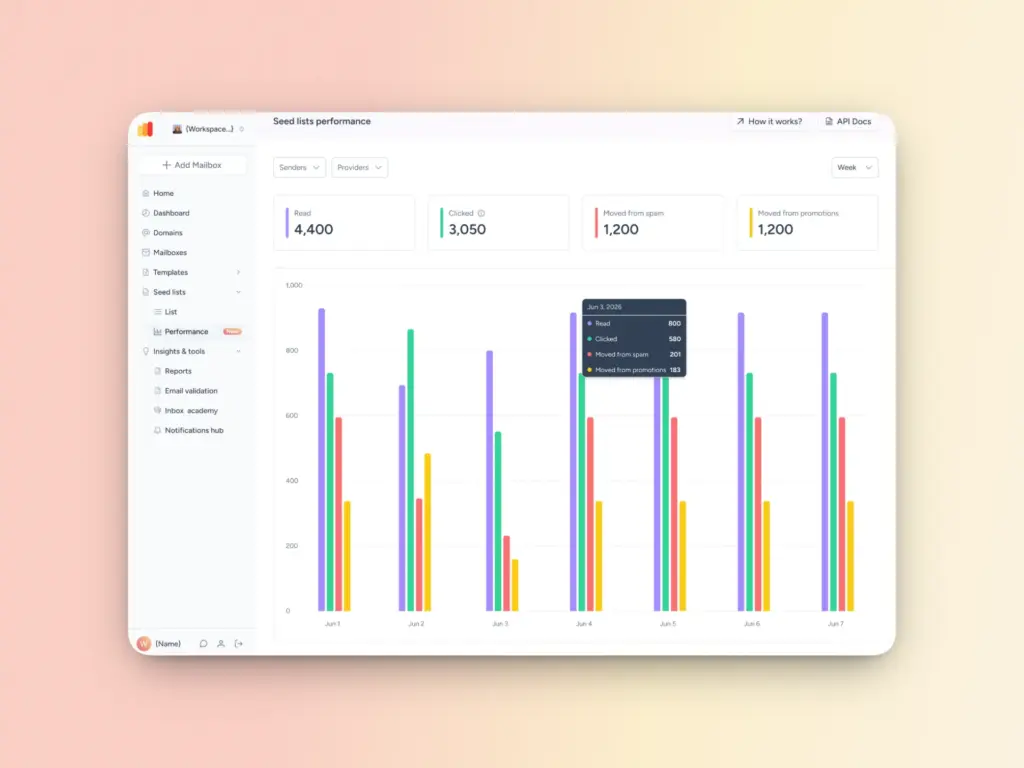
Since v2 no longer shows a reputation score, you need a direct read on where your mail actually lands. Warmy’s seed-list and placement testing send to real inboxes across Gmail, Outlook, and Yahoo and report inbox versus spam placement before you run a major campaign. That is the visibility Postmaster Tools stopped giving you, and it works across providers, not just Gmail. Paired with Warmy’s Google Postmaster integration, you can read Gmail’s own compliance and deliverability signals in one place.
Automated email warm-up
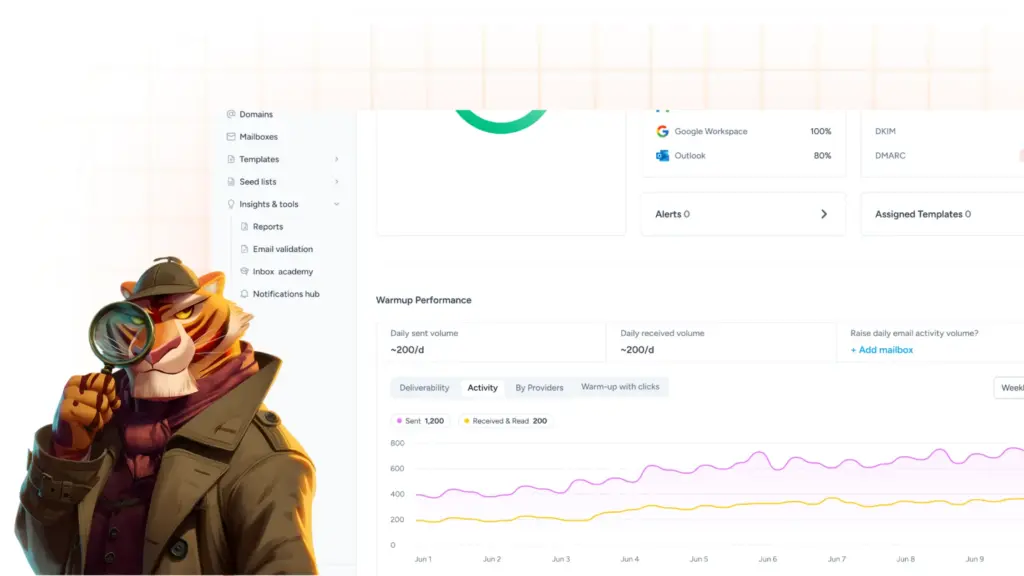
Warmy’s AI-powered email warmup helps strengthen your sender reputation by:
- Gradually increasing email volume to prevent sudden spikes that could trigger mail server rejections.
- Simulating human-like interactions to ensure emails are opened, replied to, and marked as important.
- Monitoring email reputation to identify potential issues before they impact campaigns.
By integrating Google Postmaster data with Warmy’s email deliverability platform, senders gain the comprehensive visibility and automated optimization tools needed to navigate the post-v1 landscape effectively. This combination provides the reputation insights and proactive management capabilities that are increasingly essential as Gmail’s filtering systems prioritize engagement and behavioral signals over static scores.
Warmy.io helps ensure that your emails reach the inbox instead of the spam folder. Sign up for a free trial today.