
TL;DR: Lemwarm works well enough while Lemlist is your sending platform. Two things push teams to switch: it only warms Lemlist mailboxes, and it reports a warm-up score without showing where your campaigns actually land. Per-inbox pricing adds pressure as you scale, and every option below closes at least one of those gaps. Warmy is the strongest all-around pick for teams that want adaptive AI warm-up together with real placement data and domain monitoring in one place.
The best Lemwarm alternatives in 2026 are Warmy, Mailreach, Smartlead, Instantly, Warmup Inbox and Mailivery. Warmy ranks first because it combines AI-driven warm-up with inbox placement testing and domain monitoring in a single platform. To pick the right one, match each tool to your sending stack, your recipient type, and your inbox volume.
Lemwarm built its name as the warm-up feature inside Lemlist. It works, and for anyone already running campaigns through Lemlist, it comes bundled at no extra cost. The friction starts when your setup grows past what Lemlist alone was built to handle.
Add more inboxes, move to a different sending platform, or start troubleshooting why good campaigns keep landing in spam, and Lemwarm’s ceiling becomes obvious. It warms only the mailboxes that send through Lemlist, its diagnostics stop at a surface-level score, and its per-inbox cost climbs quickly. Warmy is an AI-driven email warmup and deliverability platform that closes those gaps by pairing adaptive warm-up with real inbox placement data. Before you compare tools, run a free email deliverability test to see exactly where your messages land right now.
Below are the seven strongest Lemwarm alternatives for 2026, ranked and compared on network quality and diagnostics, with a clear note on who each one suits best.
Why teams look for a Lemwarm alternative
Warm-up is not a vanity metric. Mailbox providers decide inbox placement based on your sender reputation, and reputation is built from engagement history, complaint rates, and authentication. Google tells senders to keep their spam complaint rate below 0.1% and to never let it reach 0.3% or higher, and it requires SPF, DKIM, and DMARC on bulk mail, per its official Email sender guidelines.
Yahoo sets the same 0.3% complaint ceiling and the same authentication requirements on its Sender Hub. Microsoft joined both providers with its own high-volume sender requirements starting May 5, 2025. Industry group M3AAWG publishes the sender best practices these providers build on. Warm-up exists to build the engagement history that keeps you under those thresholds. If you want the full mechanics, our guide on email warm-up breaks down how it works at the provider level.
Lemwarm handles the basics of that job. Three limits push teams to look elsewhere once they scale.
Lemwarm only works inside Lemlist
Lemwarm warms the mailboxes you connect to Lemlist, and nothing else. Send through Instantly, Apollo, Smartlead, or a custom SMTP setup, and Lemwarm cannot touch those inboxes. Teams that adopt Lemlist purely for the warm-up end up paying for a full cold email platform they do not use, and teams that leave Lemlist lose their warm-up entirely.
Per-inbox pricing climbs fast at scale
Lemwarm is free on paid Lemlist plans, but the standalone price is charged per inbox. At Essential rates near $29 per mailbox each month, a team warming ten inboxes pays roughly ten times that figure. The model stays simple until you manage a fleet of domains, and then the invoice grows in a straight line with your inbox count.
Diagnostics stop at a basic score
Lemwarm reports a warm-up score, but it does not run seed-based inbox placement tests across real Gmail, Outlook, and Yahoo accounts. You see a number, not where your campaigns actually land. When a domain slips toward spam, a single score leaves you guessing about the cause, whether that is a content trigger, a failed authentication record, or a reputation dip. The alternatives below add the placement visibility Lemwarm leaves out.
Ready to rebuild reputation across any provider, not just Lemlist? Warmy’s AI-driven email warm-up runs on Gmail, Outlook, Yahoo, and custom SMTP alike.
Lemwarm alternatives compared side by side
| Tool | Key difference vs Lemwarm | Best for |
|---|---|---|
| Warmy | AI warm-up plus seed placement testing, Postmaster data, and blacklist monitoring in one suite; any provider | Warm-up plus real placement visibility in one platform |
| Mailreach | Standalone B2B warm-up on a Google Workspace and Microsoft 365 network, with a real-inbox spam test | B2B teams wanting warm-up plus placement testing at a lower per-inbox cost |
| Smartlead | Cold email platform with unlimited built-in warm-up | Teams that want sending and warm-up bundled across many inboxes |
| Instantly | Cold email platform with unlimited warm-up and unlimited inboxes | Teams that want an all-in-one sending and warm-up suite |
| Warmup Inbox | Standalone warm-up across a large real-inbox network | Solo senders maintaining established domains on a budget |
| Mailivery | Standalone warm-up priced by daily volume, not per inbox | Teams warming many inboxes that prefer volume-based pricing |
The 6 best Lemwarm alternatives in 2026
1. Warmy

Warmy is the most complete platform in this group because it does more than warm mailboxes. Its Adeline AI engine builds a personalized schedule for each mailbox, predicts send volumes, and adapts in real time rather than following a fixed ramp. On top of warm-up, Warmy runs seed-based placement tests through its email seed list, pulls domain reputation from Google Postmaster, and tracks blacklists and authentication through its deliverability monitoring. That combination is exactly what Lemwarm’s single score leaves out. For a direct head-to-head, see our full Warmy vs Lemwarm comparison.
Best for: Teams that want warm-up, real placement testing, and domain monitoring in one dashboard, across any sending provider.
Pros: AI-adaptive warm-up, real seed placement testing, Postmaster integration, blacklist monitoring, and B2B or B2C network controls.
Cons: Positioned as a premium platform, so it costs more than a bare warm-up tool if all you need is basic warming.
2. Mailreach

Mailreach is a standalone deliverability tool built for B2B cold outreach. Its warm-up network is weighted toward real Google Workspace and Microsoft 365 inboxes, which are the accounts whose engagement Gmail and Outlook actually trust. It also ships a spam test that sends your real email into dozens of inboxes and reports whether you land in Primary, Promotions, or Spam. It works with any sending stack, unlike Lemwarm. Our Warmy vs Mailreach breakdown covers where each one pulls ahead.
Best for: B2B teams that want warm-up plus placement testing at a lower per-inbox price.
Pros: High-quality business-inbox network, real placement testing, provider-agnostic setup.
Cons: Built for B2B cold outreach rather than newsletter or B2C deliverability.
3. Smartlead

Smartlead is a cold email platform with warm-up baked in. Where Lemwarm charges per inbox, Smartlead warms unlimited inboxes as part of its base plan, which makes it attractive to agencies and SDR teams running large fleets. Warm-up here is one feature of a wider sending suite, so it fits teams that want their outreach and their warm-up under one login.
Best for: Teams that want sending and warm-up bundled while managing many inboxes.
Pros: Unlimited warm-up on paid plans, a flexible campaign builder, and blacklist monitoring.
Cons: Its warm-up network leans on custom SMTP mailboxes, which carry less weight with Gmail and Outlook than trusted business inboxes.
4. Instantly

Instantly bundles unlimited warm-up and unlimited email accounts into every paid outreach plan, drawing on one of the largest warm-up pools in the category. Pricing scales by email volume rather than per seat or per inbox, so a small team and a large team pay the same on a given tier. It suits senders who want a single tool for sending, sequences, and warm-up. See how the two compare in our Warmy vs Instantly analysis.
Best for: Teams that want an all-in-one sending and warm-up suite with flat, volume-based pricing.
Pros: Unlimited inboxes and warm-up, a large network, and a unified reply inbox.
Cons: Warm-up scores can drift from real inbox placement, and the platform is email-only with no LinkedIn channel.
5. Warmup Inbox
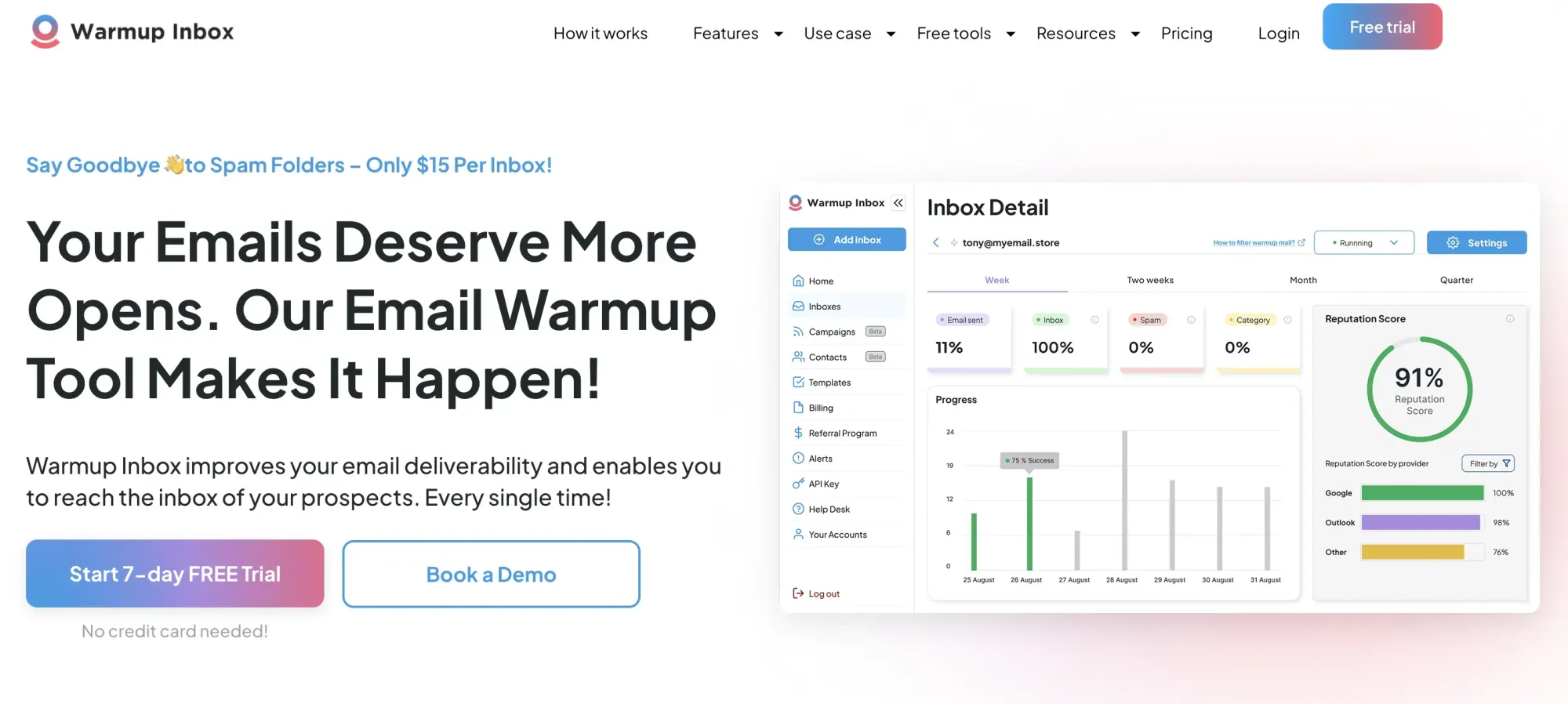
Warmup Inbox is a straightforward standalone tool that sends, receives, replies, and rescues messages across a large network of real inboxes. It connects any IMAP or SMTP provider and sets up in minutes, which makes it a practical pick for solo senders and small teams keeping an established domain healthy.
Best for: Solo senders and small teams maintaining older domains on a budget.
Pros: Broad real-inbox network, quick setup, per-provider reputation reporting.
Cons: Basic interface, no outreach features, and placement trends without content-level diagnostics.
6. Mailivery
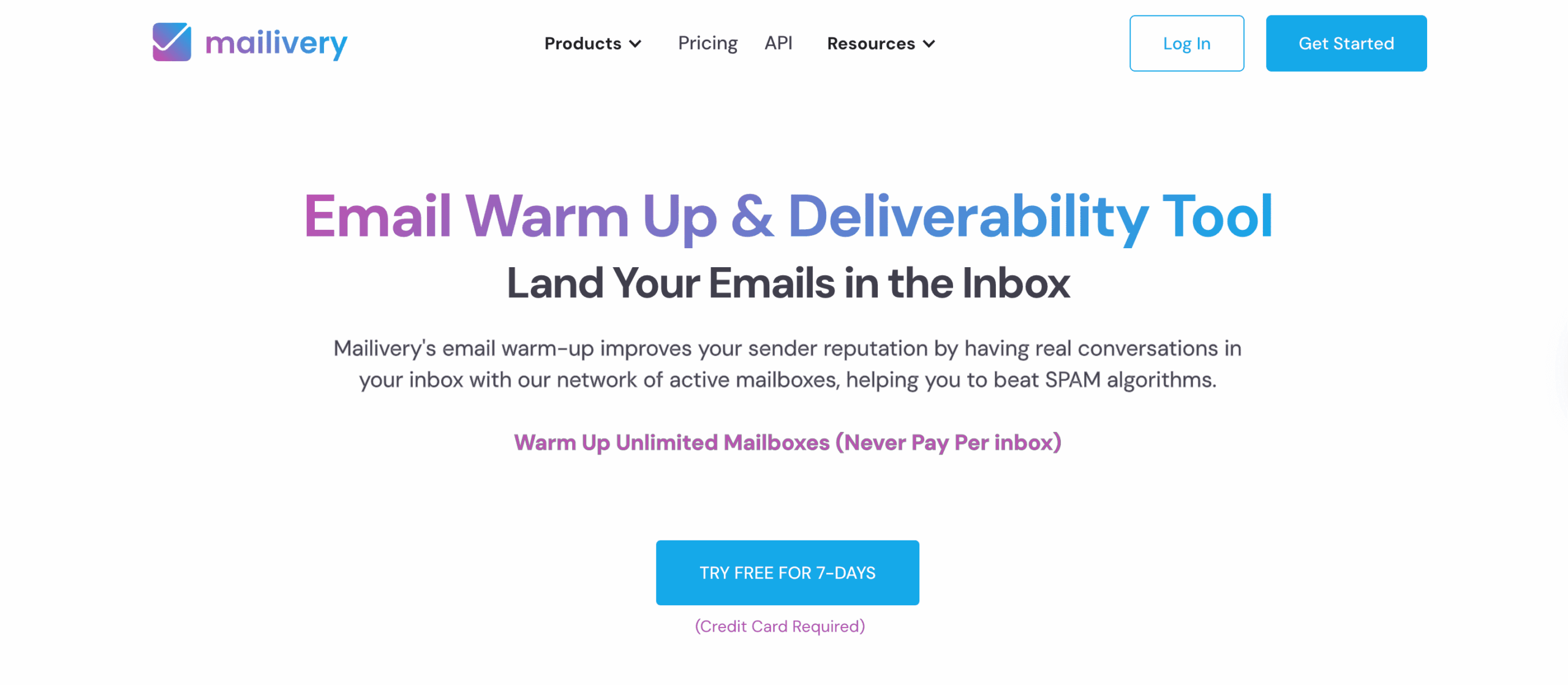
Mailivery takes a different pricing approach: it charges by daily warm-up volume rather than per inbox, so teams warming many mailboxes can connect them all under one volume cap. Its warm-up uses AI-assisted interactions to build engagement, and it works across major providers.
Best for: Teams warming many inboxes that prefer volume-based pricing over per-inbox billing.
Pros: Volume-based pricing, AI-assisted warm-up, and support for multiple inboxes under one plan.
Cons: Lighter diagnostics than a full deliverability suite, and a smaller network than the largest players.
Pro Tip: Warm-up fixes reputation, but content still trips filters. Before a campaign, run your message through Warmy’s free Template Checker to catch spam triggers and formatting issues that no amount of warming will overcome. Authentication secures the technical side, and a clean template secures the content side.
How to choose the right Lemwarm alternative
The right pick depends on three questions: who you email, how you send, and how much visibility you need. For a wider field of options, our roundup of the best email warm-up and deliverability tools goes deeper on each.
Match the network to your recipients
Warm-up signals only help when they come from the kind of inbox your prospects use. If you sell B2B, prioritize tools whose networks are weighted toward Google Workspace and Microsoft 365 business inboxes, since those providers weigh engagement from their own ecosystems most heavily. If you send B2C or marketing email, a consumer-heavy network matters more. Warmy lets you set B2B or B2C warm-up patterns directly, so your activity mirrors your real audience.
Standalone warm-up or a bundled sending platform
If Lemlist is already your sending platform, a bundled tool like Smartlead or Instantly keeps everything in one place. If you send from a mix of providers or a custom stack, a standalone tool that works anywhere gives you more freedom. The choice comes down to whether you want warm-up tied to your outreach tool or kept independent of it.
Warm-up plus placement testing, not sending alone
A warm-up score tells you the tool is running. Inbox placement testing tells you whether it is working. Pair warm-up with deliverability monitoring that shows real placement across Gmail, Outlook, and Yahoo, so you can act on a spam dip before it costs you a campaign. This is the single biggest gap between Lemwarm and the stronger alternatives on this list.
Conclusion
Lemwarm is a fine starting point, and it is the obvious choice if you already live inside Lemlist. Once you send from more than one platform, warm more inboxes, or need to know exactly where your campaigns land, its closed network and thin diagnostics start to hold you back. Mailreach, Smartlead, Instantly, Warmup Inbox, and Mailivery each solve part of that problem for a specific kind of team.
Warmy solves the whole problem in one platform, combining adaptive AI warm-up with placement testing and domain monitoring that turn warm-up from a guess into a measurable result. Book a demo and see how Warmy protects your inbox placement across every provider you send from. Book a Demo to get a volume-based quote for your inbox count.