

Dipik Rai has spent 30 years in email marketing. At Innovation Partners Group, he sends both first and third-party mail across multiple domains, and by the time a partner referral brought him to Warmy, results were slipping on both sides of that split. His team had already worked on volumes, reputation, and list hygiene. In his words, it just was not quite enough.
That combination of deep experience and degraded placement is more common than the market admits, and it is the strongest available argument for treating deliverability as a discipline with its own practitioners. Rai puts the change in the channel plainly after nearly six months on the platform:
“What used to be really straightforward email sending has started to emulate more like SEO. It’s just not that simple anymore”.
What follows is what email deliverability services actually cover, why the mechanical requirements moved under senders who were already doing things right, and five signals that indicate you have crossed the threshold from managing deliverability yourself to buying it.
What email deliverability services actually cover
Platform, consultant, and agency: Three different things
A consultant diagnoses and prescribes across a defined engagement, then hands the work back to you. An agency takes over execution, usually alongside campaign management. A platform supplies continuous monitoring, authentication tooling, and email warm-up that keeps running after any engagement would have ended.
Senders with recurring placement problems across several domains generally need the monitoring layer, with expert access attached to it rather than sold separately.
Innovation Partners Group works with Nadia, a customer success manager from Warmy. Rai describes the arrangement as one in which the account manager essentially takes care of things, while the customer retains the ability to work through them directly. This is important for a team that wants answers quickly.
What sits inside the discipline and what sits outside it
Inside: authentication records and their ongoing maintenance, per-domain reputation and inbox placement diagnosis, blocklist monitoring, warm-up for new domains and mailboxes, and the infrastructure decisions that determine whether a send has a chance before anyone reads a subject line.
Outside: creative, offer, segmentation, and copy. Those affect engagement, and engagement feeds reputation, so the two are linked. They are still separate skill sets, and this is where most senders conflate them.
The case: 30 years in email, placement still slipping
Rai came to Warmy on a recommendation from one of his partners, after his team had worked on the problem internally without resolving it.
The setup: Multiple domains, first and third-party sending
Innovation Partners Group sends across multiple domains and handles both first-party mail, sent on its own behalf, and third-party mail, sent on behalf of others. That is a materially harder profile than a single-domain marketing program.
Each domain accrues its own reputation, and third-party sending introduces reputational exposure the sender does not fully control. Multi-domain email deliverability is a different operational problem than deliverability on one domain, and almost none of the published guidance addresses it directly.
What had already been tried before outside help
Rai names three interventions his team ran before reaching out: volumes, reputation, and list hygiene. Each of those addresses a real cause, and none of them tells you which domain is failing, at which mailbox provider, and for what reason.
Third-party sending reputation in particular is difficult to isolate without per-domain visibility, because the aggregate view averages a healthy domain and a struggling one into a number that looks acceptable.
Why this kind of decline stays hidden in reporting
Rai does not describe his diagnostics, so what follows is the general mechanism rather than his account. Delivery rate and inbox placement measure different things. A receiving server that accepts a message counts it as delivered, whether it lands in the primary inbox or the spam folder, so the delivery rate can sit at 98% while placement erodes beneath it.
Engagement drops first, revenue follows, and the diagnosis arrives weeks later. The warning signs your deliverability is slipping tend to show up in engagement metrics long before anything in a sending report explains them.
Why the mechanical requirements changed under experienced senders
Rai frames deliverability as behaving more like SEO, and the comparison holds in one specific respect. The rules are set by third parties, change without your involvement, and are checked mechanically rather than negotiated. Between February 2024 and May 2025, the three largest mailbox providers each turned what had been guidance into enforcement.
Google and Yahoo, February 2024
From February 1, 2024, Google’s sender guidelines require anyone sending more than 5,000 messages per day to Gmail to have SPF and DKIM authentication, a published DMARC record, From-header alignment with either the SPF or DKIM domain, valid forward and reverse DNS records, TLS for transmission, one-click unsubscribe on marketing mail, and a user-reported spam rate below 0.3 percent in Postmaster Tools.
Yahoo introduced comparable requirements in the same period. Google also documents that bulk senders lose eligibility for delivery mitigation while their spam rate exceeds 0.3 percent, and regain it after the rate stays below that line for seven consecutive days.
Microsoft, May 2025
Microsoft followed. From May 5, 2025, per Microsoft’s announcement for high-volume senders, domains sending more than 5,000 messages per day to outlook.com, hotmail.com and live.com must pass SPF, DKIM and DMARC, with a DMARC policy of at least p=none aligned to SPF or DKIM.
Non-compliant mail was routed to the Junk folder first, then rejected outright with the response 550 5.7.515 Access denied. Microsoft was explicit that it was aligning with the changes Google and Yahoo had already made.
Every requirement is enforced per sending domain
This is the detail that turns a compliance checklist into an operational burden. None of these requirements apply at the account level or the company level. They apply to the sending domain. SPF, DKIM, DMARC, alignment, PTR records, and spam rate are all evaluated for the domain in the From header, by each provider separately.
“It’s like understanding how a car works. You’re not going to be an expert on the transmission and the engine and the exhaust all at the same time”, Dipik Rai.
The maintenance surface, multiplied
Take a sender with six active domains. Each one needs its own SPF record kept inside the ten-lookup limit, its own DKIM keys, its own DMARC policy and alignment, its own PTR record, and its own spam rate tracked against three providers with three different dashboards and three different thresholds.
Add a provider change on any single vendor and the SPF record can silently break. The work does not grow linearly with domain count so much as it grows with domains multiplied by providers, which is why domain reputation monitoring becomes a tooling problem rather than a discipline problem past a certain scale.
The specialist threshold: Five signals you have crossed it
Knowing when to hire deliverability help is a judgment call, and most content on the subject answers it with a sales pitch. These five signals are concrete enough to self-assess against. Two or more means the work has outgrown internal ownership.
Signal 1: More than two active sending domains
Past two domains, the compliance surface multiplies faster than most teams track it. The failure mode is not a dramatic block. It is one domain quietly falling out of compliance while the aggregate numbers stay acceptable, so nobody investigates until a campaign underperforms.
Signal 2: First and third-party mail on shared infrastructure
Sending on behalf of others introduces reputation you do not control into infrastructure you do. Innovation Partners Group runs exactly this configuration, and it was where the degradation showed up on both sides. If your setup mixes the two, per-domain isolation and monitoring stop being optional.
Signal 3: Diagnosis takes longer than one sending cycle
The practical test: when placement drops, can you name the failing domain and the provider within one send cycle? If the answer involves waiting for the next campaign to see whether something changed, you are diagnosing by trial. Proper placement diagnostics methods and an email spam checker close that loop to hours.
Signal 4: The fix that worked last year stopped working
Rai is direct about this in his recommendation: what works now did not work two years ago, and probably will not work in two more. Three providers changed enforcement in eighteen months. A playbook built before February 2024 is running against rules that no longer exist, and the symptom is a fix that used to resolve placement problems and now does nothing.
Signal 5: Nobody owns the placement number
In most organizations, deliverability sits between marketing, which owns the send, and IT, which owns DNS. Neither owns inbox placement as a metric they are measured on. When no single person reports that number weekly, degradation runs for months before anyone escalates it.
If you recognized two or more of these, the fastest way to find out where you actually stand is to run a free email deliverability test across your sending domains before changing anything.
What changed after bringing in a specialist layer
Nearly six months in, Rai reports zero complaints. The specifics of what he values are more useful than the satisfaction rating, because they describe what the purchase removed from his workload.
Monitoring that replaced manual seed list management
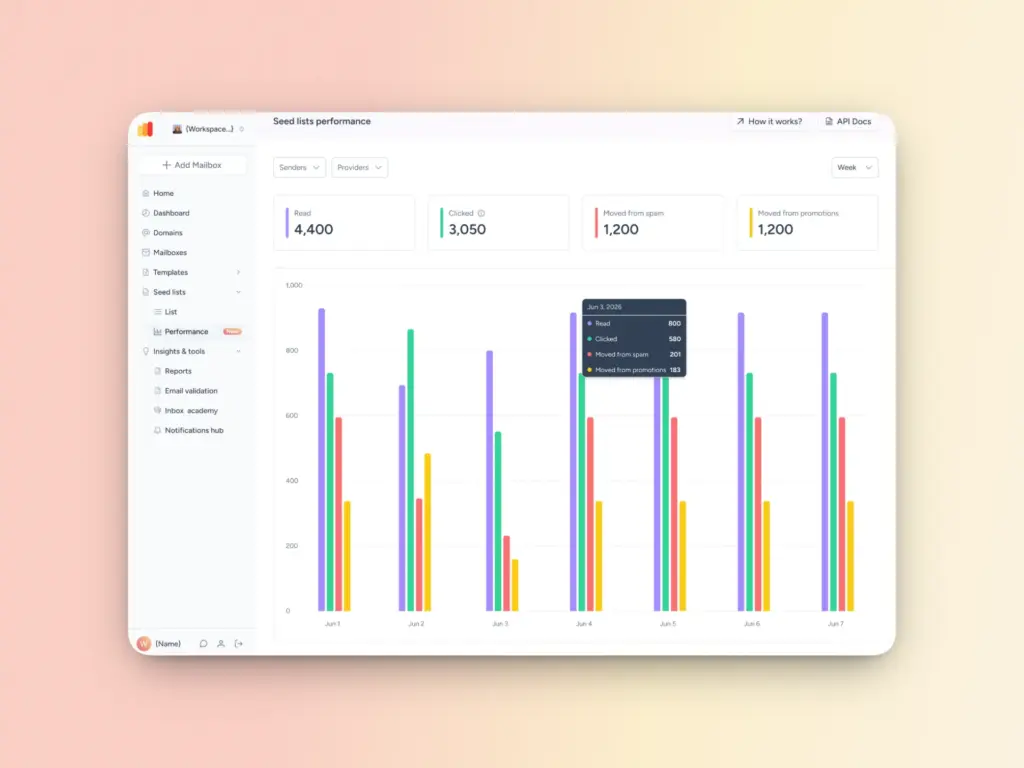
Deliverability and click monitoring in a single dashboard, without maintaining long seed lists manually. That distinction is the practical difference between running deliverability as a project and running it as infrastructure.
How seed lists work explains the manual alternative, and the maintenance overhead is the reason experienced senders abandon it. The comparison between automated versus manual domain reputation monitoring covers where the tradeoff lands at different domain counts.
DNS changes first, low ongoing effort after
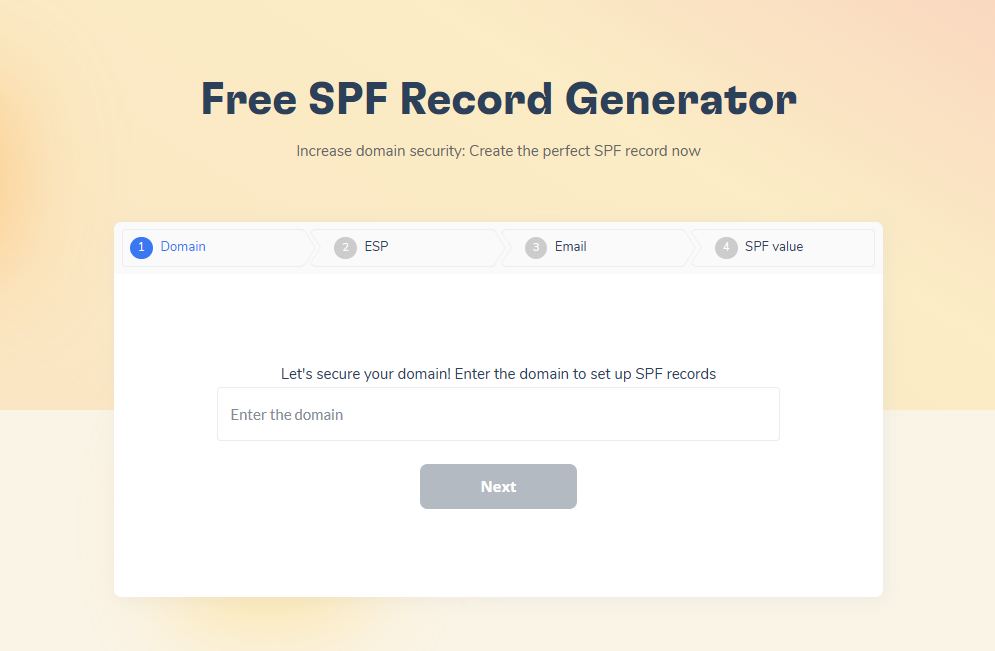
Setup involved a few DNS changes, then very little ongoing effort. Authentication is where most of the initial work sits, and it is also where the most common silent failures originate. A free SPF record generator and a free DMARC record generator remove the syntax errors and lookup-limit problems that break authentication without producing any visible error.
Account-manager-led, with self-serve available
An immediate shared Slack channel with weekend coverage, plus the option to handle things directly in the platform. Rai reports no complaints at all across nearly six months. On onboarding he describes setup as straightforward and says his own technical background was not necessary, because the product is geared at marketing and business results rather than very technical use cases.
Common mistakes when buying deliverability help
Three patterns account for most of the wasted spend in this category.
Buying a sender when the problem is reputation
Cold email platforms and ESPs send mail. They are not built to diagnose or repair sender reputation, and switching from one to another rarely resolves a placement problem, because the domain reputation follows the domain rather than the tool. Identify whether the failure is in sending or in reputation before shopping.
Treating a one-time audit as a fix
An audit produces a snapshot. Reputation is a moving state that responds to every send, every complaint, and every provider policy change. Knowing how to run a deliverability audit is genuinely useful, and it is a starting point rather than a resolution. Without continuous monitoring afterward, the same problem returns on a different domain.
Judging the purchase on open rates
Apple Mail Privacy Protection pre-loads tracking pixels regardless of whether anyone reads the message, which makes open rate unreliable as a placement proxy. Evaluate deliverability work on inbox placement by provider, spam rate trajectory, and reply behavior instead.
See where your domains actually stand
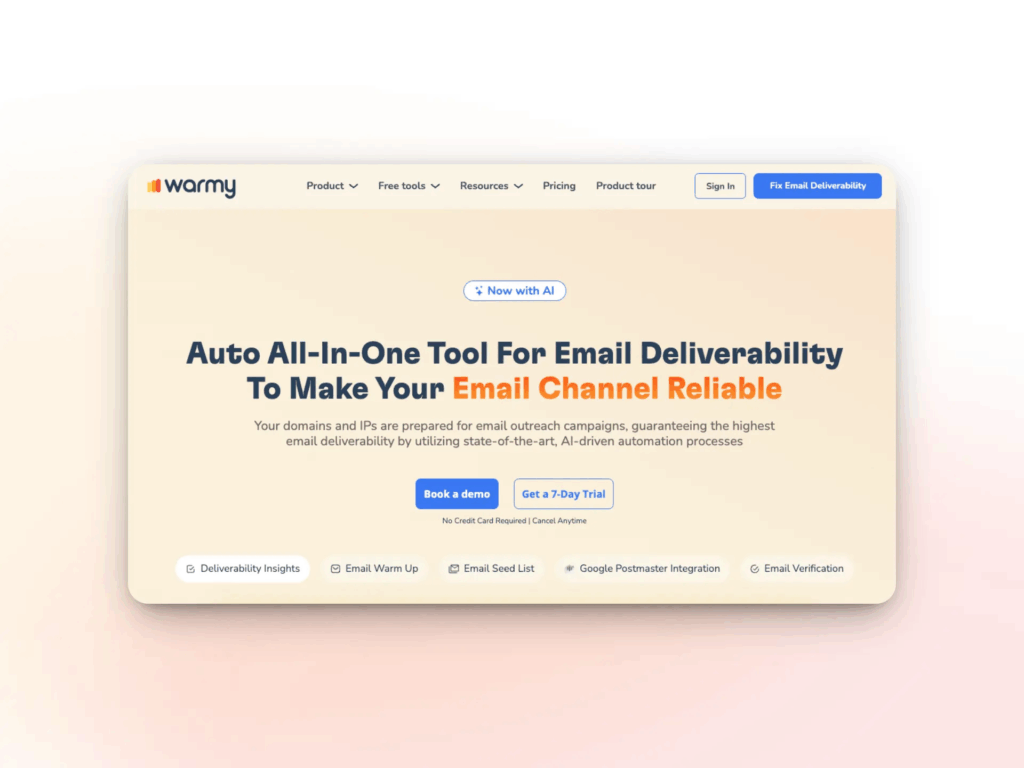
Rai closes with a suggestion for anyone weighing this decision.
“If you want to see if email will work for you, I would say try Warmy”.
What he describes buying is deliverability and click monitoring in one dashboard, a product that runs without maintaining long lists of seeds, and a named account manager on a shared channel.
Ready to see where your domains actually stand, one by one, before you change anything? Book a demo.