

Warmy’s seed list is a mailbox warm-up tool: real accounts that open, click, reply, and rescue your mail from spam, building sender reputation before you send to real recipients.
Using Warmy’s seed list in your email deliverability strategy builds sender reputation for the following reasons:
1. Real engagement signals delivered to every major provider
2. Safe warm-up for new domains and mailboxes before the first campaign
3. Reputation built separately at Gmail, Outlook, and Yahoo
4. Recovery for domains whose placement has already slipped
5. Steady activity between campaigns so your sending history never goes cold
Email seed lists have been around for a while, and for most of that time they were used passively — a set of addresses you mailed and then left alone.
That approach has a fundamental flaw: passive seed addresses don’t behave like real people. They receive emails but never open them, click links, or signal to mailbox providers that your content is worth reading or that you are a trustworthy sender. A list that generates no interaction generates no reputation.
That gap matters, because Gmail, Outlook, and Yahoo decide placement from engagement signals — opens, clicks, scrolls, replies. Those are the signals that move a sender’s standing, and a passive list produces none of them.
This article covers what a seed list is in Warmy’s sense of the term, why passive lists stopped being worth running, and how Warmy’s seed list warms your mailboxes by putting real interaction behind every send.
What is a seed list?
A seed list is a network of real, actively maintained mailboxes spread across the major providers — Gmail, Outlook, Yahoo — that receive your mail and engage with it the way an interested recipient would.
Before you send at scale to real recipients, you send to these mailboxes. They open your emails, scroll through them, click links, reply, mark them as important, and pull them out of spam when a filter has misrouted them. Every one of those actions is recorded by the provider and folded into the sender reputation it holds for your domain.
That is the whole point of a Warmy seed list: not to observe where your mail lands, but to change where it lands by building the engagement history providers trust.
How a warm-up seed list is built
Building a seed list that actually warms a domain comes down to four things:
Step 1: Cover the right providers.
Reputation is built per provider, so engagement at Gmail does nothing for how Outlook sees you. A warm-up seed list needs live mailboxes across Gmail, Yahoo, Outlook, and whichever other platforms your real recipients use.
Step 2: Match the list to your audience.
Balance the accounts by provider mix, by business versus consumer domains, and by the device behavior typical of your recipients. The closer the warm-up pattern is to your real sending pattern, the more of the trust carries over to the campaign that matters.
Step 3: Keep the accounts alive.
An address only helps if it is genuinely active. Dormant mailboxes produce nothing a provider will count, so the pool has to be maintained and rotated continuously.
Step 4: Automate it with Warmy.
Maintaining live, engaging accounts by hand is not realistic at any scale. Warmy runs the engagement for you and reports the signals each provider recorded.
Benefits of using seed lists
For anyone running email at scale, a seed list is how you arrive at a campaign with reputation already built. Alongside broader customer engagement tools, it is part of how marketers keep their audience reachable in the first place. Here is what it specifically does:
Builds inbox trust before you need it. Providers see weeks of opens, clicks, and replies on your domain, so your first real campaign is not sent by a stranger.
Generates the engagement signals filters actually weigh. Opens, clicks, scrolls, and replies are what placement decisions are made from, and a warm-up seed list produces them on demand.
Builds standing provider by provider. Gmail, Yahoo, and Outlook each keep their own record of you. Spreading engagement across providers means you build trust with each one in parallel instead of discovering later that one of them never learned to trust you.
Recovers a damaged reputation. If your mail has been landing in spam, seed accounts pull it back to the inbox and mark it as important — among the strongest correction signals a provider will act on.
Keeps reputation warm between sends. Long gaps cool a domain down. Steady seed engagement keeps the history current, so a large send never reads as a sudden spike from a quiet sender.
Limitations of traditional seed lists
Passive seed addresses receive emails and do nothing else. They don’t open them, click links, scroll through content, or respond.
As providers put more and more weight on engagement when deciding placement, a list that generates no interaction contributes nothing to your reputation. Mail goes out, nothing comes back, and your domain stands exactly where it did before.
A few specific gaps worth knowing:
1. Passive addresses produce no behavioral signal, so sending to them does nothing to build sender standing.
2. They cannot shift reputation over time, because there is no activity for a provider to record.
3. They leave a new domain as cold as it started, which is the precise situation warm-up exists to solve.
4. That is the problem Warmy set out to solve: keep the seed list, and make every address in it work.
Fueling clicks and engagement: The Warmy.io Seed List advantage
Warmy built the seed list into something that changes sender reputation instead of sitting next to it.
A passive seed list is a collection of dormant accounts; its addresses do not open, click, or reply, so they generate nothing a mailbox provider can act on. Warmy’s seed addresses actively interact with your emails — opening messages, clicking links, moving emails out of the spam folder, and marking them as important. Those positive interaction signals directly improve your domain reputation with the major Email Service Providers.
Warmy’s seed list is an email warm-up tool for newly created and recovering domains, run before you send to real customers. It is built to improve deliverability and campaign effectiveness, not to report on them.
Key features of Warmy’s Seed List feature:
- Composed of real mailboxes at Gmail, Outlook, and Yahoo. You choose how many seeds you want from each provider, so you can weight the warm-up toward the ecosystems that matter to your audience.
- Generates human-like engagement at scale — opens, link clicks, spam recovery, and marking as important — which is exactly the behavior providers use to decide whether a domain belongs in the inbox.
- Uses legitimate, continuously maintained accounts, so the engagement counts. The Seed List Receiver Update makes the process seamless for users.
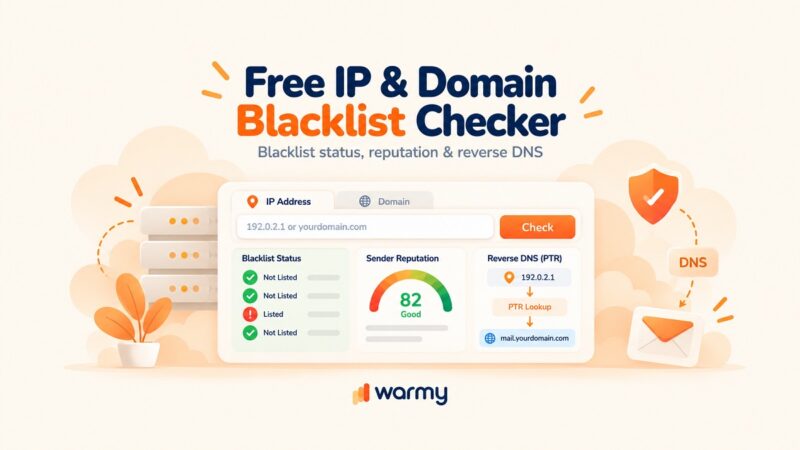
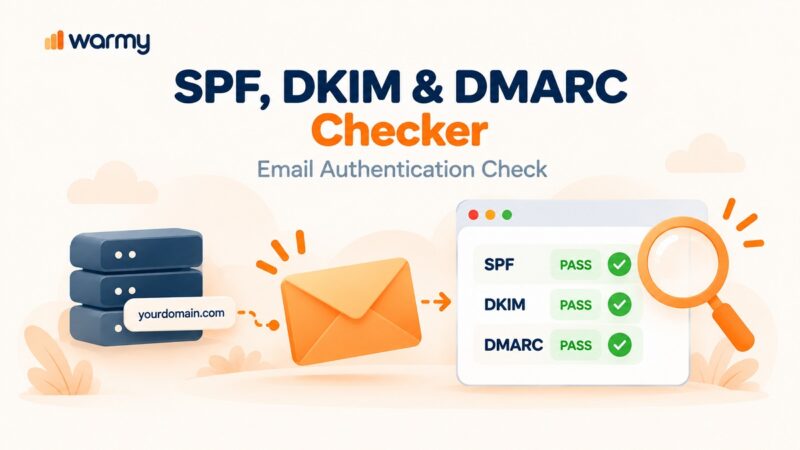
- Works on top of a sound technical setup. Warm-up builds fastest when nothing is working against it, so confirm your SPF, DKIM, and DMARC records and your blacklist status before you begin.
How to access Warmy’s Seed List feature
Warmy.io simplifies the seed list process, making it accessible and effective for businesses of all sizes. Here’s how it works:
- Purchase and download: Acquire the seed list from Warmy and download it.
- Create a campaign: Integrate the list into your email client and build a campaign addressed to it, using content that resembles the mail you actually send — same domain, same style of subject line and links.
- Send: Send your campaign to the email addresses included in the seed list.
- Keep the list fresh: Warmy rotates new addresses in continuously, so download a current list before each warm-up send. Engaging yesterday’s addresses builds reputation on mailboxes you are no longer using.
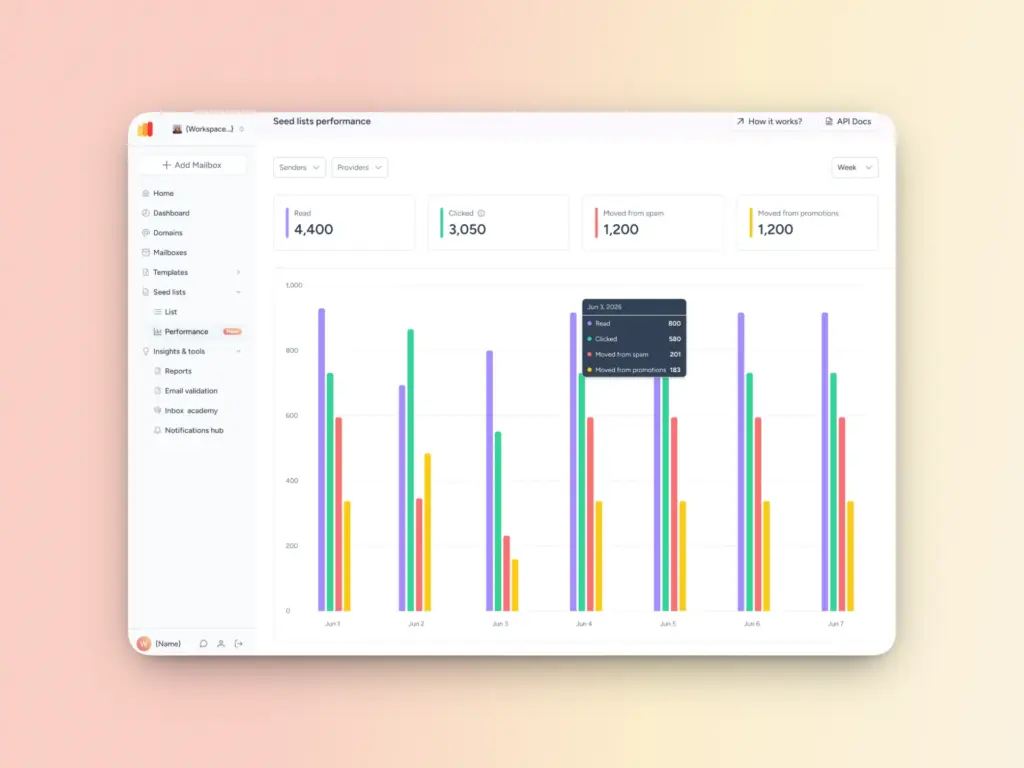
- Track the engagement you’re building: Seed List Performance Statistics in the Warmy dashboard show what each account did with your mail — opens, clicks, replies, spam recoveries — broken down by provider, so you can watch reputation forming at Gmail, Outlook, and Yahoo separately.
A more detailed seed list usage guide can be accessed here.
How to further boost sender reputation with Warmy’s suite of deliverability tools and features
Beyond the Seed List feature, Warmy offers a broader suite of tools designed to cover every layer of email deliverability from technical authentication to content and domain health.
AI-powered email warmup with customizable preferences
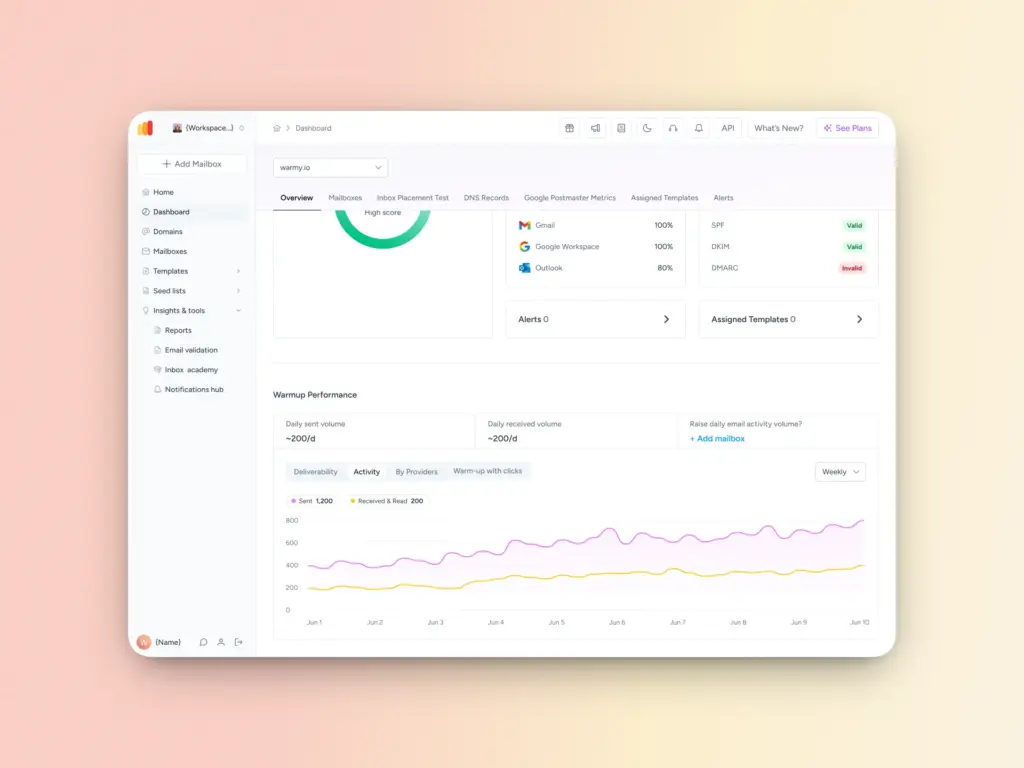
Warmy’s Seed List feature is an add-on on top of Warmy’s existing AI-powered email warmup feature. The platform not only streamlines the warmup process, but also maximizes your email deliverability through intelligent sending practices. This approach minimizes the risk of your emails landing in spam folders, thereby improving overall engagement rates.
Here’s how Warmy does it:
- Automatically yet gradually increases sending volume to build trust with various mailbox providers.
- Simulates real human-like interactions: emails are opened, replied to, and marked as important, boosting deliverability.
- Works across 30+ languages so your emails look natural and relevant for global audiences.
Additionally, Warmy takes into consideration that not every sender has the same needs, and Warmy’s Warmup Preferences feature reflects that. It lets you customize how your warmup is distributed across providers (GSuite, Gmail, M365, Outlook, Yahoo, and Private SMTP) and tailor engagement patterns based on whether you’re targeting B2B or B2C audiences.
You can apply settings across all your mailboxes at once or configure them individually, all from within the Warmy dashboard.
Free SPF & DMARC Record Generators
Authentication misconfigurations are one of the most common and avoidable causes of deliverability failures.
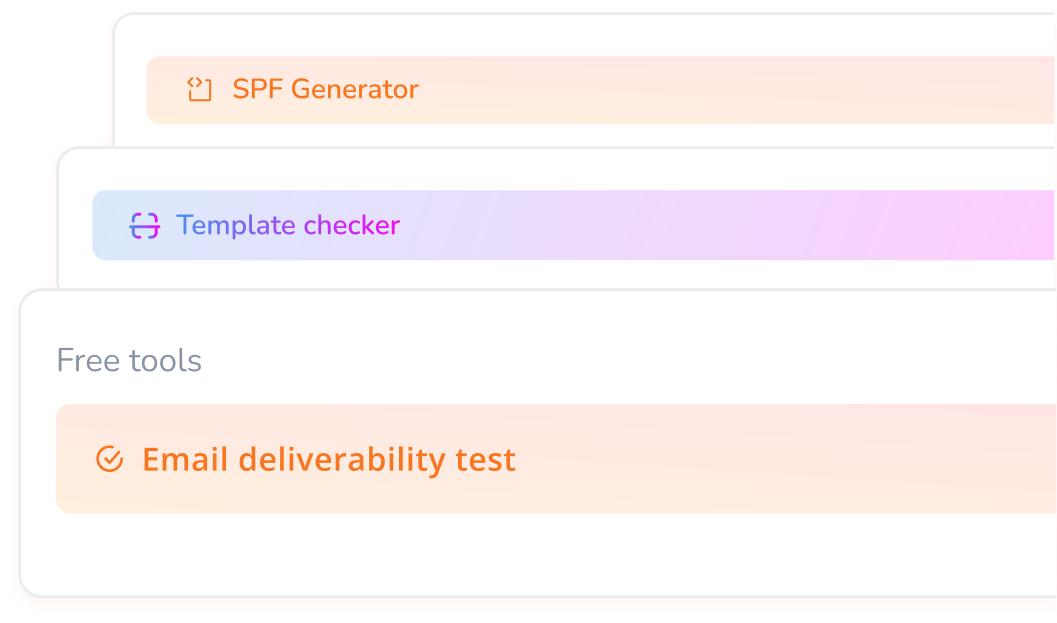
Warmy’s free SPF Record Generator and DMARC Record Generator take the complexity out of setup.
The SPF generator automatically builds a correctly formatted record based on your email providers and optimizes it to avoid exceeding DNS lookup limits.
The DMARC generator helps you create a policy suited to your security needs, with options to gradually enforce rules and monitor authentication failures over time, particularly useful when credentials are centrally managed through a secure password manager like Psono.
Domain Health Hub
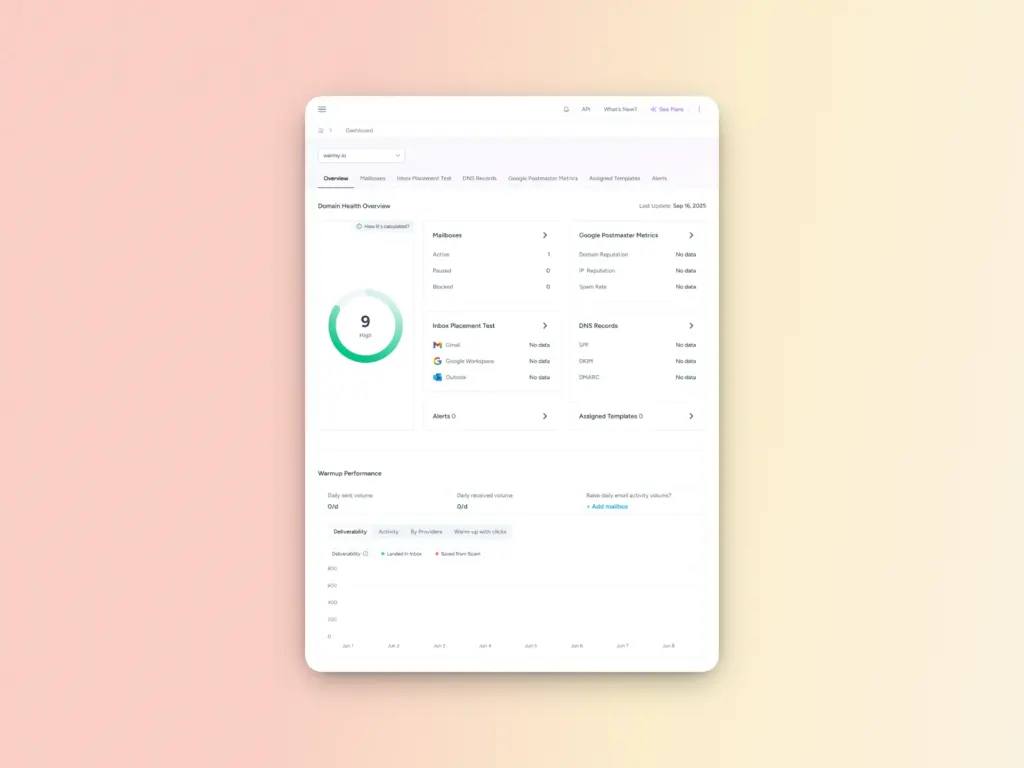
Sender reputation isn’t just a mailbox-level concern. It operates at the domain level, and that’s where the Domain Health Hub comes in.
Rather than monitoring individual email addresses, it gives you a domain-wide view of your deliverability health, including a numeric health score based on inbox placement, DNS authentication, and blacklist status. You can track spam rate trends weekly or monthly, validate SPF, DKIM, DMARC, rDNS, MX, and A records from one place, and manage multiple domains from a single dashboard to quickly identify which ones need attention.
Template Checker
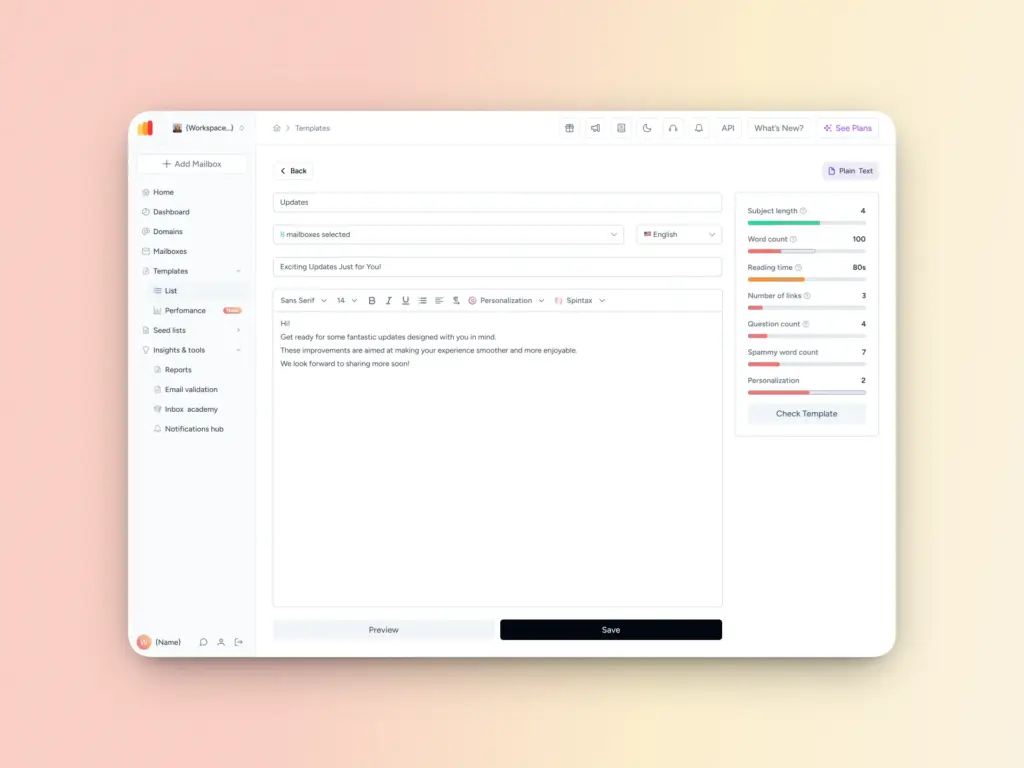
Even a well-warmed domain can run into trouble if the email content itself triggers spam filters. Warmy’s Template Checker analyzes your email against common spam triggers and formatting issues before you send, giving you a chance to make adjustments that protect inbox placement.
A Chrome Extension version is also available, letting you test templates directly from your browser as part of your pre-send workflow.
Free email deliverability test
Warmy’s free email deliverability test gives you a detailed snapshot of where your emails are actually landing. The data is broken down by percentage across inbox, promotions, spam, and unreceived across major providers like Gmail, Outlook, and Yahoo. It also surfaces blacklist status and verifies whether your SPF, DKIM, and DMARC records are correctly configured. For anyone unsure of where their sender reputation currently stands, this is a practical starting point.
For paid users, a weekly automatic test can be scheduled for more efficiency.
A seed list should build reputation, not sit there
A passive seed list does nothing for you: it receives your mail and stops. Warmy’s seed list is the opposite — it engages from the first send, so every warm-up campaign leaves your domain in a better position than it started.
Between the Seed List feature, AI-powered warmup, Domain Health Hub, authentication generators, and Template Checker, Warmy gives you everything you need to build deliverability from the ground up and maintain it over time.
Ready to warm your mailboxes properly? Sign up for Warmy’s 7-day free trial or book a demo to see the full platform in action.
FAQ
What is the difference between a seed list and email warmup?
They work together. Warmy’s AI-powered warmup builds reputation through automated sending across the Warmy network. The seed list lets you warm up using your own campaigns, with real accounts opening, clicking, and interacting with the mail you actually send. The seed list is an add-on on top of warmup, not an alternative to it.
Can I use a seed list for an already active domain?
Yes. Seed lists are not only for new domains. If your inbox placement has dropped or your sender reputation has taken a hit, running seed list campaigns rebuilds the positive engagement history providers need to see before they start trusting you again.
How often should I update my seed list?
Seed lists lose effectiveness over time as addresses become inactive or outdated. Warmy handles this automatically by continuously adding new addresses to keep the list fresh and the engagement signals credible.
How is Warmy’s seed list different from a traditional seed list?
Traditional seed lists are passive — they receive emails and nothing else happens. Warmy’s seed list actively opens emails, clicks links, recovers messages from spam, and marks them as important, sending genuine engagement signals to ESPs. That makes it a warm-up tool that improves sender reputation rather than a list that just sits in your sending platform.