

TL;DR: Pick a closing phrase based on what you want the reader to do next, not on what sounds polite. Follow-ups work when they hand the recipient an easy exit. If none of your closings move the needle, the issue may sit one layer below the copy, in whether the message reaches the primary inbox at all.
Count how many times you’ve typed “looking forward to hearing from you” this month. Now count how many of those emails came back with a reply.
The phrase is grammatically fine but feels empty. Your reader has seen it in every vendor pitch, recruiter note and invoice reminder. It reads as filler, which is a problem when it’s the last thing on the screen before someone decides whether to answer you.
Below are 56 replacements grouped by situation: formal, casual, cold outreach, follow-up, and closings that ask for something specific. If you’ve been hunting for another way to say looking forward without landing on more template language, start here.
Every entry is a non-robotic email phrase you can paste in and adjust in seconds. For good email endings beyond this phrase, see our full list of professional and creative email sign-offs.
Why “Looking Forward to Hearing From You” Sounds Robotic
The phrase shows up in a huge share of business email, and repeated patterns get filed as background noise. Formulaic language reads like a mass send even when it wasn’t one, which lowers the odds anyone bothers to reply.
At the same time, it asks for nothing. It describes your emotional state and leaves the recipient without an instruction, a decision or a date. An email with one small, concrete ask is simply easier to answer.
Fast Company covered a Boomerang analysis of more than 350,000 email threads: average response across the sample was 47.5%, gratitude lifted average response by 36%, and “thanks in advance” led at 65.7% while a bare “best” finished last at 51.2%.
Quick Pick by Situation
| Situation | What the closing should do | Example |
|---|---|---|
| Formal or client email | Ask for direction without pressure | Please let me know how you’d like to proceed. |
| Casual or internal note | Stay short and human | Let me know what you think. |
| Cold outreach | Make replying cheap, including a no | Even a one-line “no” helps me clean up my list. |
| Follow-up | Offer an easy exit | Happy to close the loop if this isn’t a fit. |
| Closing with a CTA | Name the action and the date | Can you confirm by Thursday so we can lock the schedule? |
Formal Alternatives
Use these for clients, executives and anyone you’ve never met. Email closing salutations in this register work best when they hand the reader a decision rather than a feeling. These are closing lines, not sign-offs: you still end with “Best regards” or whatever your professional email closing normally is.
- I’d appreciate your thoughts whenever you have a moment.
- Please let me know how you’d like to proceed.
- I’m available to discuss this at your convenience.
- Your feedback would be helpful before we move ahead.
- I’ll wait for your confirmation before taking the next step.
- Please advise on a timeline that works on your end.
- Any guidance you can share would be welcome.
- I’m glad to provide anything else you need for review.
- Kindly confirm receipt so I can close this out.
- I’d welcome the chance to talk this through.
- Do let me know if a different format would suit you better.
- I’ll follow your lead on scheduling.
Casual and Friendly Alternatives
For teammates, long-standing clients and anyone whose last message to you had an emoji in it. Brevity is the point. A casual closing that runs two lines has already failed.
- Let me know what you think.
- Shout if anything’s unclear.
- Curious to hear your take.
- Give me a yell when you get a chance.
- Happy to jump on a quick call if that’s easier.
- Ball’s in your court.
- Tell me if I’ve missed something.
- Drop me a line whenever.
- No rush on this one.
- Excited to hear where you land.
- Ping me if you want to talk it through.
- Talk soon.
Cold Outreach Alternatives
Cold email is where the cliché does the most damage, because a stranger has no other evidence that you wrote to them on purpose. Another way to say looking forward to a reply here is to lower the price of answering. Give people permission to say no and more of them say something.
- Worth a 15-minute conversation?
- If this isn’t your area, point me to whoever owns it.
- Reply “not now” and I’ll check back next quarter.
- Open to a short call next week?
- Happy to send the numbers before we ever talk.
- If I’ve read your setup wrong, tell me and I’ll drop it.
- Interested in how this works for a team your size?
- Say the word and I’ll send a two-minute walkthrough.
- Is this a priority this quarter, or should I circle back?
- Would a short demo be useful, or is the timing off?
- Even a one-line “no” helps me clean up my list.
- Want me to put a 20-minute slot on your calendar?
Running these at volume means templating them. Most sequencers support conditional blocks, which let one template carry the right closing per segment instead of five near-identical templates:
{% if contact.stage == "cold" %}
Worth a 15-minute conversation?
{% elsif contact.stage == "follow_up" %}
Still worth pursuing on your end?
{% else %}
Please let me know how you'd like to proceed.
{% endif %}
{{sender.first_name}}
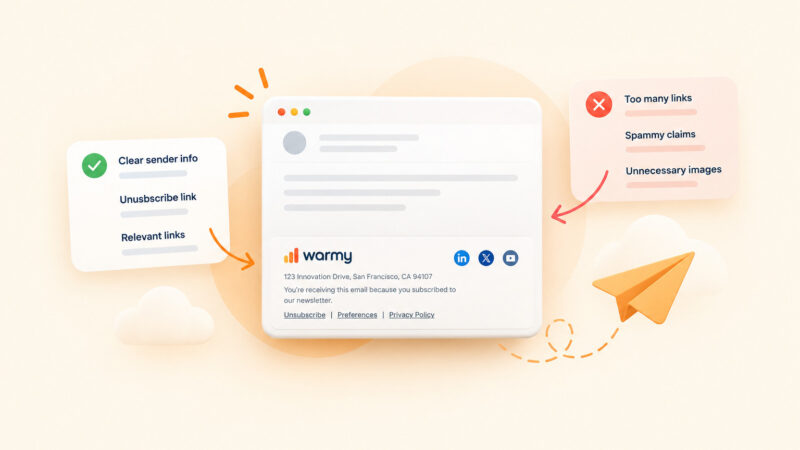
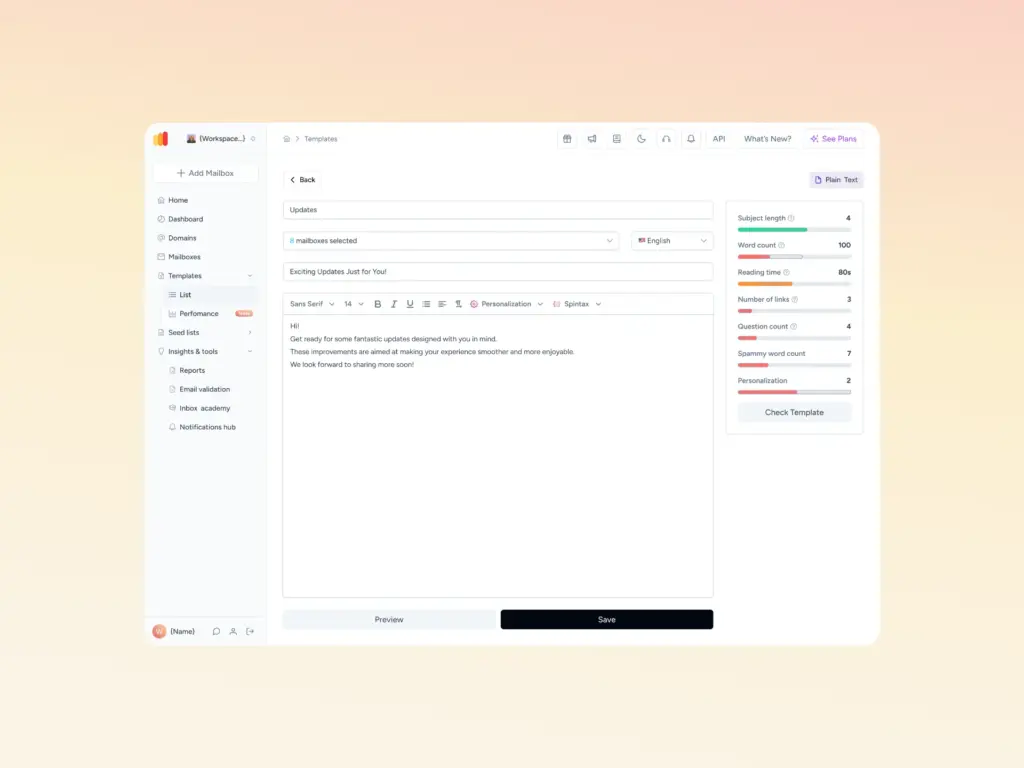
Whatever you rotate, run the finished template through Warmy’s free Template Checker before the campaign goes out. A closing line that reads well can still sit next to formatting or trigger words that push the whole message into spam.
Follow-Up Email Alternatives
A follow-up has a different job than a first touch: you’re finding out whether the thing is still alive. Ways to end an email professionally at this stage almost always involve giving the recipient a graceful way out.
- Still worth pursuing on your end?
- Happy to close the loop if this isn’t a fit.
- Bumping this in case it slipped past you.
- Any movement since we last spoke?
- Let me know if the timeline has shifted.
- I’ll assume this is on hold unless I hear otherwise.
- Do you need anything from me to unblock it?
- Checking whether this is still with you or with someone else now.
- If a colleague picked this up, I’d be glad to reach out to them.
- Give me a nudge when it’s back on your desk.
Alternatives With a Clear Call to Action
These convert best and are the easiest to overuse. One per email, only when a specific next step exists. Another way to say looking forward to it, once a deal is in motion, is to name the action and attach a date.
- Can you confirm by Thursday so we can lock the schedule?
- Pick a time here and I’ll handle the rest.
- Reply with a yes and I’ll send the contract today.
- Send over the file and I’ll turn it around within a day.
- Approve the draft and it goes live Monday morning.
- Answer one question for me: who signs off on this?
- Book the slot that works and I’ll prepare the numbers.
- Confirm the headcount and I’ll adjust the quote.
- Say yes and I’ll start onboarding this week.
- Let me know by Friday, otherwise I’ll release the slot.
A formatting note: a CTA closing loses force when it’s glued to a heavy signature block. Give it its own paragraph with space beneath it, and keep the signature light:
<p style="margin:0 0 18px 0;">Can you confirm by Thursday so we can lock the schedule?</p>

<table role="presentation" cellpadding="0" cellspacing="0" border="0">
<tr>
<td style="font-family:Arial,Helvetica,sans-serif;font-size:13px;line-height:18px;color:#444;">
Jane Doe<br>
Head of Partnerships, Acme<br>
<a href="https://example.com" style="color:#1a73e8;">example.com</a>
</td>
</tr>
</table>
When to Skip the Closing Line Entirely
Not every email needs one. In a fast thread where two people are already trading messages, an extra line of politeness adds nothing. Skip it when you’re confirming something in four words, when the body already ends with a direct question, or when a reply is expected within the hour.
Dropping the closing line and dropping the sign-off are different moves. Keep “Thanks,” or “Best,” and keep your signature. What you cut is the sentence above them, the one repeating an ask you’ve already made. Diluting a strong question with soft filler is the most common way people weaken their own emails.
What a Closing Line Can’t Fix
If you’ve rewritten your closings and nothing changed, the copy probably isn’t the bottleneck. Mailbox providers decide placement before a human reads a word, and Google asks bulk senders to keep user-reported spam rates under 0.1%, warning that 0.3% or higher hits inbox delivery much harder.
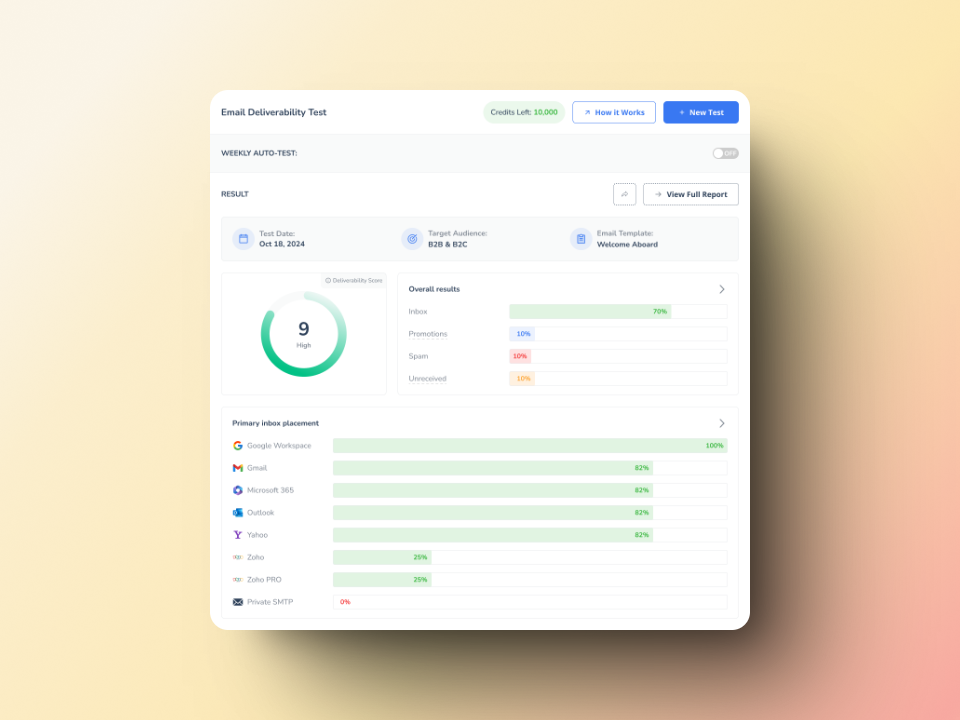
Warmy is an AI-driven email warmup and deliverability platform that builds domain reputation through gradual, human-like sending activity and shows where your messages land across Gmail, Outlook and Yahoo. Run the free Email Deliverability Test before you rewrite another line.
Conclusion
Good email endings come from the situation, not from a phrase you memorized once. Read the last line of your draft and ask what it’s doing. If the answer is “being polite,” swap it for something above that asks for a decision, a date or an exit. That’s the whole method behind an email closing without clichés.
Want more email sign off examples across every register? Browse our list of funny email sign-offs, and use the free Signature Builder to build a signature that matches your tone.
Then make sure those emails arrive at all. Book a demo and see how Warmy protects your inbox placement.