TL;DR: Domain age affects email deliverability, though the mechanism is indirect. A brand-new domain carries no sending history for mailbox providers to evaluate, and several public blocklists add newly registered domains automatically during their first days online. Your registration date sits in the public registry record. Look it up, then build reputation deliberately.
You bought a domain on Monday. By Friday you’ve got SPF, DKIM, and DMARC configured, a scrubbed list and a copy you actually like. The first send goes out and a third of it lands in spam.
Nothing you did was wrong. Receiving servers just had almost nothing to judge you on, and one of the few data points sitting there was your registration date, published in a record anyone can query in about two seconds.
Most advice on this topic tells you domain age matters and stops there. We’re going to open the registry data itself and give you an honest read on how much weight each field carries. Warmy is an AI-driven email warmup and deliverability platform that builds the sending history a young domain is missing, and before you go further it’s worth two minutes to check your domain’s current reputation and deliverability.
What a WHOIS record actually shows
WHOIS began life as a directory service. The protocol is defined in RFC 3912, published back in 2004, and tells who is responsible for a domain name. Registrars collect the data at registration, registries publish a subset of it, and anyone can query the result.
ICANN phased out certain WHOIS protocol obligations for gTLD registries and registrars on 28 January 2025. RDAP, the Registration Data Access Protocol, is the replacement, and it returns structured JSON instead of a text blob. Habit keeps the word “WHOIS” in circulation, but a .com query in 2026 usually runs through RDAP.
Both routes surface the same core fields:
# The classic query, still served on port 43 by most registrars
whois example-outreach.com

# The modern equivalent, returning structured JSON
curl -s https://rdap.org/domain/example-outreach.com | jq '{
  created:   [.events[] | select(.eventAction=="registration") | .eventDate],
  registrar: [.entities[] | select(.roles[]=="registrar") | .vcardArray[1][1][3]],
  status:    .status
}'
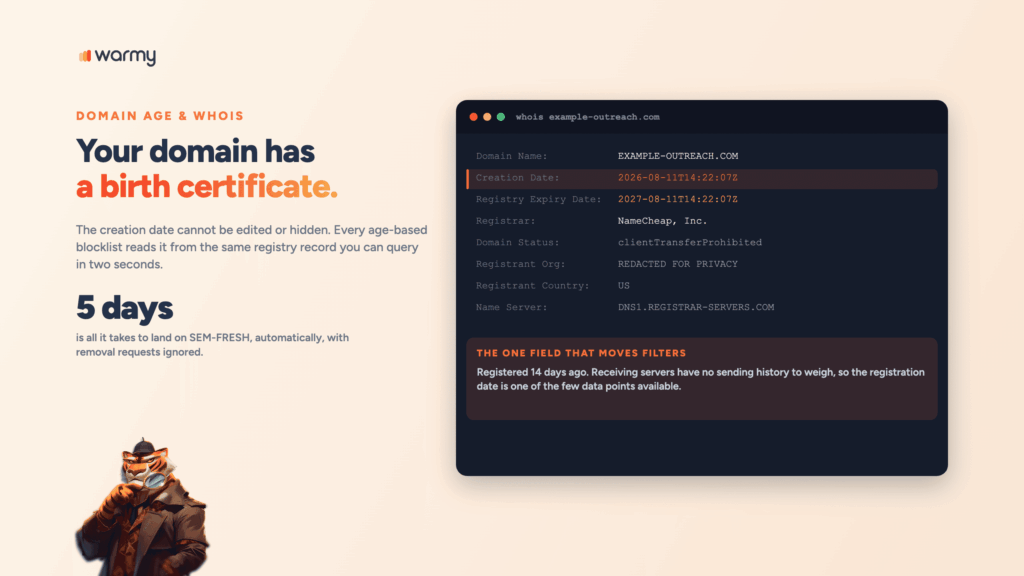
And here’s the plain-text version for a domain registered two weeks ago:
Domain Name: EXAMPLE-OUTREACH.COM
Creation Date: 2026-08-11T14:22:07Z
Registry Expiry Date: 2027-08-11T14:22:07Z
Registrar: NameCheap, Inc.
Domain Status: clientTransferProhibited
Registrant Organization: REDACTED FOR PRIVACY
Registrant Country: US
Name Server: DNS1.REGISTRAR-SERVERS.COM
Domain registration date
The creation date is the timestamp the registry wrote when the domain came into existence, it can’t be edited, and it can’t be hidden. Every age-based blocklist reads it from the same place you just did.
Reputation vendors also track a first-seen date, meaning the first time their sensors observed the domain sending mail or appearing inside a message body. A domain registered in 2019 that never sent anything until last Tuesday reads as brand new to systems that measure behavior instead of paperwork.
The domain registrar
Registrars vary enormously in how they police abuse. Some run tight verification and suspend bad actors within hours. Others sell throwaway domains by the thousand at a dollar apiece. Filtering systems notice, which gives the registrar name in your record a faint reputational tint that has nothing to do with you.
WHOIS privacy protection status
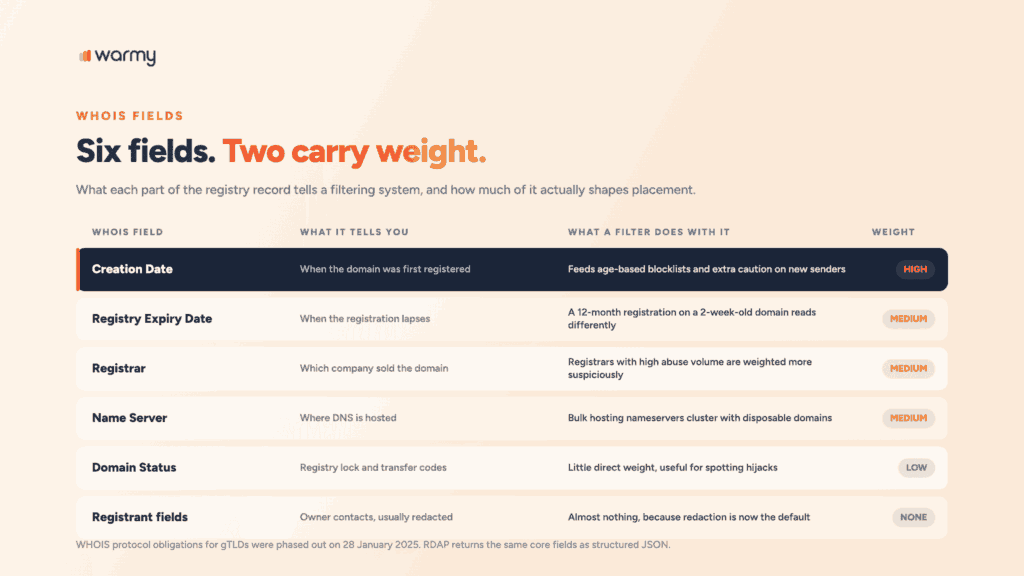
| WHOIS field | What it tells you | What a filter can do with it |
|---|---|---|
| Creation Date | When the domain was first registered | Feed age-based blocklists and apply extra caution to new senders |
| Registry Expiry Date | When the registration lapses | A 12-month registration on a two-week-old domain reads differently than a five-year one |
| Registrar | Which company sold the domain | Weight registrars with high abuse volume more suspiciously |
| Domain Status | Registry lock and transfer codes | Little direct deliverability weight, useful for spotting hijacks |
| Registrant fields | Owner contact details, usually redacted | Almost nothing, because redaction is now the default |
| Name Server | Where DNS is hosted | Bulk hosting nameservers cluster with disposable domains |
Does domain age really affect deliverability?
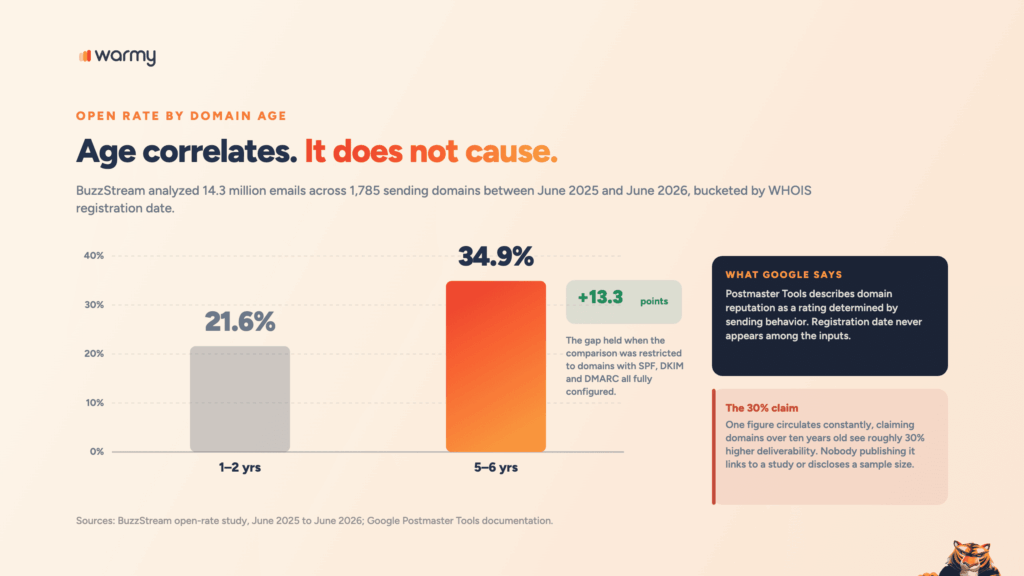
Yes, and the effect is real enough to plan around. It’s also smaller and far less direct than the people selling aged domains would like you to believe.
One figure circulates constantly in this space, claiming domains over ten years old see roughly 30% higher deliverability than new ones. Nobody publishing it links to a study or discloses a sample size, and several of the sites repeating it happen to sell aged domains.
Better data exists. BuzzStream analyzed 14.3 million emails across 1,785 sending domains between June 2025 and June 2026, using WHOIS registration data to bucket each domain by age. Domains aged one to two years averaged a 21.6% open rate.
Domains aged five to six years averaged 34.9%. The gap held up when the comparison was restricted to domains with SPF, DKIM, and DMARC all fully configured.
Now put that next to what the mailbox providers say about themselves. Google’s Postmaster Tools documentation describes domain reputation as a rating determined by sending behavior, and registration date never appears among the inputs.
Old domains are trusted because twelve years is a lot of time in which to accumulate the sending history reputation systems genuinely measure.
Pro Tip: If you’re evaluating an aged domain for purchase, check its sending history rather than its birthday. A 2011 domain previously used by a spammer is worse than a domain you registered this morning, because it carries a negative signal.
New domain blacklists you should know about
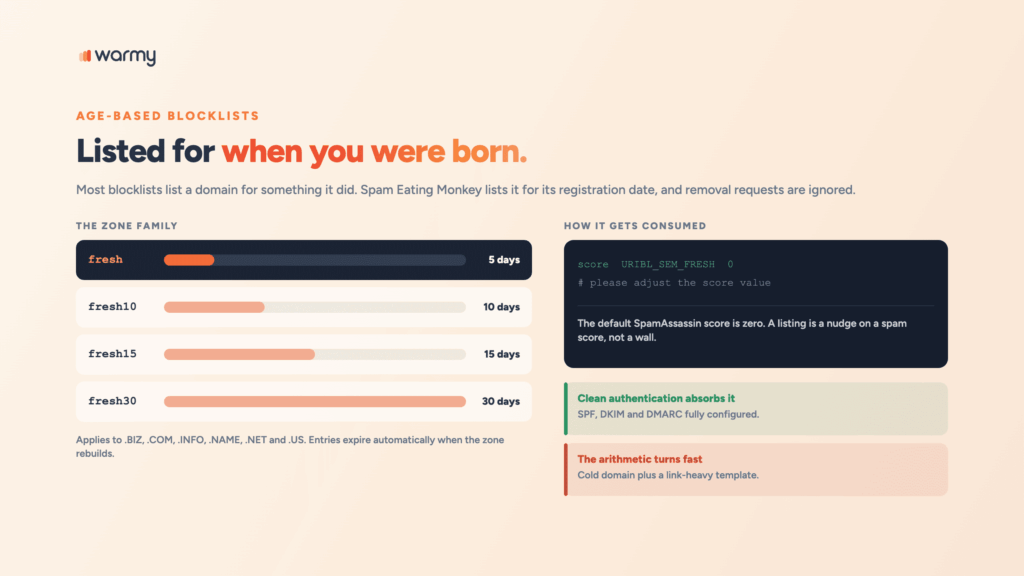
Spam Eating Monkey runs a family of blocklists that works on a different principle from everything else in the space. Most blocklists list a domain for something it did. SEM-FRESH lists a domain for when it was born.
The published SEM-FRESH specification is refreshingly blunt: every domain registered in the last five days across the .BIZ, .COM, .INFO, .NAME, .NET and .US extensions, entries expiring automatically when the zone rebuilds, removal requests ignored. Longer windows run from the same shop under fresh10, fresh15, and the widest of them, SEM-FRESH30, which applies identical logic across thirty days. If you registered a .com this week, you’re on at least one of these lists right now.
You can query any of them with a single DNS lookup:
# A 127.0.0.2 answer means listed. No answer means not listed.
dig +short example-outreach.com.fresh.spameatingmonkey.net A

# Check the whole family in one pass
for ZONE in fresh fresh10 fresh15 fresh30; do
  RESULT=$(dig +short "example-outreach.com.${ZONE}.spameatingmonkey.net" A)
  echo "${ZONE}: ${RESULT:-not listed}"
done
What matters is how these lists get consumed on the receiving end. Here’s the SpamAssassin rule that ships with SEM-FRESH:
urirhssub  URIBL_SEM_FRESH  fresh.spameatingmonkey.net. A 2
body       URIBL_SEM_FRESH  eval:check_uridnsbl('SEM_FRESH')
describe   URIBL_SEM_FRESH  Contains a domain registered less than 5 days ago
tflags     URIBL_SEM_FRESH  net
score      URIBL_SEM_FRESH  0 # please adjust the score value
Look at the last line. The default score is zero, with a comment telling the mail administrator to pick their own value. A listing is a nudge on a spam score rather than a wall, and whether it sinks your message depends on what else is already stacked against you.
Clean authentication absorbs it easily. Add a cold domain and a link-heavy template and the arithmetic turns fast. We’ve written up the SEM Fresh blacklist and what to do about a listing if you want the operational detail.
Because content and technical signals get scored together, run your message through the free Template Checker before the first campaign from a new domain. While you’re carrying an age-based listing, everything else needs to be spotless.
What WHOIS privacy protection signals (and doesn’t)
A question that surfaces in every outreach forum: does WHOIS privacy protection hurt deliverability, because filters read redacted contacts as evidence of something to hide?
Not in 2026, no.
After ICANN’s response to GDPR, redaction became the default state for gTLD registration data rather than a paid add-on. Registrant name, email, phone, and postal address come back as REDACTED FOR PRIVACY on most domains, whether or not the owner ever asked for privacy. A signal present on most of the internet can’t tell one sender from another.
What pattern-matching systems actually flag is the combination. A domain registered three days ago, sold by a registrar with weak abuse handling, with redacted contacts, pointing at nameservers on a bulk host, sending four hundred cold emails on day one.
Domain age vs. sending history: Which matters more
| Domain age | Sending history | |
|---|---|---|
| What it measures | Calendar time since registration | Volume, engagement, complaints, and bounces over time |
| Who reads it | Age-based blocklists and some heuristic filters | Gmail, Outlook, and Yahoo reputation systems |
| How fast it changes | One day per day, no exceptions | Days to weeks with deliberate sending |
| How much you control | Nothing at all after registration | Nearly everything |
| Recovery after damage | Not applicable | Possible, though slow and unpleasant |
| Weight at Gmail | Not listed as an input | The primary input |
Take a domain registered in 2014 that sat parked for six years, then gets pointed at a cold sequence. On paper it’s twelve years old. In practice Gmail has no recent behavioral data for it, and a jump from zero to three hundred messages a day looks precisely like a compromised domain. Domain reactivation needs the same ramp as a fresh registration. For the wider picture, see the complete guide to domain age.
How to check your own domain’s age and reputation
A proper domain reputation check has three layers, and most people only run the first one.
- Pull the registration date from the registry, or use ICANN’s own lookup tool, which runs RDAP and falls back to WHOIS when RDAP is unavailable.
- Check the age-based blocklist zones. Under thirty days old, expect at least one listing and don’t panic about it.
- Confirm authentication and current inbox placement. This layer decides whether the first two matter at all.
Here’s the whole thing as one script:
#!/usr/bin/env bash
DOMAIN="example-outreach.com"

# 1. Registration date
curl -s "https://rdap.org/domain/${DOMAIN}" \
  | jq -r '.events[] | select(.eventAction=="registration") | .eventDate'

# 2. Age-based blocklist zones
for ZONE in fresh fresh10 fresh15 fresh30; do
  echo "${ZONE}: $(dig +short "${DOMAIN}.${ZONE}.spameatingmonkey.net" A)"
done

# 3. Authentication records
dig +short TXT "${DOMAIN}"        | grep -i 'v=spf1'
dig +short TXT "_dmarc.${DOMAIN}" | grep -i 'v=DMARC1'
That script tells you what your DNS says. It can’t tell you where your mail is landing, and that is why a domain reputation test exists as a separate thing. Warmy’s free Email Deliverability Test runs your domain across Gmail, Outlook, and Yahoo and reports the exact share reaching the inbox versus spam or promotions, plus a blacklist sweep and an authentication check.
Check your domain reputation before the next campaign goes out, not after.
What to do if your domain is new
- Register and wait. Get SPF, DKIM, DMARC, and a real website live before a single message goes out.
- Let the age-based listings expire. Five days clears SEM-FRESH, thirty clears SEM-FRESH30. There’s no form to submit.
- Warm up gradually. Start low, increase steadily, and generate genuine engagement rather than opens alone.
- Watch the numbers weekly. A downward trend caught in week two is a much cheaper problem than the same trend caught in week eight.
Warmy’s warmup raises volume on a schedule while real accounts open, scroll, click, reply, and pull anything that lands in spam back into the inbox marked as important.
When you’re ready, start warming up a new domain the right way. For the longer version of everything that feeds a sender’s standing, read our guide to building email domain reputation.
Conclusion
Your WHOIS record holds one field that genuinely moves the needle, and it’s the creation date. It feeds automatic blocklists during your first month and correlates with better placement long term.
The uncomfortable part is that you can’t do anything about the one field that counts, because registration dates move in one direction at one speed. What you can control is the sending history layered on top, which happens to be the signal Gmail and Outlook weigh most heavily anyway. Warmy handles the warmup, monitors each domain’s health score, and flags the drops before a campaign pays for them. Book a demo and see what your domains look like from the receiving end.