Email volume is still climbing in 2026, and the requirements for reaching the inbox have tightened across every major provider. Those were the twin themes of Deliverability & Compliance: The 2026 Email Masterclass, a Warmy webinar held on June 25, where we spoke with Tom Wozniak, chief operating officer of Optizmo, about suppression, opt-outs, the rules inbox providers enforce, and where a channel many keep writing off is actually headed.
This article recaps the main points and adds verified context where it helps.
Inside Optizmo, and the COO who runs it
Wozniak has worked in digital since the late 1990s and sent his first marketing email around 1995. He has been with Optizmo for almost 9 years, first as head of marketing and then as COO. The company has operated for 17 years, and in his words,
“We’ve really become the leader in suppression and email compliance.”
Its clients are advertisers and networks, and its core job is to make it easy for mailers to follow laws such as CAN-SPAM by collecting and honoring opt-outs and suppressing addresses that should not be mailed.
Mailers reach Optizmo through a product called Access, which lets them pull suppression files and opt-out links, while the suppression engine itself is called Suppress. For mailers that access is free, since advertisers are the paying clients. As Wozniak put it, the company functions as a kind of insurance policy that helps keep the industry on the right path.
What email compliance really means in 2026
Wozniak’s central message was that compliance now has two halves, and a sender has to satisfy both at once.
The legal layer
Rules differ by country, and he was careful to note that he is not an attorney. Even so, one principle is close to universal:
“If you email someone and they say stop, you have to stop.”
The specifics vary by region:
- In the United States there is no opt-in requirement, and senders have up to ten business days to honor an opt-out, a timeline confirmed by the FTC’s CAN-SPAM compliance guide.
- Most other regions, including the EU under GDPR and Canada, require permission before the first message goes out.
- Third-party liability is real. The FTC notes that both the business whose product is promoted and the agency or affiliate sending on its behalf can be held liable, with penalties that can reach tens of thousands of dollars per email.
The inbox-provider layer
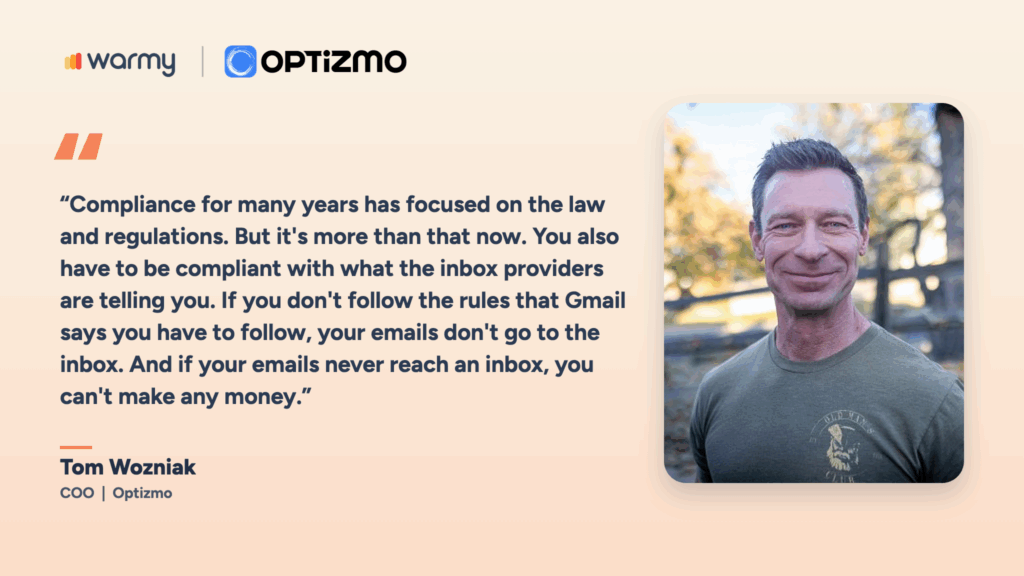
The second half is the inbox provider, a layer he argued is now every bit as important as the law:
“You also have to comply with the rules of the inbox providers, the ISPs.”
The stakes are blunt, as he put it earlier in the talk: “If your emails never reach an inbox, well, you can’t make any money.”
That maps directly to the bulk-sender requirements Gmail and Yahoo began enforcing in February 2024, which call for:
- Authentication with SPF, DKIM, and DMARC.
- A one-click unsubscribe in promotional mail.
- A user-reported spam rate kept below 0.3 percent.
Microsoft introduced comparable rules for Outlook in May 2025, and Google escalated to permanent rejections for non-compliant traffic in November 2025.
Why the “email is dead” story keeps being wrong
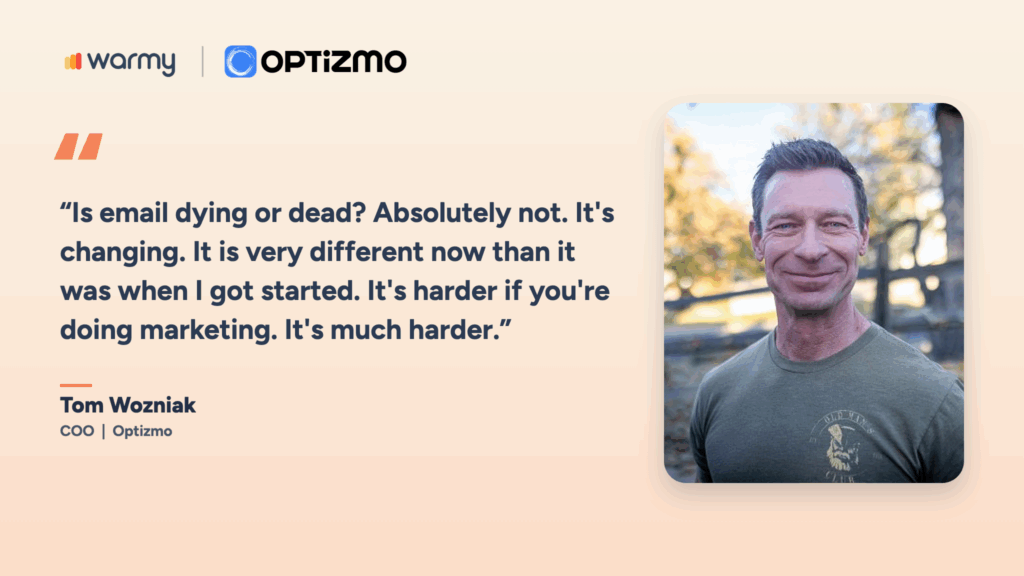
Asked whether email is fading as marketers shift to other channels, Wozniak was direct:
“Is email dying or dead? Absolutely not. It’s changing.”
He pointed out that yearly email volume keeps climbing, and the forecasts back him up. Email is projected to reach about 4.7 billion users worldwide in 2026 and close to 5 billion by 2028, while daily volume is expected to rise from roughly 392 billion messages in 2026 toward 424 billion by 2028, a compound annual growth rate of about 4 percent (Radicati Group, via Statista).
His explanation is that email remains the closest thing to a universal identifier online, serving as the login and username for most apps and services. He does not see SMS replacing it for marketing, partly because of the cramped interface and partly because users tolerate a level of promotional volume in email that they would never accept on their phones.
Email and compliance by the numbers
| Metric | Figure (2026 and beyond) |
|---|---|
| Email users worldwide | About 4.7 billion in 2026, projected near 5 billion by 2028 |
| Emails sent and received per day | About 392 billion in 2026, projected toward 424 billion by 2028 |
| Growth in email volume | About 4 percent a year (CAGR through 2028) |
| Spam complaint ceiling (Gmail, Yahoo) | Below 0.3 percent, with under 0.1 percent as the working target |
| Opt-out window (US, CAN-SPAM) | Up to 10 business days, with immediate processing as best practice |
| Maximum CAN-SPAM penalty per email | Up to $53,088 |
Sources: Radicati Group via Statista (users and volume); Gmail and Yahoo sender guidelines (spam rate); FTC CAN-SPAM compliance guide (opt-out window and penalty).
The skill that separates winners: Attention to detail
When we asked what predicts success in email this year, Wozniak named attention to detail as the single most important factor. He recalled a friend who runs a well-known email agency telling him that the campaign checklist that used to be short has grown sharply:
“Now the checklist of all the things we make absolutely sure in place is extensive.”
Miss one item, he explained, and you can damage your sender reputation or burn an IP, with effects that carry into every campaign that follows.
The old approach he called spray and pray, where any valid address would reach the inbox, no longer works, because deliverability has become a discipline in its own right. His forward-looking addition was to stay curious about new technology and willing to adapt rather than assume that what worked before will keep working.
Compliance as a performance lever
One of his most useful reframes was treating compliance as an optimization tool for performance rather than a box to check. Lowering spam complaints and raising engagement keeps a sender in the inbox and lifts results at the same time, which he described as a virtuous circle.
He also pushed marketers to study what he calls negative marketing signals, the unsubscribe and spam-complaint data that most teams ignore once a recipient says no:
“There’s all kinds of things you can learn when you look at those signals.”
He suggested that patterns in who opts out can reveal which audience segments need different messaging.
Optizmo’s next move: The Deploy platform
After 16 years focused on suppression, Optizmo is extending into deployment with a platform called Deploy, which is rolling out in waves and pointed toward Affiliate Summit East as a key milestone.
Wozniak framed it simply: “Think of it as a front end that sits on top of a mailer’s existing email infrastructure.”
The point is to remove friction from planning and sending campaigns. The clearest example is suppression. Instead of downloading files and cleansing lists manually before each send, the suppression will happen behind the scenes automatically for any advertiser already in Optizmo’s system.
That saves time and, as he noted, reduces the potential for error, since a missed manual cleanse can cause a compliance problem even without any bad intent.
Deploy also aims to automate testing, optimization, and offer orchestration based on segmentation, with the stated goal of giving mailers time back while improving the return on the mail that goes out.
AI, with the human element intact

AI ran through the entire conversation. Wozniak sees it as a major disruptor for marketers, especially for content creation once a model has a strong context layer covering brand voice and product details.
His advice to other C-level leaders was to invest heavily in AI while protecting the human side of the business:
“People like to do business with people they like.”
He added a reminder that “even if you’re B2B, it’s still people at the end.” His view is that the companies most likely to win in the near term will pair strong people with capable AI agents rather than stripping people out in pursuit of efficiency.
How Warmy and Optizmo fit together
Warmy and Optizmo address different parts of the same problem, which is why the partnership works.
Warmy focuses on email deliverability and inbox placement, including warming up sending infrastructure, building and monitoring sender reputation, and helping messages land in the inbox rather than the spam folder.
Optizmo focuses on compliance, including the collection and honoring of opt-outs, suppression-file management, and keeping mailers on the right side of laws such as CAN-SPAM and GDPR.
The capability Optizmo brings that sits outside Warmy’s deliverability scope is the legal and suppression layer. In practice that means:
- A central opt-out repository, where unsubscribes from every mailer promoting the same advertiser offer are pooled, so a new mailer automatically inherits the opt-outs collected by everyone else mailing that offer.
- Opt-out link hosting and suppression-file access through Access.
- Automatic suppression at send time through Deploy.
- Management of the third-party liability Wozniak described, where an advertiser running an affiliate program can be accountable for what its mailers do.
Honoring opt-outs and suppressing the right addresses reduces spam complaints, and a lower complaint rate protects the sender’s reputation, on which deliverability depends. Warmy works to earn inbox placement, and Optizmo helps ensure that the mail going out is compliant and properly suppressed so that placement is not undermined by avoidable complaints.
A 2026 compliance and deliverability checklist
- Authenticate every sending domain with SPF, DKIM, and DMARC, now required by Gmail, Yahoo, and Outlook for bulk senders.
- Include a working opt-out link in every commercial email, with one-click unsubscribe on promotional mail.
- Cleanse against the most current suppression file before every send, and pull a fresh file rather than reusing an old one.
- Honor opt-outs within the legal window, up to ten business days in the United States, though immediate processing is the safer practice.
- Confirm consent where the law requires opt-in, including the EU under GDPR and Canada.
- Keep the user-reported spam complaint rate below 0.3 percent, with under 0.1 percent as the working target.
- Use accurate headers and subject lines, and include a valid physical postal address as CAN-SPAM requires.
- Monitor sender reputation and protect sending IPs, since a single mistake can affect later campaigns.
- Review negative signals such as unsubscribe and complaint rates for segmentation insight, not only positive metrics like clicks.
- Test and optimize each campaign, then carry the learnings into the next one.
- For affiliate and third-party offers, verify that every mailer in the stream is compliant, because the advertiser can be held liable.