Email is the lifeblood of modern business – and the favourite hunting ground of cybercriminals. In 2025, more than 90% of successful cyberattacks start with a phishing email, making it the leading method used by threat actors to breach networks and steal data. Phishing attacks have grown more frequent, more targeted, and harder to spot, while Business Email Compromise continues to drain billions from companies of every size each year. If you’re a business owner, marketing consultant, or agency leader, the odds are that your email system is being probed right now.
The good news is that the tools to fight back have evolved just as fast as the threats themselves. Today’s cloud-based email security platforms handle the heavy lifting for you – from blocking malicious messages before they reach your team, to protecting the domain reputation that your entire outreach strategy depends on.
But security doesn’t start and end with a spam filter. A compromised or poorly configured domain can land your legitimate emails in junk folders just as easily as a cyberattack can. That’s why email deliverability and email security go hand in hand – one protects your business from bad actors, the other ensures your messages actually reach the people you’re trying to reach.
We’ll also show you how building a strong sender reputation fits into a complete email security strategy — because staying out of spam folders is just as important as keeping threats out of your inbox. Our Email Deliverability Guide is a good place to start.
The Modern Email Threat Landscape
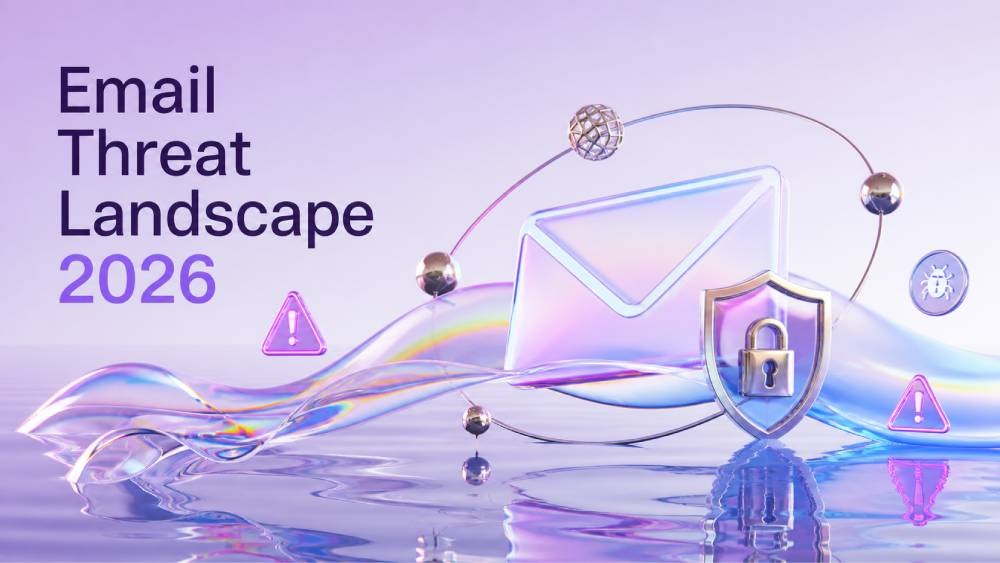
Before diving into solutions, it helps to understand what you’re up against. Email threats today are not your grandfather’s Nigerian prince scams. They are sophisticated, personalized, and increasingly powered by artificial intelligence.
Phishing remains the dominant entry point for cyberattacks, and its sophistication has skyrocketed. Attackers now use polymorphic techniques – subtly altering each message to slip past filters – while generative AI produces emails that are grammatically flawless and uncannily convincing. The days of spotting a scam by its broken English are largely over.
The major threat categories your business needs to be aware of include:
- Phishing and spear phishing – Mass and targeted credential-harvesting campaigns, often impersonating trusted brands or colleagues. One successful click can hand attackers the keys to your entire operation.
- Business Email Compromise (BEC) – Attackers impersonate executives or vendors to redirect payments or extract sensitive data. BEC remains one of the most financially damaging forms of cybercrime for businesses of every size.
- Malware delivery – Weaponized attachments (ZIP and HTML files dominate) that install ransomware or spyware once opened.
- QR code phishing (quishing) – QR codes embedded in emails bypass URL scanners entirely, redirecting victims to malicious sites on their mobile devices where defences are often weaker.
- Account takeover (ATO) – Stolen credentials are used to hijack inboxes and weaponize them as trusted launchpads for further attacks against your clients and colleagues. If your domain gets caught up in this, getting off an email blacklist can be a painful and time-consuming process.
Traditional Secure Email Gateways (SEGs) are struggling to keep up. These legacy, signature-based systems were built for a different era – one where threats were static and predictable. Today’s AI-generated, polymorphic attacks are engineered specifically to evade them. Relying on a SEG alone is no longer a complete strategy, which is why understanding your domain’s deliverability health has become just as important as the security tools sitting in front of your inbox.
What Is SaaS Email Security for Microsoft 365 and Google Workspace?
The term SaaS email security refers to cloud-delivered platforms that protect your organization’s inboxes without the need for on-premises hardware, complex deployments, or dedicated security teams. Instead of installing and maintaining your own filtering infrastructure, you subscribe to a service that sits in front of, or integrates directly with, your existing email environment.
These platforms typically connect to Microsoft 365, Google Workspace, or other cloud email systems via API, processing every inbound and outbound message in real time. Because they operate in the cloud, they receive continuous threat intelligence updates, benefit from machine learning trained on billions of signals, and can scale with your organization almost instantly.
For small and mid-sized businesses, this model is particularly compelling: you get enterprise-grade protection without the enterprise-grade headcount or budget to match. For larger organizations, it offers agility and a constantly evolving defence posture that’s difficult to achieve with static on-premises tools.
The Business Case for Cloud-Based Protection
A simplified view of how SaaS email security processes incoming messages in the cloud. Source: Adapted from GreatHorn.
Moving to saas email protection is not just a technology decision; it’s a business decision. Let’s look at the core advantages that make the cloud-first model so appealing:
| Benefit | What It Means for Your Business |
|---|---|
| No hardware required | Deploy in hours, not weeks. No rack space, power costs, or physical maintenance. |
| Automatic updates | Threat intelligence refreshed in real time. You’re never running yesterday’s definitions against today’s attacks. |
| Scalability | Add users or mailboxes in minutes. Ideal for growing teams and seasonal spikes. |
| Predictable costs | Per-user monthly subscriptions make budgeting straightforward and capex-free. |
| 24/7 monitoring | Your protection doesn’t clock out. Threats at 3am are handled the same as threats at 3pm. |
For agencies and consultancies managing email on behalf of clients, these platforms also make multi-tenant administration far cleaner: one dashboard, multiple client domains, centralized reporting.
Roman Milyushkevich, CEO and CTO at HasData.com, points to a lesser-known risk that cloud-based protections need to address: ‘A significant number of targeted phishing campaigns today are fuelled by publicly available data scraped from the web: employee names, email formats, LinkedIn roles, and company structures. Attackers don’t need to breach your systems to build a convincing spear-phishing email. They just need good data collection tools. Businesses should assume that their organizational chart is already in attackers’ hands and choose email security solutions that account for this level of personalized targeting.’
Key Threats Driving Demand for Email Security SaaS
Understanding why organizations are rapidly adopting email security saas platforms requires looking at the specific pain points legacy tools have failed to solve.
First, there’s the AI arms race. As noted above, generative AI has made phishing emails virtually indistinguishable from legitimate messages. Traditional spam filters and keyword-matching engines simply weren’t built for this. Cloud-native solutions, by contrast, can deploy AI-based detection models that are continuously retrained on current threat patterns, including the very AI-generated emails they encounter. Security teams staying ahead of this curve are increasingly turning to generative AI courses to understand how these threats are built — and how to counter them.
Second, the rise of multi-channel attacks means that email is no longer the only vector. Attackers often begin with an email and then pivot to SMS, phone calls, or collaboration tools like Slack and Teams to build trust before the actual attack. A modern email security platform contributes to a broader security posture that can be integrated with endpoint and identity tools.
Third, supply chain and partner impersonation has become a critical gap. In over 60% of phishing emails, attackers impersonate a well-known brand or trusted partner. Your finance team receiving an invoice from what appears to be a known vendor is a scenario that many email filters still miss, particularly if the sending domain has a valid DMARC record.
Verizon’s 2025 Data Breach Investigations Report confirms that around 60% of breaches are linked to human actions, which underscores why technology alone is never enough. The best SaaS platforms combine automated detection with real-time employee coaching, flagging suspicious emails with clear, contextual warnings that help users make smarter decisions in the moment.
What to Look for in Secure Email Software
Not all platforms are created equal. When evaluating secure email software for your organization, these are the capabilities that genuinely move the needle:
- API-native integration with Microsoft 365 and Google Workspace, ensuring deep visibility into inbound, outbound, and internal email flows (not just what comes from outside).
- Behavioural analysis and anomaly detection: the ability to flag unusual sending patterns, atypical login geolocations, or message content that deviates from a user’s normal communication style.
- Link and attachment sandboxing: detonating suspicious URLs and files in an isolated environment before they ever reach the end user’s inbox.
- Impersonation and display name spoofing detection: catching attacks that pass authentication checks but use look-alike sender names or domains (e.g., support@micros0ft-help.com).
- Data loss prevention (DLP): preventing sensitive information from leaving your organization via email, whether maliciously or accidentally.
- Integrated security awareness training: turning flagged emails into teachable moments rather than just silently blocking them.
- Incident response and remediation: the ability to automatically quarantine and remove malicious emails from all inboxes retroactively, even after delivery.
Ease of administration matters too. If your team has to spend hours tuning rules and investigating false positives, the platform is adding friction rather than reducing risk. Look for solutions that surface clear, actionable insights without burying you in raw log data.
Andrew Libby, CTO and Co-founder at StatusGator.com, a platform that aggregates real-time status updates for hundreds of cloud services, draws a parallel between service reliability monitoring and email security operations: ‘Most businesses have no idea when one of their SaaS tools is experiencing a security incident versus a simple outage. Email security platforms should follow the same principle as uptime monitoring: you need continuous, real-time visibility, not a report you read after the fact. The organizations that respond fastest to email threats are the ones that have invested in platforms that surface signals in real time, not the ones waiting on a weekly digest.’
Email Encryption Products: What They Do and When You Need Them
End-to-end encryption ensures sensitive email content remains protected even if intercepted in transit. Source: Adapted from DataMotion.
One category deserves its own spotlight: email encryption products. These tools go beyond filtering and threat detection to protect the content of messages themselves, ensuring that sensitive information remains unreadable to anyone other than the intended recipient.
There are two main types of encryption to understand:
- Transport Layer Security (TLS): The standard for encrypting email in transit between servers. Most modern email providers support this by default, but it’s not end-to-end: messages are decrypted at the receiving server, which means a compromised server can expose content.
- End-to-end encryption (E2EE): Ensures that messages can only be decrypted by the recipient, not by the email provider, an attacker, or a government agency. Solutions like S/MIME and PGP implement this, though usability has historically been a challenge.
For businesses handling sensitive client data, financial records, legal correspondence, or healthcare information, encryption is often a regulatory requirement rather than a nice-to-have. GDPR, HIPAA, and various financial regulations all impose strict requirements on how sensitive data must be handled in transit.
Many modern SaaS email platforms bundle encryption capabilities directly into their offering, making it easier to enforce policies without requiring users to manage certificates or keys manually. Look for solutions that offer policy-based encryption, where encryption is applied automatically based on content triggers (e.g., any email containing a credit card number or patient identifier is encrypted before sending).
The APWG’s latest phishing report recorded 3.8 million phishing attacks in 2025, with SaaS and webmail services ranking as the most targeted sector at 20.3% of attempts, a direct reminder that your cloud-based tools are primary targets and need to be hardened accordingly.
Enterprise Data Privacy: Compliance Isn’t Optional
As organizations grow, enterprise data privacy concerns move from the IT department’s to-do list to the boardroom agenda. And email sits at the intersection of nearly every privacy regulation in existence.
Under GDPR, for instance, any personal data transmitted via email must be handled with appropriate technical and organizational measures. A breach, even one caused by a phishing attack rather than negligence, can trigger notification obligations and substantial fines. Similar requirements exist under CCPA, HIPAA, and sector-specific frameworks like PCI-DSS.
A robust SaaS email security platform supports compliance in several concrete ways:
- Audit logs and reporting: Maintaining detailed records of email flows, security events, and policy actions for regulatory review.
- Data residency controls: Ensuring that email data is processed and stored in geographies that comply with local regulations.
- Role-based access controls: Limiting who within your team can access sensitive email data or security dashboards.
- Retention policy enforcement: Automatically archiving or deleting emails according to defined schedules.
It’s worth noting that compliance and security are not the same thing. For teams that still rely on fax for legal, healthcare, or financial documents, FaxSIPit is another option to consider when evaluating secure document transmission alongside email security. A system can be technically compliant while still being vulnerable, and vice versa. The goal is to use compliance requirements as a minimum baseline while building toward a genuinely resilient email security posture.
Read our guide to email authentication best practices to understand how DMARC, SPF, and DKIM work together to protect your domain from spoofing, a foundational step for any compliance framework.
How to Choose the Right Platform for Your Business
With a market this active, the options can feel overwhelming. Here’s a practical framework to narrow things down:
Start with your current environment. If you’re running Microsoft 365 or Google Workspace, prioritize platforms with deep, API-based integrations rather than traditional gateway deployments. Native integrations give the platform visibility into internal email flows, not just inbound messages, which is critical for catching account takeover attacks.
Define your threat model. A law firm handling M&A transactions has very different risks than a digital marketing agency. Understand which threat categories are most relevant to your industry and look for solutions with demonstrated strength in those areas.
Evaluate the reporting and visibility. Log into the demo dashboard and ask: could a non-technical person make sense of this? The best platforms make it easy to see what was blocked, why, and what action was taken, without requiring a security analyst to interpret the data.
Check for vendor track record and transparency. Look for independently audited threat detection rates, third-party test results, and publicly available incident reports. A vendor that is opaque about how their detection works should raise questions.
See how to set up DMARC for your domain: one of the first protective measures any platform will recommend and one of the most effective ways to prevent your domain from being used in phishing attacks against others.
Quick Comparison: Legacy Gateway vs. SaaS-Native Email Security
| Feature | Legacy SEG | SaaS-Native Platform |
|---|---|---|
| Deployment | Days to weeks | Hours |
| Internal email visibility | Limited or none | Full (via API) |
| AI/ML detection | Rule-based, updated infrequently | Continuously retrained |
| Maintenance overhead | High (patching, tuning) | Low (managed by vendor) |
| Scalability | Requires hardware upgrades | Instant, per-user |
| Cost model | CapEx + OpEx | Subscription (OpEx only) |
| Deliverability Impact | Can cause “false positives” and block legitimate mail due to rigid filters | Uses behavioral analysis to ensure legitimate business communication remains uninterrupted |
Building a Layered Email Security Strategy
No single tool will protect your business completely. The most resilient organizations treat email security as a stack of multiple complementary layers that compensate for each other’s blind spots.
At the foundation, you need email authentication: SPF, DKIM, and DMARC configured correctly for your sending domains. This prevents attackers from spoofing your domain in outbound attacks and helps receiving servers make better decisions about inbound mail. Only 47.7% of internet domains currently have a valid DMARC record, meaning more than half of businesses are leaving an obvious door open.
On top of that, your SaaS platform handles filtering, sandboxing, and anomaly detection. Then comes endpoint security, multi-factor authentication for email accounts and, critically, regular security awareness training for your team.
That last point deserves emphasis. 33.2% of untrained users will fail a phishing test, according to KnowBe4’s research. Train your people to be the last line of defence, not the first point of failure.
Explore our business cybersecurity checklist for a step-by-step walkthrough of the controls every organization should have in place, from MFA enforcement to incident response planning.
Final Thoughts
Email threats are not slowing down. AI is making them cheaper to produce and harder to detect. Authentication protocols are being bypassed at alarming rates. And the cost of a single successful BEC attack, averaging $150,000 per incident in 2024, is enough to destabilize a small business entirely.
The good news is that the tools available to defend against these threats have never been more capable. Cloud-native email security platforms offer levels of detection accuracy, speed, and ease of management that simply weren’t possible a few years ago. For most businesses, migrating away from legacy gateways and toward a modern, subscription-based model is not just a security improvement; it’s an operational one.
Start by auditing your current posture: are your authentication records in order? Do you have visibility into internal email flows? Is your team trained to spot the latest attack techniques? Then evaluate platforms that address your specific gaps, and don’t be afraid to demand proof of efficacy before you commit.
Your inbox is valuable. Protect it accordingly.