No other digital channel reaches as many decision-makers as consistently as email. Nearly 4.73 billion people use email globally, more than any social platform, making it the highest-reach channel available to B2B marketers.
Yet the landscape has become more demanding. AI-powered inbox filters at Google, Yahoo, and Microsoft now weigh sender behavior, engagement history, and authentication completeness together. Buyers have longer decision cycles, more decision-makers involved, and higher expectations for relevance. A B2B email that arrives at the right inbox but misses on relevance or timing is still a missed opportunity.
Best Practice #1 — Build and Grow a High-Quality Email List
Organic List Building vs. Purchased Lists
Purchased email lists are a false economy. Recipients never opted in, spam complaints accumulate fast, and your sender reputation absorbs every hit. One bad batch can take weeks of warmup to recover from.
Organic list building takes longer but compounds. Every subscriber opted in specifically to hear from you, which means higher engagement signals, lower bounce rates, and a sending history inbox providers reward with better placement.
Opt-in Strategies That Attract Your ICP
The highest-quality B2B list growth comes from content that prospects genuinely want: gated research reports, ROI calculators, webinar registrations, and LinkedIn-led lead magnets targeting a precise ICP. Double opt-in is worth the friction in 2026 because it filters out typo addresses and uninterested contacts before they dilute your engagement metrics.
List Hygiene as an Ongoing Practice
A list that was clean six months ago may not be clean today. Set up automatic suppression for hard bounces immediately. Run the full list through a verification pass at least quarterly, removing invalid, inactive, and role-based addresses that drag down engagement rates and inflate spam complaints.
Best Practice #2 — Segment Your Audience Beyond Basic Firmographics
Why Generic Blasts Fail B2B Audiences
A single email sent to your entire database treats a CFO at a 500-person company the same as an SDR at a five-person startup. Both may be on your list. Neither will find the same message relevant.
For understanding your B2B target audience, firmographics are the starting point, not the finish line. Role, behavior, intent, and lifecycle stage each add a layer of relevance that generic blasts can never match.
Segmentation Layers That Actually Move the Needle
The most effective B2B programs layer segmentation across multiple dimensions:
- Firmographic: Industry, company size, revenue range, geography
- Role-based: Seniority level, department, buying authority
- Behavioral: Pages visited, content downloaded, pricing page views
- Intent: Engagement frequency, recency of activity, sales-cycle stage
- Lifecycle: New subscriber, marketing-qualified lead, opportunity, customer
Each layer narrows the audience toward contacts with a specific, current problem your email can address. The closer the match, the higher the engagement, and the stronger the engagement signals you send back to inbox providers.
Best Practice #3 — Personalize Beyond “Hi [First Name]”
What Real B2B Personalization Looks Like in 2026
First-name personalization is table stakes. Real B2B personalization in 2026 means the email references the prospect’s industry, their company’s current stage, or a behavior they recently took: a webinar they attended, a pricing page they visited, a resource they downloaded. Research consistently shows personalized emails significantly outperform generic bulk sends, and AI-assisted personalization makes this possible at scale without manual effort per contact.
Dynamic Content and Role-Based Messaging
Dynamic content blocks let you serve different body copy, case studies, or CTAs to different segments within a single campaign. A VP of Sales sees a pipeline ROI case study; a marketing manager sees an engagement metric story. Same send, different narrative, far higher relevance.
Progressive Profiling to Build Richer Contact Data
Rather than asking for ten fields on a single form, progressive profiling collects one or two new data points per interaction. Over time, your CRM builds a complete picture of each contact’s role, priorities, and purchase stage, which feeds more precise personalization on every subsequent send.
Best Practice #4 — Map Email Content to the Buyer Journey
TOFU, MOFU, BOFU: What Each Stage Needs
The most common B2B email mistake is sending the same kind of email regardless of where the prospect sits in the funnel. A cold lead who just downloaded a research report does not want a demo request. A prospect who has visited your pricing page three times in a week does.
| Funnel Stage | Goal | Content Type |
|---|---|---|
| TOFU (Awareness) | Educate, build trust | Blog posts, research reports, how-to guides |
| MOFU (Consideration) | Show capability, nurture | Case studies, comparison guides, webinar invites |
| BOFU (Decision) | Drive action | Demo invites, free trials, ROI calculators |
Lead Nurture Sequences That Educate Before They Convert
A lead nurture sequence that starts with three to five educational emails before introducing a soft CTA will consistently outperform an immediate demo push. Each email should answer a real question the buyer has at that stage, not pitch your product features.
Behavior-based triggers make nurture sequences more responsive. When a prospect opens your pricing comparison email and clicks through, the next send should escalate toward a conversion CTA, not send the next educational email in a fixed sequence.
Best Practice #5 — Write Subject Lines That Earn the Open
What Works in B2B Inboxes in 2026
Subject lines with a specific benefit, number, or outcome outperform vague curiosity-bait in B2B. Decision-makers scan inboxes for relevance to a current problem, not novelty. Shorter subject lines perform better on mobile, and personalized subject lines consistently lift open rates, so both levers are worth testing in every campaign.
For deeper guidance and tested examples, Warmy’s email subject line best practices covers 70 proven formats you can adapt for B2B campaigns.
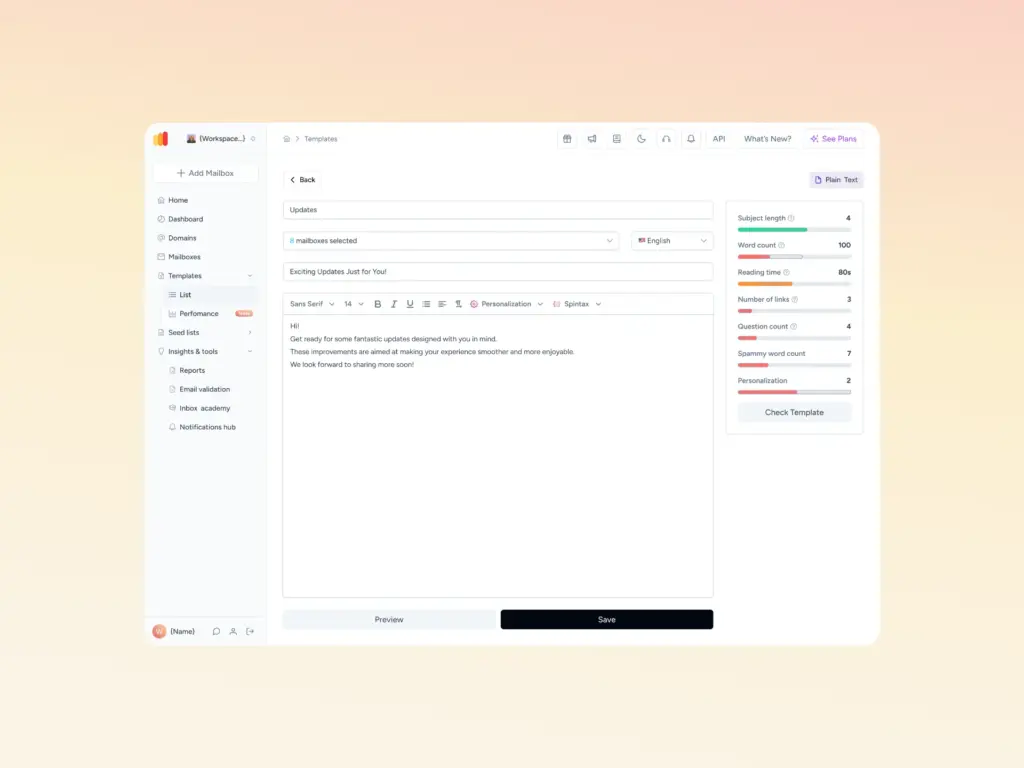
Before any campaign goes out, run subject lines and email copy through Warmy’s Email Template Checker to catch promotional language and spam triggers before they reach a filter.
Subject Line Patterns Worth Testing
- Benefit-led: “How [Company] reduced response time by 40%”
- Question format: “Are your emails reaching the inbox?”
- Number-driven: “3 segmentation errors killing your B2B open rates”
- Curiosity with context: “What our top 10% senders do differently”
A/B Test Subject Lines Systematically
Test one variable at a time: length, format, personalization, or framing. Run tests with a statistically meaningful segment (at least 200 contacts per variant) before sending the winner to the full list. Build a running log of results — subject line learnings compound across campaigns.
Best Practice #6 — Use Automation and Behavioral Triggers
Core B2B Automation Workflows
Automation compounds the impact of every other practice on this list. Sending the right message at the right moment, triggered by real behavior, consistently outperforms fixed-schedule broadcast campaigns.
The core workflows every B2B program should have running:
- Welcome sequence: Onboard new subscribers with context about who you are and what to expect
- Lead nurture: Educational sequence aligned to buyer journey stage
- Re-engagement: 90-day silence triggers a win-back sequence before you suppress the contact
- Post-demo follow-up: Personalized follow-on content based on the demo conversation
- Trial or onboarding: In-product activity triggers contextually relevant emails
For a deeper look at how email sequencers and ROI connect in practice, the link covers sequence frameworks built for B2B conversion.
Behavior-Based Triggers That Outperform Drip Sequences
Static drip sequences send on a fixed schedule regardless of prospect behavior. Behavioral triggers respond to what actually happened: a prospect who viewed your pricing page three times in a week should receive a different email than one who opened your last newsletter and moved on. Behavioral triggers create relevance at the moment of peak interest.
AI-assisted personalization at scale now makes it possible to dynamically generate email copy based on CRM data, browsing behavior, and segmentation rules, without manual customization per contact.
Best Practice #7 — Get the Copy and Design Right
Plain Text vs. HTML in B2B
Plain text emails consistently outperform heavily designed HTML in cold outreach and early-stage nurture sequences. They look like messages from a person, not a marketing platform, which is exactly the impression a first-touch B2B email should create. HTML templates work better for newsletters, product updates, and later-stage campaigns where the brand relationship is already established.
Writing Copy That Speaks to Decision-Maker Priorities
B2B buyers are evaluating business outcomes, not product features. Copy that leads with specific ROI metrics, problem-solution logic, and customer proof outperforms copy that describes capabilities.
For examples of high-converting B2B emails, the link covers copy structures proven to move pipeline at each stage of the funnel.
Keep body copy concise. Three to five short paragraphs with a single clear CTA outperforms a long email with multiple competing asks. Every sentence should earn its place.
Mobile-First Design and CTA Placement
The majority of B2B emails are now opened on mobile devices. If your email requires pinching to read, your conversion rate suffers before the prospect reads a word. Use a single-column layout, 14px minimum body font, and CTAs that are easy to tap without zooming.
Place your primary CTA above the fold where possible and repeat it at the end of the email. One email, one CTA. Competing links dilute click intent and complicate attribution.
Best Practice #8 — Optimize Send Timing and Frequency
Best Days and Times for B2B Sends
Mid-week sends generally outperform Monday and Friday in B2B, and morning hours tend to see stronger engagement as professionals work through their task list. That said, optimal timing varies by industry, role, and geography. Your own engagement data will always be more reliable than any general benchmark.
Finding the Right Cadence: Relevance Beats Frequency
Over-sending is a larger deliverability risk than under-sending. High frequency to an audience that is not engaging increases spam complaints, drives unsubscribes, and generates the negative engagement signals that inbox providers weigh heavily.
Start conservative: one to two emails per week for active sequences, one to two per month for nurture tracks. Monitor engagement rates, not just sends. When engagement drops, reduce frequency before you change content.
Letting Engagement Data Guide Your Schedule
Use send-time optimization tools to analyze when individual contacts historically open and click, then schedule sends accordingly. Contacts who respond to evening sends should receive evening sends. Contacts on your unengaged re-engagement list should receive less frequent sends until they show signs of renewed activity.
Best Practice #9 — Stay Compliant with GDPR and CAN-SPAM
Opt-in Documentation and Consent Records
GDPR requires documented consent for contacts in the EU, and CAN-SPAM requires clear sender identification and a functional opt-out mechanism for US recipients. In 2026, compliance is not just a legal obligation: it is a deliverability signal. Inbox providers reward programs with clean consent records and punish those with high complaint rates.
Maintain records of how and when each contact opted in. For EU contacts, document the specific consent mechanism, the date, and the IP address where applicable.
Unsubscribe Handling That Protects Your Reputation
An easy unsubscribe is not a loss. It is a cleanup. A contact who unsubscribes stops counting against your engagement rates. A contact who cannot find the unsubscribe link presses “Mark as spam” instead, which damages your sending reputation with every occurrence.
Process unsubscribes immediately, within 10 business days at absolute maximum (CAN-SPAM) and within 30 days under GDPR. For a full breakdown of how unsubscribe link management affects deliverability, the link covers both the compliance and the reputation angle.
Key 2026 Compliance Requirements B2B Marketers Must Know
Google and Yahoo tightened bulk sender requirements in 2024 and Google enforced stricter policies in late 2025. Requirements include: valid SPF and DKIM authentication, a functional DMARC record at minimum p=none, a one-click unsubscribe mechanism, and a spam complaint rate below 0.10%. These rules apply to senders pushing more than 5,000 emails per day to Gmail accounts, but following them improves deliverability for all senders at any volume.
Best Practice #10 — Protect Your Sender Reputation and Deliverability
Why Great Content Is Useless If It Lands in Spam
A significant share of marketing emails never reach the inbox at all, landing in spam or being filtered before a prospect ever sees them. Every other practice on this list depends on your emails arriving first. Deliverability is not an afterthought. It is the prerequisite.
Authentication Fundamentals as Non-Negotiable Infrastructure
SPF, DKIM, and DMARC are the three authentication protocols that tell inbox providers you are who you claim to be. Authentication sets the floor — it confirms identity — but engagement signals determine final inbox placement. For Google’s current bulk sender requirements, the official Google bulk sender policy covers all current thresholds.
List Hygiene, Bounce Management, and Inbox Placement Testing
Keep bounce rates low by suppressing hard bounces immediately and running list verification regularly. A pattern of high bounces signals list health problems to inbox providers and accelerates reputation decay.
Inbox placement testing shows you where your emails actually land across Gmail, Outlook, and Yahoo before you send to your full list. Running placement tests at the campaign planning stage, not after a failed send, is the only way to catch deliverability issues before they cost you pipeline.
Pro Tip: Use Warmy’s free email deliverability test to check your domain’s inbox placement, blacklist status, and authentication records before every major campaign. Five minutes of testing can save weeks of sender reputation recovery.
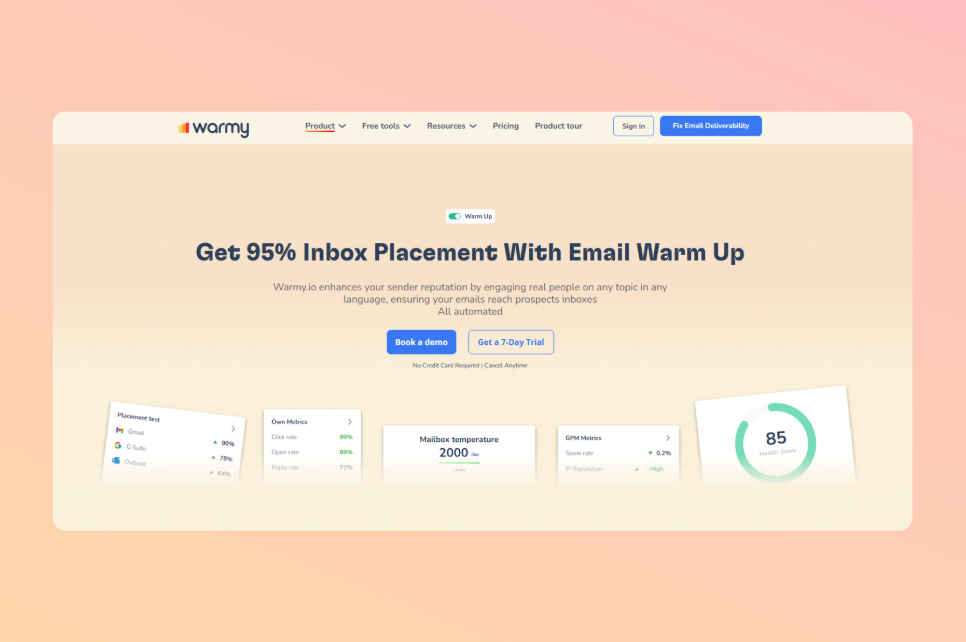
Already passing your deliverability checks? The next step is protecting your sender reputation long-term. Warmy’s email warm-up automatically builds and maintains your domain’s reputation with inbox providers — so your campaigns land where they’re supposed to, every time.
How to Measure B2B Email Marketing Success
Core Metrics That Actually Reflect Performance
| Metric | What It Measures | Why It Matters in 2026 |
|---|---|---|
| Open rate | Reach (treat as directional only) | Inflated by Apple MPP — use as a trend signal, not absolute truth |
| Click-through rate | Engagement quality | More reliable than opens — shows real content interest |
| Reply rate | Intent and conversation | Strongest signal of genuine interest in B2B cold outreach |
| Bounce rate | List health | Rising bounces damage sender reputation quickly |
| Unsubscribe rate | List fit and frequency | Spikes signal audience mismatch or over-sending |
| Conversion rate | Pipeline contribution | The metric that connects email activity to revenue |
Why Opens Alone Are Misleading in 2026
Apple Mail Privacy Protection pre-loads tracking pixels before a recipient views an email, which inflates open rate data across every platform. Open rates remain useful as a directional trend across segments, but click-through rate, reply rate, and email-attributed revenue are the primary performance indicators to track in 2026.
Building a Continuous Test-Measure-Optimize Loop
Treat every campaign as a data source. Track which subject lines, CTAs, content types, and send times generate the most clicks and conversions. Build a testing calendar that isolates one variable per send. Over quarters, these incremental learnings compound into a measurably stronger program.
How Warmy Helps You Follow All 10 B2B Email Marketing Best Practices
Email Warmup and Domain Reputation: The Foundation for Practice #10
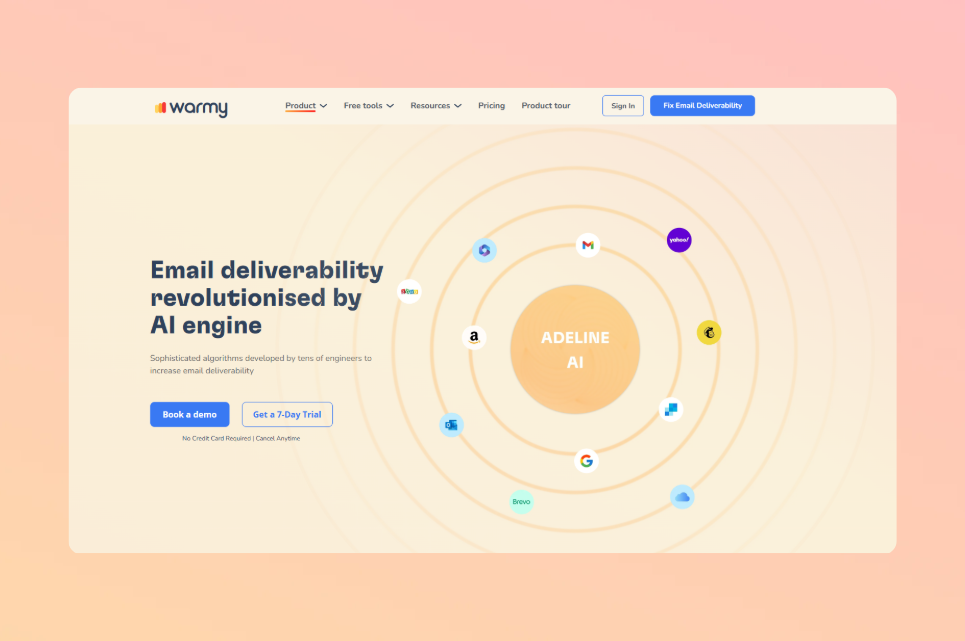
Warmy is an AI-driven email warmup and deliverability platform built to give B2B senders the infrastructure their programs depend on. The Adeline AI engine powers the warmup process, analyzing domain age, mailbox history, and sending behavior to adapt the warmup pace automatically. Rather than following a fixed ramp-up schedule, Adeline responds to how your domain performs in real time.
Warmup runs through real peer-to-peer interactions. Its network opens, replies to, and marks emails as important if they land in spam, generating the positive engagement signals inbox providers weight most heavily. Warmy’s warmup network scales to millions of warmup emails per day, making it the most capable platform in the category for high-volume senders and agencies.
Free Tools That Support Practices #1 Through #9
Warmy’s free tool suite eliminates the need for separate platforms at each stage of a B2B email program:
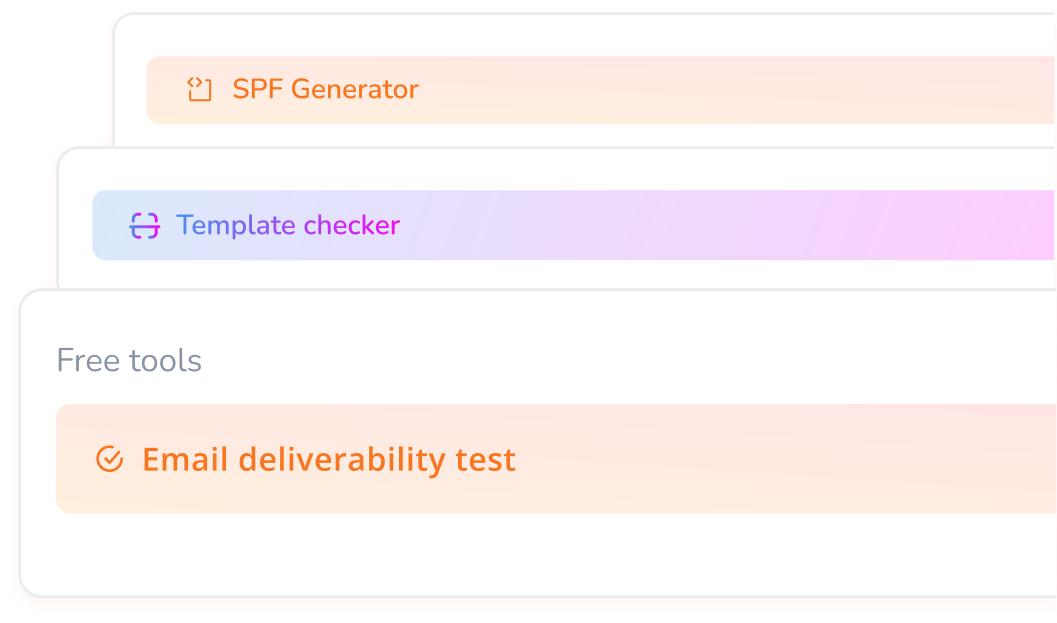
- Free Email Deliverability Test: Checks inbox placement across Gmail, Outlook, and Yahoo, blacklist status, and authentication records in one diagnostic run (Practice #10)
- Mailbox Calculator: Calculates the right number of mailboxes for your sending volume so you scale without burning your sender reputation (Practice #10)
- SPF Generator: Creates a correctly formatted SPF record for your domain without requiring DNS expertise (Practices #9 and #10)
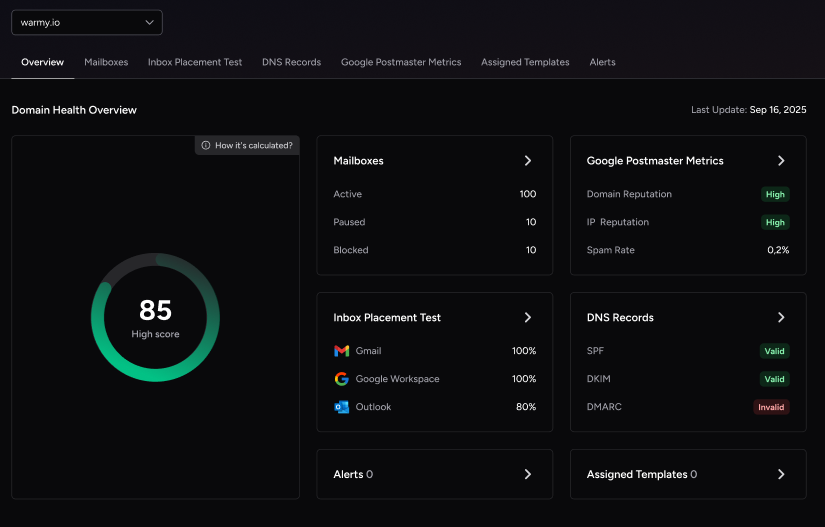
- Domain Health Hub: Real-time monitoring of SPF, DKIM, DMARC status, blacklist presence, and domain reputation signals, all in one dashboard (Practices #9 and #10)
- DMARC Generator: Generates a valid DMARC record through a guided four-step setup, no raw DNS knowledge needed (Practice #10)
Who Warmy Is For
B2B marketing teams managing newsletter and nurture campaigns, B2C businesses, SDR teams running cold outreach, agencies managing deliverability for multiple clients, and growth teams scaling into new domains — all benefit from the same infrastructure layer. Any team relying on email to generate pipeline needs sender reputation protected before the campaign work begins.
For teams that need to validate inbox placement across a controlled set of real addresses before scaling, Warmy’s Seed List provides a curated network of real mailboxes spanning Gmail, Outlook, Yahoo, and other major providers. Instead of discovering placement failures after a live send, you test against a representative slice of your actual audience — seeing exactly where your emails land, which authentication signals are flagged, and which providers are filtering you out. It is the infrastructure check that runs before the campaign does.
Conclusion
B2B email marketing in 2026 rewards precision at every layer. Quality lists, deep segmentation, genuine personalization, buyer-journey alignment, strong subject lines, behavioral automation, sound copy and design, smart timing, compliance, and protected sender reputation do not work in isolation. Each practice strengthens the others. A perfectly personalized email means nothing if it lands in spam. Great deliverability is wasted on a message sent to the wrong audience at the wrong stage.
The teams generating the strongest B2B email ROI treat all ten practices as a single system, not ten separate projects. Start with your deliverability foundation, because everything else depends on it.
Book a demo to see how Warmy’s AI warmup, Domain Health Hub, and monitoring tools work together to protect your pipeline.