
TL; DR:
- Email domain warmup for fintech companies takes 2–6 weeks.
- Domains with prior sending history are ready in 2–3 weeks while brand-new or dormant domains need 4–6+ weeks.
- Start with fewer than 20 emails per day, increase by 30–50% weekly, and authenticate with SPF, DKIM, and DMARC before sending your first email.
- Don’t forget to keep an eye on your engagement metrics as the warmup progresses.
- The fintech sector is highly regulated, given the sensitive and confidential data at hand. Thus, understanding the time it may take to warm up domains is crucial. Starting too hot, or too fast, is detrimental to your email deliverability process.
Why is email domain warmup critical for fintech companies?
For fintech businesses who work in a highly regulated and sensitive area, reputation is crucial. Gmail, Outlook, Yahoo, and other mailbox providers have advanced algorithms that assess sender reputation and decide which emails make it to recipients’ inboxes. To prevent scams and fraud, emails are then subject to review to verify if they are from trustworthy, reliable, and reputable senders.
According to the latest email deliverability benchmark by Digital Bloom, the fintech industry is reported to have a total spam rate of 6.2%. It’s an industry where trust is everything and regulations are strict, which means deliverability issues can pose bigger threats far more than open rates. Email warmup sets the foundation for responsible sending: maintaining integrity, staying compliant, and ensuring the right messages reach the right people.
Protection against financial phishing risks
From account verification emails and transaction confirmations to fraud alerts, regulatory disclosures, and product announcements, fintech companies rely on email to deliver time-sensitive, high-stakes information. So when those emails do not reach the inbox, the consequences can pile up as they affect compliance, customer trust, and even revenue.
Phishing and spoofing attacks targeting financial services are on the rise. To further describe exactly how big of a threat we’re talking about, here are some of the statistics from AAG’s latest report:
- The average cost of a data breach against a company exceeds $4 million.
- Google thwarts some 100 million phishing emails each day.
Additionally, 74% of organizations reported email phishing as the top method of attack, and the financial service and SaaS platforms accounts for 60% of these attacks.
With such numbers, it’s no wonder that ESPs and businesses in general are taking even more draconian measures towards security and filtering. Due to such strong policies, legitimate email senders can be categorized as spam or suspicious.
This is where email warmup comes in: it helps you build a good and trusted sender reputation.
When your domain consistently sends reputable, highly-engaged emails through a legitimate warm up process, email service providers are more able to recognize that your messages are authentic and not spoofed or malicious. This also lowers the possibility of your emails being confused for phishing ones, which can save both your and your recipients’ brand from fraudulent activities.
Ensures compliance with email regulations
Fintech companies must also navigate strict email marketing and communication regulations such as the General Data Protection Regulation (GDPR) in Europe and the CAN-SPAM Act in the United States. These laws require clear consent from recipients, transparent communication practices, and easy unsubscribe options.
Proper domain warmup supports compliance by encouraging responsible sending patterns that reduce spam complaints and respect user preferences. It ensures that your emails are more likely to be welcomed by recipients and that your agency or company avoids legal risks associated with unsolicited or poorly managed email campaigns.
Not sure about your current deliverability? Test it now with our free email deliverability test.
How does email domain warmup for fintech work?
Email warmup is the practice of gradually increasing your sending volume from a new or inactive domain over a period of weeks. Instead of blasting 50,000 emails on day one, you start by sending a small number of emails each day and slowly scale up. This gradual approach allows inbox providers to observe your sending behavior, track recipient engagement, and assign your domain a positive reputation score.
Inbox providers use sophisticated algorithms to assess every sender to confirm which emails are actually spam and which ones are legitimate.
Key factors include:
- Sending volume and consistency: sudden spikes trigger spam filters
- Engagement signals: opens, clicks, and replies indicate recipient interest
- Bounce rates: high bounces suggest poor list hygiene
- Spam complaints: even a small number can damage your reputation quickly
- Email Authentication records: missing SPF, DKIM, or DMARC is a red flag
New domains often fall under the category of spam due to the lack of email deliverability testing and domain warmups. Tools like Warmy.io allow you to confirm if your emails are landing in spam.
Typical timeline to warm up an email domain in fintech
Warming up a new email domain is not an exact science as various factors influence the time it takes to build a solid sender reputation. However, having a clear estimate helps fintech companies plan outreach campaigns, set realistic expectations, and avoid costly deliverability setbacks.
Generally, warming up a domain takes between two to six weeks, but this timeline can extend depending on specific circumstances.
Standard warmup duration (2 to 6 weeks)
Domains that already have a sending history warm up faster (2-3 weeks) due to established reputation, while brand-new or dormant ones require 4-6+ weeks to avoid spam triggers.
|
Domain Type |
Duration |
Daily Volume Ramp |
Key Practices |
|
Prior Reputation or Moderate History |
2-3 weeks |
Week 1: 10-25 Week 2: 25-75 Week 3: 75-150+ |
|
|
Brand New/Dormant |
4-6+ weeks |
Days 1-7: ≤10 Days 8-21: 10-50 Weeks 4-6: 50-200+ |
|
The Warmy Research Team released a comprehensive report on different email platforms and diverse domain configurations and how they affect warm-up. Access the complete report here: The Science and Process of Warming Up Newly Created Email Domains
Factors that can extend email domain warmup time for fintech
There are a few reasons why it might take longer for a fintech email domain to get warmed up properly. Knowing these will enable you to better plan and not fall into the same traps that slow down trust on the inbox provider side.
Strict financial compliance requirements
- Fintech communications are heavily regulated to protect consumers and prevent fraud.
- Inbox providers also apply heightened scrutiny to emails from financial sectors, often enforcing stricter filtering rules.
- This means your email warmup process must be slower and more deliberate to demonstrate compliance and build trust gradually without triggering spam filters.
Low initial engagement
- Email providers rely heavily on user engagement signals such as opens, clicks, and replies to assess sender reputation.
- If your early warmup emails fail to engage recipients, providers may hesitate to increase inbox placement or allow higher sending volumes.
- Maintaining relevant and personalized content during warmup is crucial to encourage positive interactions.
Previous reputation issues or blacklisting
- Domains or IP addresses with a history of poor deliverability, spam complaints, or inclusion on blacklists require additional time to regain trust.
- Providers track past behavior. Any negative record can significantly slow down the warmup process as you rebuild your sender reputation from the ground up.
Volume and frequency mismanagement
- Rapidly increasing email volume or sending inconsistent amounts can raise red flags with inbox providers. Sudden spikes in volume are often interpreted as spam-like behavior.
- Proper warmup requires carefully controlled, incremental volume increases paired with consistent sending schedules to avoid penalties.
Mailbox provider (e.g., Gmail, Outlook)
- Different mailbox providers have varying filtering algorithms and tolerance for new senders.
- For example, Outlook’s filters may be stricter compared to others, affecting the pace at which your emails gain trust and achieve inbox placement.
Content quality and engagement
- High-quality, relevant email content fosters recipient engagement, which positively influences sender reputation.
- Low-quality or irrelevant content can lead to higher spam complaints or unsubscribes, lengthening the warm-up timeline.
Not sure if your email content triggers spam filters? Try Warmy’s free Template Checker before you send out your campaigns.
Technical setup (SPF, DKIM, DMARC)
- Proper email authentication through SPF, DKIM, and DMARC is foundational.
- Incorrect or missing configurations increase the chance of emails being flagged as suspicious or rejected, requiring a longer warmup to overcome these technical barriers.
- These authentication layers are often integrated during fintech app development to ensure secure and scalable communication systems.
What happens if you skip or rush warmup for fintech?
The cost of skipping warmup is not hypothetical. It results in a sequence of consequences that can take far longer to recover from than the warmup itself would have taken.
Increasing spam folder placement
When inbox providers see a sudden volume spike from an unestablished sender, they may route emails to the spam folder by default. For fintech companies sending time-sensitive emails or fraud alerts, this means your customers may miss these crucial communications.
Inclusion in blacklists
When recipients receive unexpected bulk email, spam complaint rates may spike. If complaints continue, your domain or sending IP can be added to industry blacklists. Once listed, your emails are blocked or rejected by mail servers that reference those lists, often without any notification to you or your recipients.
Revenue will take a hit
The business impact is direct. For fintech companies using email to drive account activations, loan applications, card sign-ups, or investment onboarding, even a 15–20% reduction in inbox placement translates to meaningful lost conversions.
Brand and regulatory damage
In financial services, trust is the product. When customers report your emails as spam, the implicit signal is that your brand is untrustworthy. For regulated entities, this can attract scrutiny from financial authorities concerned about consumer communication standards.
Recovery timeline and cost
Recovering from damaged domain reputation typically takes 3–6 months. It may require new IP addresses, subdomain restructuring, or in severe cases, a new sending domain entirely. Factor in lost pipeline during the recovery period, IT remediation costs, and the staff hours spent managing the fallout. The math strongly favors doing the email warmup correctly the first time.
Best practices for warming up a fintech email domain
- Start low and slow. Begin at 20–50 emails per day. The first week is not about reaching your audience right away. It is more about establishing that your domain sends consistent, legitimate email to recipients who want it.
- Scale gradually based on metrics. Increase your daily volume by 30–50% each week, but only if your metrics support it. Keep spam complaint rate below 0.1%, bounce rate below 2%, and open rate above 20%. If any metric slips, pause and investigate before scaling further.
- Lead with your most engaged recipients. Your warmup audience matters as much as your schedule. Start with recent opt-ins, active customers, or anyone who has engaged with your brand in the past 90 days. High early engagement compresses the warm-up timeline and builds a stronger reputation foundation.
- Send personalized and relevant content. Generic batch-and-blast email underperforms during warmup. Reference the recipient’s specific account activity, a product they explored, or a relevant financial update.
- Send at consistent times. Same approximate time each day, no multi-day gaps followed by sudden volume spikes. Consistency tells inbox providers you are a legitimate operation with a real audience and a regular communication cadence.
- Monitor metrics daily. Check inbox placement rate, spam complaint rate, bounce rate, and engagement metrics every day during the warmup process. Problems caught early can be corrected before they cascade. Problems caught late or after complaints spike or blacklisting occurs are far more costly to fix.
- Use automation to remove the manual burden. AI-powered email warmup platforms like Warmy.io manage your schedule, simulate real engagement, and monitor reputation signals automatically. They reduce the daily manual effort required to run a disciplined warm-up and respond to changes in your deliverability data faster than any human team realistically can. For fintech teams with limited bandwidth and high compliance obligations, automation is the most practical path to a reliable warmup.
Technical requirements before starting warmup
SPF Record
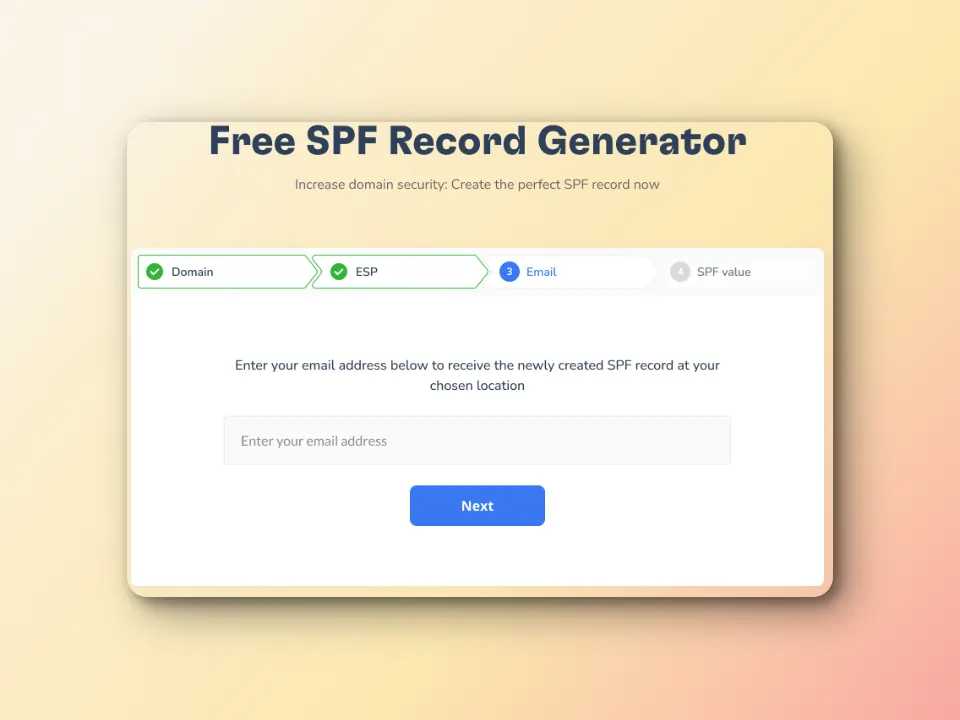
Sender Policy Framework (SPF) is a DNS record that tells inbox providers which mail servers are authorized to send on behalf of your domain. Without it, there is no way for providers to verify your emails are legitimate. Set it up first with Warmy’s free SPF Record Generator.
DKIM
DomainKeys Identified Mail (DKIM) adds a cryptographic signature to each outgoing email, allowing providers to confirm the message has not been altered in transit. Gmail and Yahoo require DKIM for bulk senders. It is non-negotiable.
DMARC
DMARC (Domain-based Message Authentication, Reporting & Conformance) builds on SPF and DKIM by specifying what inbox providers should do with emails that fail authentication — quarantine them, reject them, or report them.
Start with p=none (monitoring mode) to collect data, then move to p=quarantine or p=reject as your sending matures.
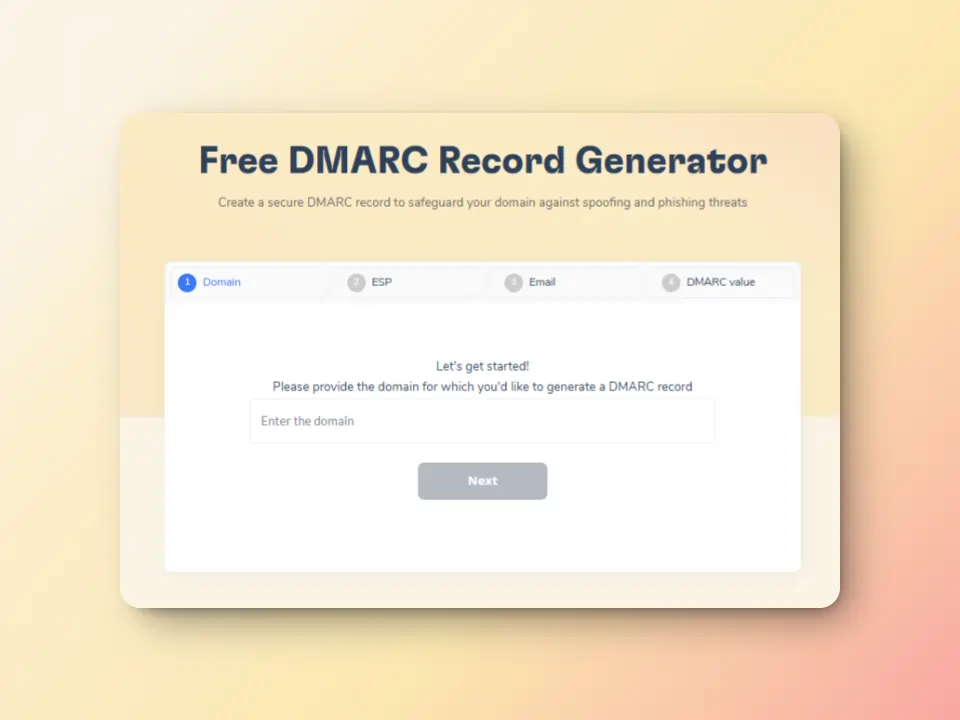
For fintech companies, DMARC is increasingly a regulatory expectation, not just a deliverability best practice. Check out Warmy’s free DMARC generator.
BIMI (Recommended)
Brand Indicators for Message Identification (BIMI) displays your company logo next to your emails in supported inboxes. It requires a valid DMARC policy of p=quarantine or p=reject, so it also incentivizes proper DMARC implementation. In fintech, where brand recognition drives email open rates, BIMI is a meaningful conversion lever.
Blacklist and reputation checks
Before starting warmup, run your domain and send IPs through blacklist lookup tools (MXToolbox is a common starting point). If you are already listed, request removal and resolve the root cause before warming up. Warming up a blacklisted domain without first addressing the listing is a waste of time.
What are the warmup metrics to monitor?
Track all of these daily during warmup. If multiple metrics deteriorate simultaneously, stop sending and audit your list, content, and sending infrastructure before resuming.
|
Metric |
Target |
Why It Matters |
|
Inbox Placement Rate |
> 95% |
The core measure of warmup success. It answers the question: are your emails reaching the inbox? |
|
Spam Complaint Rate |
< 0.1% |
Gmail and Yahoo’s enforced threshold; exceeding it triggers automatic filtering |
|
Bounce Rate |
< 2% |
High bounces signal poor list hygiene and damage sender reputation |
|
Open Rate |
> 20% |
Confirms recipient engagement and that emails are reaching the inbox |
|
Click Rate |
> 2% |
A stronger engagement signal than opens; weighted more heavily by some providers |
|
Reply Rate |
> 0.5% |
The strongest positive engagement signal recognized by inbox providers |
|
Spam Trap Hits |
0 |
Any hit is a serious red flag; investigate immediately and pause sending |
|
Blacklist Status |
Not listed |
Check daily across Spamhaus, Barracuda, and Microsoft’s lists |
How Warmy.io helps fintech companies warm up faster with less manual work
Warmy.io is purpose-built for email warmup, with features that address email deliverability challenges that fintech companies face. Some of its features are:
AI-driven warmup process with customizable features
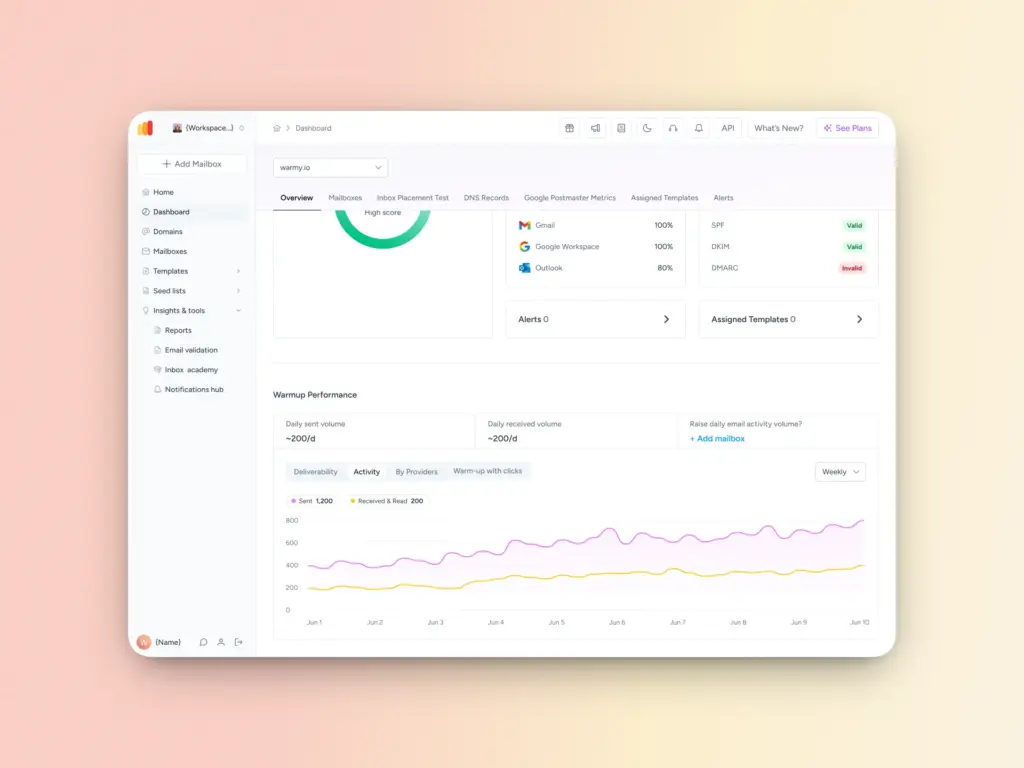
Warmy.io uses artificial intelligence to create personalized warm-up schedules tailored to your domain’s age, sending history, and compliance needs. You can choose from over 30 languages.
The Warmup Preferences feature allows senders to customize the warmup distribution across providers and select B2B engagement patterns over B2C. This allows you to align warmup emails with your fintech brand voice and regulatory requirements.
Real mailboxes, real interactions, real results
Unlike automated bots or fake accounts, Warmy’s warmup network is composed of real email addresses. This generates genuine engagement signals such as opens and replies, which inbox providers value highly when assessing sender reputation.
Domain Health Hub
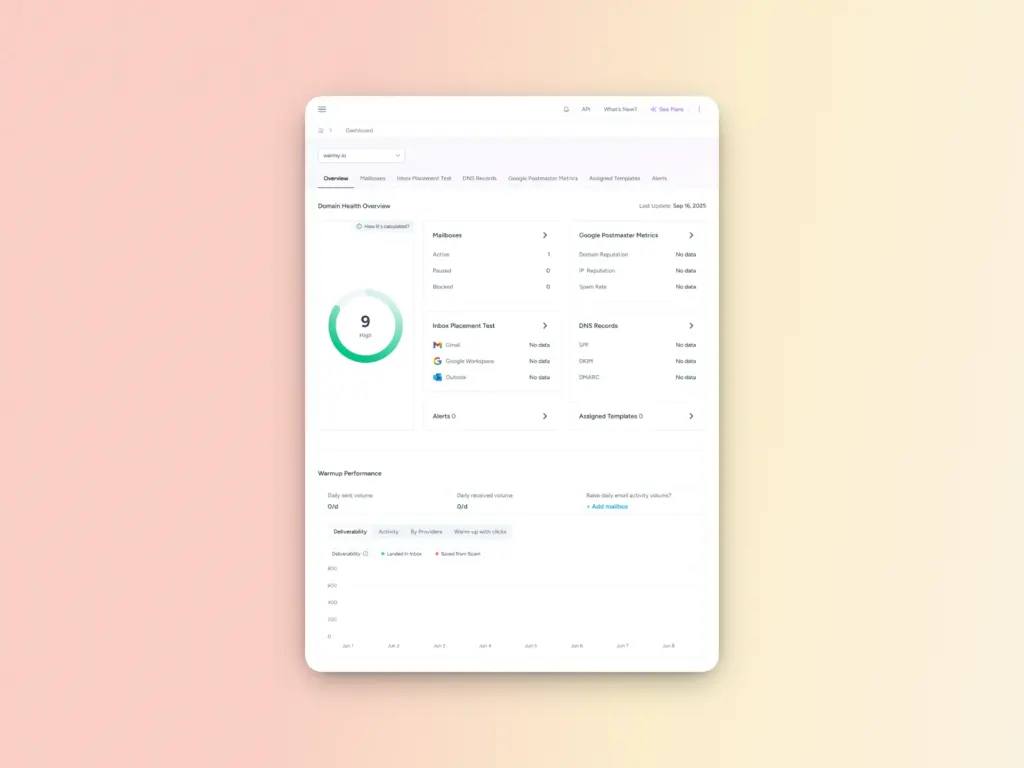
Warmy.io’s Domain Health Hub provides a domain-level health dashboard with the following features:
- A domain health score based on various factors like authentication, blacklist status, and inbox placement tests.
- Weekly and monthly tracking options for spam rate trends and overall deliverability performance
- Comprehensive DNS status checks to easily validate SPF, DKIM, DMARC, rDNS, MX, and A records for stronger authentication & security.
- Optimized multi-domain monitoring so users can manage all their domains from one dashboard and identify which ones need immediate attention.
Built for compliance
Warmy.io supports the full authentication stack (SPF, DKIM, DMARC) required by Gmail and Yahoo’s bulk sender requirements and expected by GDPR and CAN-SPAM compliance frameworks. Warmup activities align with permission-based sending standards, so the platform’s activity does not create compliance exposure while it builds your deliverability.
Start warming up the right way
Email domain warmup is not a technical formality. It is the foundation of a deliverability strategy that protects your revenue, your compliance posture, and the trust your customers place in every email you send.
Here is what you now know:
- Fintech has uniquely high warmup stakes because of regulatory requirements, phishing risk, and the financial consequences of missed communications
- Most domains warm up in 2–6 weeks. Where you land in that range depends on your domain history, list quality, sending consistency, authentication setup, and content
- Skipping or rushing warmup leads to spam placement, blacklisting, lost revenue, and a recovery process that costs far more time than the warmup itself.
- SPF, DKIM, and DMARC must be configured correctly before you send a single warmup email
- Monitoring key metrics daily keeps you in control of the process and lets you catch problems before they cascade
- AI-powered tools like Warmy.io automate the scheduling, engagement simulation, and monitoring that make disciplined warm-up practical for any fintech team
The fintech companies whose emails reliably reach the inbox are not the ones with the biggest budgets. They are the ones who did the groundwork and who use the right tools to maintain it.
Ready to see where your domain stands right now? Start by testing your current email deliverability. Warmy.io’s free deliverability test lets you check your inbox placement rate, authentication setup, and blacklist status in minutes.
If you are ready to start warming up, try Warmy.io free and have your first warmup emails running today.
Not sure where to begin for your specific setup? Book a demo and walk through your domain’s situation with the Warmy.io team. We’ll help you build a warmup plan that fits your sending volume, compliance requirements, and timeline.
FAQ
How long does it take to warm up an email domain for a fintech company?
Most fintech email domains take 2–6 weeks to warm up. Domains with prior sending history are typically ready in 2–3 weeks, while brand-new or dormant domains require 4–6 weeks or more. The exact timeline depends on your domain history, list quality, authentication setup, and how consistently you ramp up volume.
What happens if I skip email domain warm-up?
Skipping warm-up leads to a predictable sequence of problems: immediate spam folder placement, rising complaint rates, and potential blacklisting on services like Spamhaus or Barracuda. For fintech companies, the stakes are higher. Missed fraud alerts, compliance exposure, and lost conversions from emails that never reach the inbox. Recovery typically takes 3–6 months and may require a new sending domain entirely.
What technical setup do I need before warming up a fintech email domain?
You need SPF, DKIM, and DMARC configured correctly before sending a single warmup email. These records verify to inbox providers that your emails are legitimate and unaltered. BIMI is also recommended for fintech companies. It displays your brand logo in supported inboxes and requires a valid DMARC policy at p=quarantine or p=reject to activate.
How many emails should I send per day during warm-up?
Start with 20–50 emails per day in the first week, targeting your most engaged contacts. Increase volume by 30–50% each week, provided your spam complaint rate stays below 0.1%, bounce rate below 2%, and open rate above 20%. Never scale faster than your metrics support.