Email deliverability issues for iGaming operators happen because gambling and casino content triggers stricter ISP filtering than standard marketing email, and affiliate-sourced player lists accelerate domain reputation decay faster than in most other verticals. Fixing it takes proper authentication, a structured warmup period, and ongoing reputation monitoring, not a single setting change.
Why Your Casino Emails Keep Landing in Spam
Your welcome bonus emails are well designed. Your reactivation offers are personalized. And a meaningful share of them still never reach a player’s primary inbox. That’s not a content problem. It’s a reputation problem, and iGaming operators face a version of it that generic email marketers rarely encounter.
Warmy is an AI-driven email warmup and deliverability platform that helps high-risk senders, including casino and betting operators, build the domain reputation ISPs require before they’ll trust bonus, deposit, and retention emails at scale. Before you can fix that reputation gap, it helps to understand why it opens up faster for a casino CRM program than for almost any other sender type. If you want a baseline before reading further, run a free email deliverability test to see exactly where your current campaigns are landing.
Why Gambling Emails Are Different From Regular Email Marketing
Every sender deals with spam filters. iGaming operators deal with a second, parallel layer: content-based filtering that specifically flags gambling terminology, regardless of how clean your list is or how strong your authentication looks.
Mailbox providers score email using two broad signal types: who is sending (domain and IP reputation, authentication, sending history) and what is being sent (subject lines, body copy, structure). For most B2B or retail senders, the “who” carries most of the weight.
For casino and betting operators, the “what” matters more than it should, because words like “bonus,” “free spins,” and “deposit match” sit close to language patterns filters associate with financial fraud and unregulated gambling spam. Across all industries, marketing email averages an open rate in the low-to-mid twenties, and gambling-vertical sends routinely underperform that baseline because a portion of the list never reaches the inbox to be opened at all.
Sender-side risk compounds the problem. This is why most mainstream ESPs, including Mailchimp, Klaviyo, and ActiveCampaign, explicitly restrict or reject gambling-related sending in their acceptable use policies, even for fully licensed, regulated operators. It isn’t personal. ESPs share infrastructure across thousands of customers, and one flagged gambling sender can drag down deliverability for everyone else on that shared IP pool. That’s why iGaming CRM teams increasingly run dedicated sending infrastructure paired with a warmup and monitoring layer built to operate outside a shared reputation pool.
What Is Email Sender Reputation, and Why iGaming Operators Lose It Fast
Sender reputation is the score mailbox providers assign your domain and IP based on authentication status, sending history, and how recipients interact with your mail. It’s cumulative, and it decays the moment your engagement signals turn negative.
For a typical B2B sender, reputation erodes slowly. For a casino CRM program, it can erode in a single send. Two mechanics drive this. First, engagement thresholds: Google’s bulk sender guidelines instruct senders to keep their spam rate below 0.3% and ideally under 0.1%, and once a domain crosses that line, Gmail starts routing its future mail to spam by default. Complaint rates run higher on gambling content because recipients who feel over-solicited report it more readily than they unsubscribe.
Second, list composition: affiliate-sourced and co-registration player lists, common in iGaming acquisition, contain a higher share of stale, mistyped, and disengaged addresses than opt-in lists built directly through your own signup flow. Every bounce and every unopened send against that list drags your domain-level engagement rate down, and ISPs weight recent engagement heavily when deciding where your next campaign lands.
The compounding effect is what catches most CRM teams off guard. A domain with no warmup history and a shaky list doesn’t fail gradually, it fails all at once, right when a promotional surge needs to land. You can build domain reputation proactively, but it has to happen before the campaign calendar demands it, not during.
How ISPs Detect and Filter Gambling Content
Beyond content scoring, ISPs and third-party reputation networks maintain infrastructure-level blocklists that operate independently of message content entirely.
The most consequential of these is the Spamhaus Blocklist, a DNS-based blocklist that tracks IP addresses and domains associated with spam and abuse and feeds that data to thousands of ISPs, hosting providers, and enterprise mail systems worldwide. When a receiving server queries Spamhaus and finds your sending IP or domain listed, it can refuse the connection before your email is evaluated at all, no matter how compliant or well-written your content is.
In Microsoft environments this typically surfaces as an explicit bounce code; in Gmail, the signal is quieter, usually a sudden collapse in open rates with no bounce to explain it. You can read more on how a Spamhaus listing affects inbox placement for a breakdown by provider.
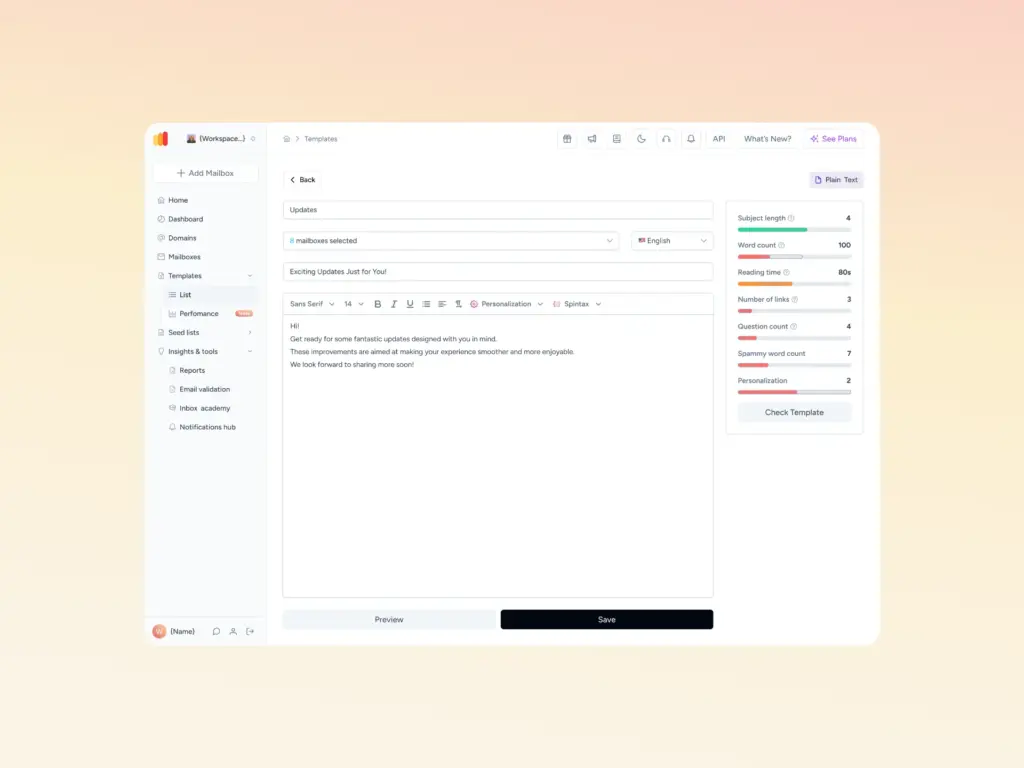
This is the part CRM managers, understandably, find frustrating: a listing isn’t always earned through bad intent. A single promo surge sent too fast from a new domain, or one bad list segment inherited from an affiliate, can trigger a blocklist entry that then throttles every subsequent send. Keep this in mind while reading the practical fixes below. A Template Checker helps with content-level spam triggers, but it can’t undo an infrastructure-level blocklist. Those need separate remediation.
Pro Tip: Before your next major promo send, check your sending domain and IP against Spamhaus directly, not just your ESP’s internal reputation score. ESP dashboards often lag real blocklist status by days.
Generic Email Sender vs. iGaming Sender
| Factor | Generic Email Sender | iGaming Sender |
|---|---|---|
| ESP access | Full access to Mailchimp, Klaviyo, HubSpot, etc. | Restricted or banned by most mainstream ESPs |
| Content risk | Low; standard promotional language | High; gambling keywords trigger extra filtering |
| List source | Typically opt-in, owned | Often includes affiliate and co-registration traffic |
| Reputation recovery time | Days to weeks after an issue | Weeks to months, due to compounding content and list risk |
| Warmup requirement | Recommended for new domains | Effectively mandatory, and ongoing, not one-time |
The 4 Most Common iGaming Email Deliverability Problems (and Their Fixes)
- New domain with no warmup. A fresh sending domain has zero history, so ISPs treat its first high-volume send as suspicious by default. Fix: run a structured warmup period, and see how long domain warmup actually takes before your first real campaign.
- ESP migration reputation drop. Moving providers resets some of your accumulated trust, because the new sending IPs and infrastructure are unfamiliar to ISPs even if your domain isn’t. Fix: re-warm the new infrastructure gradually rather than resuming full volume immediately, and track your sender reputation score through the transition.
- Blacklisting after a promo surge. A sudden spike in send volume around a big promotion is exactly the pattern blocklist algorithms are built to catch. Fix: ramp volume ahead of major promotions instead of spiking on the day, and pair that with continuous warmup activity built for sender reputation rather than a one-off push.
- Affiliate list quality decay. Lists sourced through affiliates and co-registration partners degrade faster than owned opt-in lists, and every unengaged address you keep mailing drags down your domain-level engagement signal. Fix: segment affiliate traffic separately from owned-list traffic, suppress consistently unengaged addresses, and never merge the two into one sending stream.
How to Fix Email Deliverability for a Casino CRM: Step-by-Step
Once you understand why iGaming email fails differently, the fix follows a clear sequence. Skipping steps is what turns a fixable reputation dip into a full blocklist event.
- Check domain reputation first. Before touching content or list hygiene, confirm where you actually stand. A free email deliverability test shows inbox, spam, and unreceived rates across Gmail, Outlook, and Yahoo, plus your current blacklist status and authentication setup in one pass.
- Audit sender list quality. Separate affiliate-sourced and co-registration segments from your owned opt-in list, and remove hard bounces and long-inactive addresses before your next send. For the technical side of authentication, the guide to authentication and inbox warmup covers SPF, DKIM, and DMARC setup step by step, and the free DMARC Record Generator builds a compliant record without the manual guesswork.
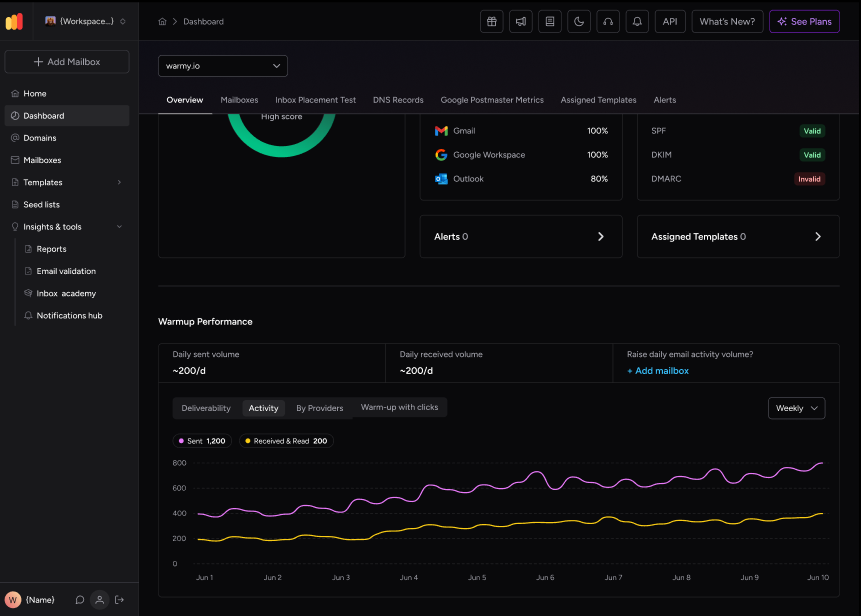
- Warm up the domain properly. New or reactivated sending domains need a gradual ramp with real engagement signals before they carry full campaign volume. This is where an AI-driven email warmup tool does the structural work: it simulates opens, clicks, and replies across a real mailbox network so ISPs see a legitimate sending pattern building before your bonus and reactivation campaigns launch at scale.
Ready to stop guessing where your bonus emails land? Book a demo and see how a warmup and monitoring layer built for high-risk senders protects your next promotional push.
- Run a seed list test before every major send. Big promotions are exactly when a reputation problem shows up publicly. Seed list testing lets you send to a set of real, actively monitored addresses across major providers before you commit to the full player list, so you catch a placement problem before it costs you a live campaign, not after.
- Monitor ongoing, not just before launches. Sender reputation isn’t a box you check once. Track domain health, blacklist status, and engagement trends continuously so a dip gets caught in hours instead of after a quarter’s worth of promotional sends have already underperformed.
Warmy’s Core Features for iGaming Senders
A casino CRM program needs more than a generic warmup tool. Here is what runs under the hood for high-risk, high-volume senders:
- Adeline AI manages warmup pacing and engagement automatically, adjusting to a casino domain’s specific reputation signals instead of running a fixed generic schedule.
- Warmup With Clicks layers real link clicks and Promotions-tab removal on top of standard warmup, the engagement signal Gmail weights most heavily, with a dashboard that shows the click activity directly instead of an unverifiable claim.
- Seed Lists across Gmail, Outlook, and Yahoo let you test a promo template against real, actively monitored inboxes before it reaches your full player list.
- Warmup Preferences let you set the provider split across Gmail, Outlook, M365, Yahoo, and private SMTP, and choose B2B or B2C engagement patterns, so warmup traffic reflects how your actual player base is distributed.
- Blacklist monitoring is built into the Email Deliverability Test, so a Spamhaus or provider-level listing shows up alongside your inbox placement data instead of requiring a separate tool.
- Deliverability Insights dashboard tracks domain health, DNS authentication, and inbox placement trends in one place, so a reputation dip surfaces before it affects a live promotional send.
- A dedicated Customer Success Manager and deliverability expert are assigned to every account, which matters in a vertical where a single promo surge can trigger a blocklist event with no warning.
- Multi-language and topic-based warmup run in 30+ languages, useful for operators sending to players across multiple regulated markets.
Try Warmy Free, Built for iGaming CRM Teams
Warmy is the only email warmup platform with built-in seed list testing, designed for high-volume B2C senders like casino and betting operators. Start your free trial and see where your next campaign actually lands before you send it to your full player list.