Email deliverability is the metric that makes or breaks everything else. Copy, targeting, and automation can all be world-class, but none of it matters if your emails never reach the inbox. It’s why smart marketers tackle email deliverability first, before anything else. And that starts with practices like:
- Email authentication: SPF, DKIM, and DMARC records should be properly set up
- Maintenance of a clean email list: Avoid email bounces by cleaning your email list of inactive or invalid email addresses
- Avoid spam traps: Valid email addresses ESPs use these to catch and punish spammers or those who purchase lists.
- Monitor blacklists: One of the reasons why ESPs are rejecting your emails.
- Domain warmup: A process of gradually increasing your sending volume to build trust with ESPs.
This roadmap walks you through each of these areas so your deliverability strategy grows with your business, not against it. Get this right, and you’ll consistently land in inboxes, drive more opens and clicks, and convert more cold emails into real pipelines.
What email deliverability metrics actually matter?
Before you can fix anything, you need to know what to measure. These are the numbers that provide insights regarding your email performance and the type of improvements you need to work on:
- Open rate: the percentage of recipients who actually opened your email. High open rates mean you’re hitting the inbox and your subject lines are doing their job. Low open rates might mean your emails may be landing in spam, or your subject lines need work.
- Click-through rate (CTR): tells you how many people opened your email and then clicked something. A high CTR means your content is resonating and pushing them towards the next step. A low one means people opened it and felt nothing. This signifies more of a content problem, not a deliverability one.
- Bounce rate: refers to the share of emails that never made it to the recipient’s server. A high bounce rate usually means your list has bad addresses or your email infrastructure has issues. Either way, ESPs notice and they don’t forget.
- Spam complaint rate: is the percentage of recipients who mark your email as spam. Even a small spike here can damage your sender reputation fast and put you on the path to blacklisting. This one compounds quickly, so don’t ignore it.
- Conversion rate: is the bottom line. Are your emails actually getting people to book a call, sign up, or take action? If your conversion rate is low despite solid open and click rates, the problem is usually your offer or your copy—not your deliverability.
The deliverability methodology that actually scales
Deliverability isn’t a box you check once and then forget about it. It’s something you build and maintain regularly. Here’s how to build it the right way.
Step 1: Establish technical authentication
This is non-negotiable. Before you send a single email, your domain needs SPF, DKIM, and DMARC records properly configured. These tell ESPs you’re a legitimate sender and they prevent your emails from being spoofed or flagged before they ever reach anyone.
If you’re not sure where to start, use Warmy’s SPF Record Generator and DMARC Record Generator to automatically generate correctly formatted records. These tools eliminate the guesswork and ensure your authentication is set up right from day one.
Step 2: Warm up by volume stage
Email warmup is the process of gradually increasing sending volume to build trust with email providers. Skipping warmup or rushing through it is one of the most common reasons new domains land in spam. This is especially critical when launching a cold email campaign or setting up a new mailbox.
Here’s how to think about warmup in stages:
| Stage | Timeline | Daily volume | Goal |
| Foundation | Days 1–7 | 10–30 emails/day | Establish baseline reputation |
| Growth | Days 8–21 | 30–100 emails/day | Build engagement signals |
| Ramp | Days 22–45 | 100–300 emails/day | Normalize sending behavior |
| Scale | Days 46+ | 300–1,000+ emails/day | Sustain and expand |
Note that the exact pace depends on your domain age, ESP, and target audience. However, the principle remains the same: increase gradually and keep your engagement signals healthy at every stage.
Warmy’s AI-powered email warmup tool automates this entire process.
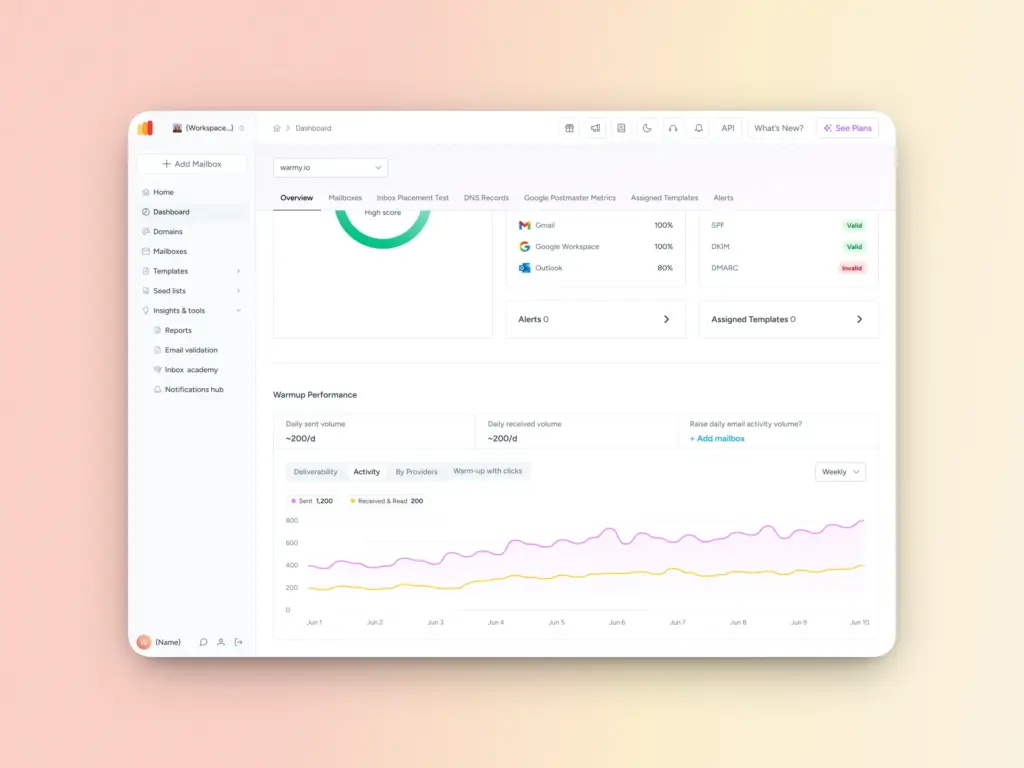
It gradually scales your sending volume with the help of AI. It simulates natural email interactions, and builds trust with ESPs without requiring manual management. With Warmup Preferences, you can tailor your warmup strategy by choosing B2B or B2C engagement patterns, setting frequency, and distributing warmup emails across Gmail, Outlook, and other providers.
Step 3: Build a multi-domain and multi-mailbox setup
Once you’re sending more than a few hundred emails a day, a single domain and mailbox becomes a real liability. ESPs have per-domain sending limits, and concentrating everything in one place is how you get flagged.
The solution is to diversify. Here’s how:
- Use multiple sending domains: Create dedicated outreach domains (like getcompanyname.com or trycompanyname.com) separate from your primary brand domain. If one gets flagged, your main domain stays clean.
- Set up multiple mailboxes per domain: Best practice is no more than 30–50 emails per mailbox per day. Sending 500 emails daily? That’s 10–15 warmed-up mailboxes across 2–3 domains.
- Warm up each domain and mailbox separately: Every new one needs its own warmup period before going live.
- Rotate sending across mailboxes: Spread the load evenly so no single mailbox spikes unexpectedly and triggers spam filters.
This architecture is what separates scalable outreach operations from single-sender campaigns that hit walls at low volume.
Step 4: Keep deliverability healthy while scaling
Getting to good deliverability is one thing. Staying there is another. Here’s what ongoing maintenance looks like:
- Keep your list clean. Sending to invalid or inactive addresses inflates your bounce rate and hurts your sender reputation. Scrub regularly, remove unresponsive contacts, and don’t let your list get stale.
- Avoid spam traps. These are addresses ESPs use to catch senders with poor list hygiene or usually people who bought lists or never clean their data. Stay away from purchased lists entirely.
- Monitor blacklists continuously. If your domain or IP gets blacklisted, your emails are getting rejected often without you knowing. Warmy’s Email Deliverability Test checks your blacklist status, spam score, and inbox placement so you can catch problems before they cost you a campaign.
- Run deliverability tests before every new campaign. Don’t launch blind. Test first, fix what’s broken, then send.
- Use top-tier seed lists as an active deliverability strategy, not just for testing. Warmy’s seed list feature lets you send emails to real mailboxes across Gmail, Outlook, Yahoo, and others so you can specifically target better deliverability across these providers. The seed lists are composed of genuine email addresses that send high-quality engagement signals like opening emails, recovering emails from spam, replying, marking as important, and even clicking on links.
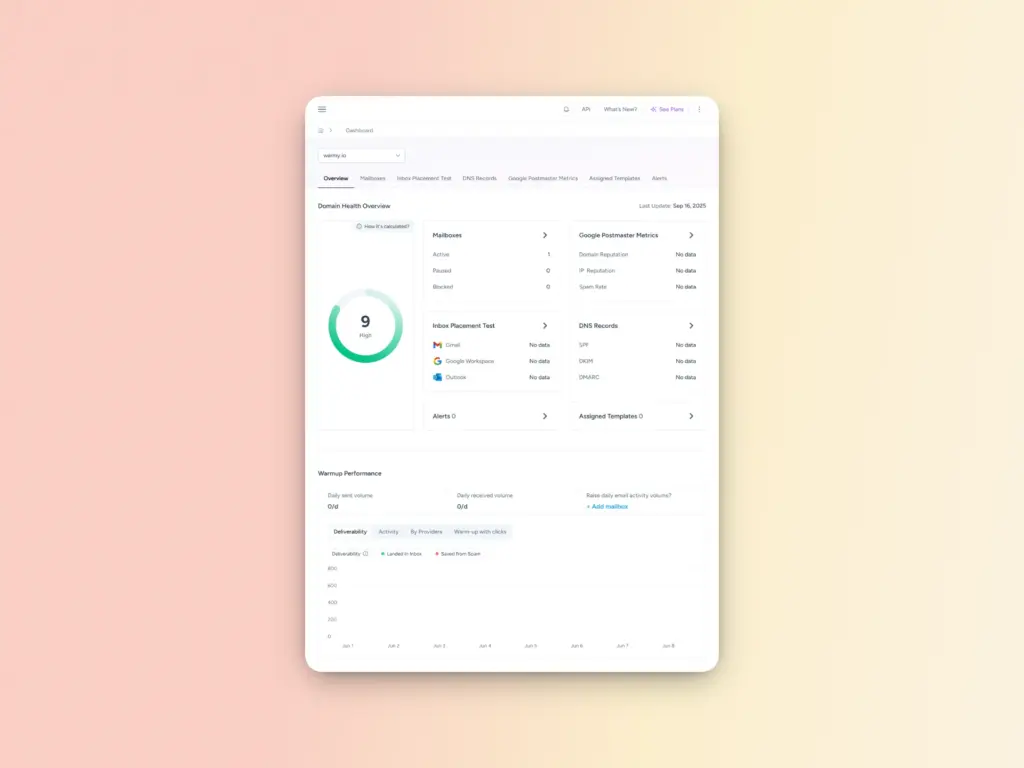
- Monitor domain health on an ongoing basis. Think of it as a dashboard for your sender reputation: authentication status, spam complaint levels, and deliverability scores, all in one place. Warmy’s Domain Health Hub is a great example of this.
The roadmap to getting more opens
Getting into the inbox is step one. Getting people to actually open your email is step two. Here’s what moves the needle:
- Write subject lines that earn the open. Around 43% of recipients decide whether to open an email based on the subject line alone. It’s your first impression so make it count.
- Personalize wherever you can. Even something as simple as using the recipient’s name can meaningfully increase open rates. Don’t skip the easy wins.
- Segment your list. Sending the same message to everyone is a fast way to get ignored. Segmented campaigns can drive up to 760% more revenue than generic blasts.
- Test your send times. Timing matters more than most people think. A well-timed email gets seen. A poorly timed one gets buried. Test different windows and let your audience tell you when they’re most engaged.
- A/B test your subject lines. Don’t guess what works. Simply test it. Small changes in phrasing can have a big impact on open rates.
The roadmap to getting more clicks
Click-through rates (CTR) tell the story of how well your email engages recipients beyond the open. Yes, getting your emails opened is an important first step. However in the end, your cold email campaign is only as good as its ability to drive action. Here is how to boost CTR.
- Ensure mobile optimization. A huge percentage (50-60%) of emails are opened on mobile devices. Emails that are not mobile-friendly will miss out on potential clicks.
- Avoid broken links. Fewer things are more frustrating to recipients than clicking on a link that doesn’t work. Make sure to weekly track and test all hyperlinks in your email copy to be sure that they will lead traffic to the right pages. Not only do broken links cause your CTR to plummet, but they can harm your sender reputation as well.
- Don’t forget to use UTMs for tracking. You can pinpoint which email campaigns generate the most users so you can tweak your strategy accordingly.
- Create strong Calls to Action (CTAs). Use action-oriented language like “Get Started,” “Learn More,” or “Claim Your Offer.”
- Create engaging, relevant content. To increase your click-through rate, your content has to be what your audience wants. Generic messages won’t cut it. Focus on delivering actual value like useful and engaging content. This is also where segmentation comes into play because more personalized content is more likely to get clicks.
The roadmap to getting more sales
The end goal of email marketing is revenue—leads, conversions, signed deals. High conversion rates mean your emails aren’t just landing and being opened, but actually compelling action.
- Automate follow-up sequences. Cold email sequences are one of the highest-leverage tools in outreach. Automated follow-ups nurture leads, remind prospects of your offer, and dramatically increase conversion rates over time.
- Use social proof. Testimonials, case studies, and reviews build trust and lower the perceived risk of saying yes. Include them or link to them.
- Lead with benefits, not features. Speak directly to your recipient’s pain points and show them how your product solves a specific problem they have.
It’s time to rake in more opens, clicks, and sales with Warmy.io
This roadmap covers the critical areas that email senders absolutely need to nail when working to improve email performance. With these strategies, you’ll be able to accelerate and scale your email outreach without being stuck in limbo.
Of course, email deliverability provides the foundation for email success. No amount of optimizing for opens, clicks, and sales will help you reach your business goals if your emails aren’t landing in inboxes.
Don’t let poor deliverability stand in the way of your success—start optimizing your email strategy today and see the difference in your open rates, click-throughs, and sales. Check out your free trial with Warmy today and start scaling your outreach and growing your pipeline.
FAQ
What is email deliverability and why does it matter?
Email deliverability refers to your ability to land emails in a recipient’s inbox rather than their spam folder. It matters because even the best email campaign is worthless if it never reaches the people it’s meant for. Deliverability is the foundation everything else is built on.
How long does domain warmup take?
It depends on your domain age, ESP, and target sending volume but most domains need anywhere from 4 to 8 weeks before they’re ready for high-volume outreach. Rushing the process is one of the most common reasons new domains end up in spam.
How do I know if my emails are landing in spam?
The most reliable way is to run a deliverability test before every campaign. Tools like Warmy’s Email Deliverability Test show you exactly where your emails are landing: inbox, spam, or promotions tab along with your spam score and authentication status.
What’s the difference between a hard bounce and a soft bounce?
A hard bounce means the email address is permanently invalid or doesn’t exist. A soft bounce is a temporary issue like a full inbox or a server being down. Hard bounces should be removed from your list immediately, as repeatedly sending to them damages your sender reputation.
How many email accounts do I need for cold outreach?
It depends on your sending volume, but a good rule of thumb is no more than 30–50 emails per mailbox per day. If you’re sending 500 emails daily, that means 10–15 warmed-up mailboxes spread across 2–3 domains. This keeps your sending patterns natural and protects your deliverability as you scale.