We live in an era of abundant data, when every decision can be technically guided by accurate and up-to-date information. The paradox is that most of us continue to rely on our intuition when making business choices. It just seems so natural to us, assuming our instincts are uniquely reliable and therefore worth trusting.
This is also true for marketers when it comes to sending cold emails. Marketing is a highly creative field; there is no denying that, but creativity in marketing doesn’t have to be blind and, therefore, handicapped.
There are plenty of ways to test cold email subject lines before dissemination, and choosing the right approach can dramatically improve your open rates. Follow this article to learn only the best testing methods that we’ve cherry-picked for you.
Do this before you test a single cold email subject line
Before we dive into the action, it’s worth pausing for a moment to prepare. In particular, there are several things you should do before testing, which will maximize your chances for success.
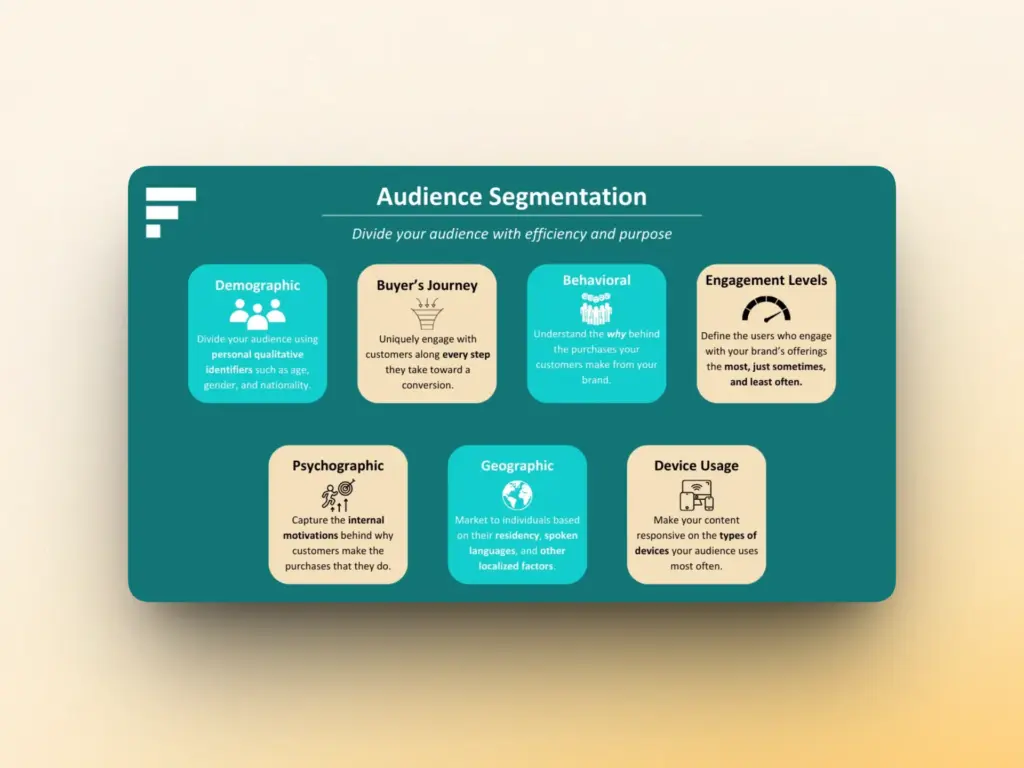
Segment your audience to avoid misleading results
The same subject line may produce different results when shown to different target audiences. For instance, decision-makers (e.g., top management, board members, etc.) will react better to short and result-oriented subject lines. At the same time, potential retail buyers will respond better to promotional and urgency-oriented email titles.
When sending your cold emails, you’ll target specific audiences. So, why not test dissemination based on each segment before going mass and live? Otherwise, you’ll have mixed results, and your testing will produce a lot of noise.
Here are some potential characteristics to consider when grouping your test recipients:
- Job role or seniority level.
- Industry or business niche.
- Company size or growth stage.
- Geographic location or market.
- Previous engagement with your emails.
- Customer lifecycle stage (lead, prospect, client).
Disciplined segmentation will lead to more reliable testing outcomes and better decisions. It’s also a good habit, as you can use the same audience groups or customer profiles in your real outreach and make it more focused and more effective.
Source: Fourfront
Write subject line variations based on one clear hypothesis
Another useful technique that often precedes testing is a hypothesis approach to subject line variations. Don’t be scared of the name; it’s just a fancy way of saying that your subject lines must pursue clear goals.
For example, you may assume (hypothesize) that your top decision-makers would prefer shorter subject lines. For the same token, adding personalization should lead to higher open rates. These are assumptions, seemingly obvious and self-explanatory at first glance, but it’s important to have them.
A hypothesis-driven approach helps you isolate variables and understand what truly impacts open rates. With a strong hypothesis, you’ll clearly know what you want to test and what specific outcome you want to achieve.
This technique best works when applied incrementally, i.e., changing one element at a time, not the whole subject line.
In practice, your subject line hypothesis will focus on these elements:
- Personalization (name, product, brand, company, specific industry).
- Length (short vs. detailed subject lines).
- Tone (business and formal vs. casual or conversational).
- Urgency or time-sensitive language (only 5 products left in stock, discount valid for two days).
In addition, you may alternate between question and statement-based subject lines. Use a dry or conversational style, add humor, or a curious fact to grab attention.
Make a list of hypotheses that you want to test and be ready to deploy relevant subject lines during testing.
Define test duration and sample size
To get reliable results from testing, define the test duration and the size of your sample in advance. A too-small sample size won’t be representative of the entire recipient/customer group that you’ve identified in the earlier stage. For this exact reason, professional survey agencies always indicate sample size when presenting their survey findings.
Sample size determines how many participants take part in your testing. Test duration defines the length of the test, e.g., an hour, a few days, or even two weeks. Both are important factors in statistics, determining the reliability of the research.
When setting the duration, keep in mind that most email opens happen within the first 24-48 hours of dissemination. Anything shorter than that may give you unreliable data, so don’t set shorter times unless you are pressed for time.
As for the sample size, aim for hundreds of recipients and above. Given that not everyone will respond, the bigger your initial dissemination list, the better. Participation rate of 70% and above is considered to be fully representative of the group, while lower than 50% might signal a problem or a need to run the testing again.
Before running tests, verify that your email sending configuration supports authentication, encryption, and proper message handling to ensure consistent participation across test groups.
Eliminate external factors that can skew open rates
External factors like email deliverability (elimination of technical barriers) or different sending times for different tests can distort the results. Controlling them is about the same success as controlling duration and sample size.
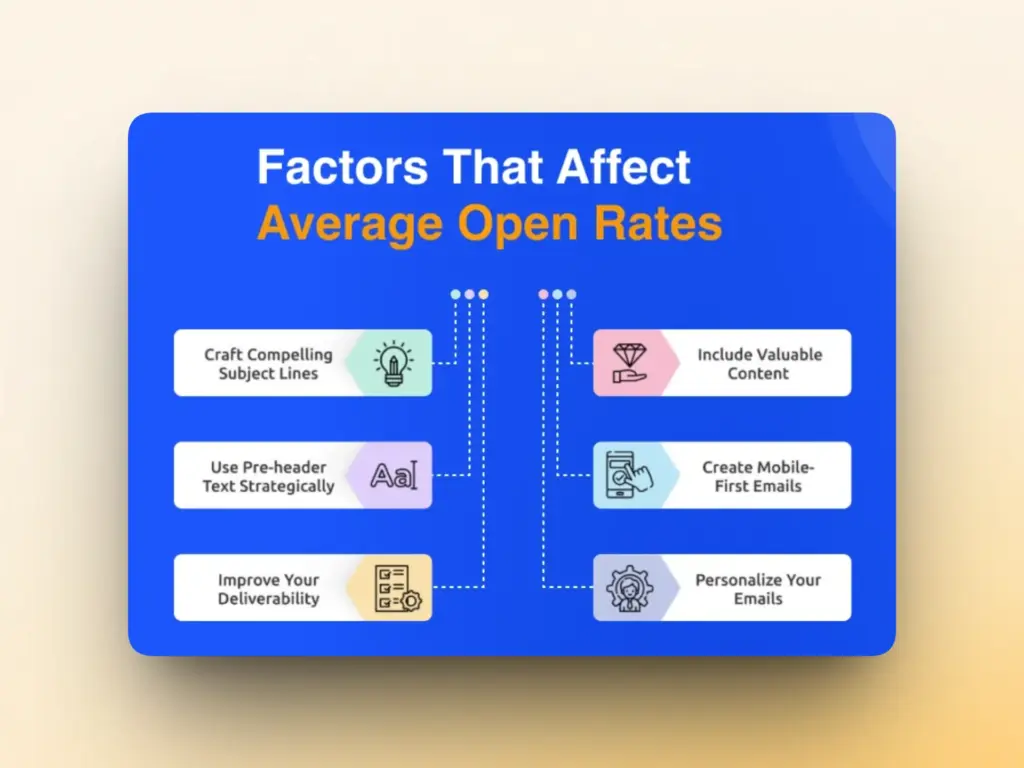
To ensure your future test brings reliable results with minimum distortion, aim to control the following external factors:
- Sending time and day of the week (e.g., late hours work worse than mornings).
- Sender name and email address (reputation, readability, and length all play a role).
- Special occasions like holidays, red-letter days, etc.
- Email content and body structure.
- Email frequency and possible overlap with other email campaigns.
- Technical barriers, such as spam filtering.
Deliverability can also be influenced by your domain’s overall link profile, which is why some teams rely on external support — this service specializes in managing and improving backlink quality to help maintain long-term domain trust.
To sum up, here are all factors that can possibly affect email open rate all in one place:
Source: Bookyourdata
Proven methods to test cold email subject lines
Once all the prerequisites for seamless testing are in place and you clearly know what ideal results you expect (hypothesis), it’s time to do the testing.
1. A/B testing subject lines in live cold email campaigns
A/B testing remains one of the most accessible and effective ways to test cold email subject lines that work in real-world settings. Instead of relying on assumptions, marketers test two variations of a subject line at a time (A and B variants, hence the name A/B testing).
When you do this with each of your audience segments, you can identify what resonates with each segment and works the best, driving engagement and open rate.
Follow these best practices in your A/B testing of live campaigns:
- Test only one variable (e.g., subject line length) at a time to isolate its impact.
- Allocate the same audience sizes across variations of tests (e.g., same size for A and B variants).
- Keep email content identical across all versions, as most testers tend to identify improvement opportunities in texts during long testing and may change some details, which will distort the results.
- Monitor open rates and engagement metrics upon each test iteration.
- Allow enough time for statistically meaningful results (the earlier rule of 24-48 hours of wait time).
It’s important to keep a track record of all the successful variants and apply winning subject lines to your future campaigns.
Also, for consistent testing accuracy, conduct a detailed examination of link-building reports alongside segment engagement data. With backlinks, you’re looking at one step post open rate and measuring the overall impact of your outreach on brand visibility, authority, and long-term campaign performance.
2. Sequential testing to refine subject lines over time
Unlike A/B testing, sequential testing of email subject lines stipulates an incremental, step-by-step testing process, where each new variant is tested for a given period of time.
This method works best for smaller audience groups, where it provides deeper insights into what changes improve performance.
The focus of this testing method can be on refining a tone, length, structure, or particular variation of words.
For maximum efficiency, follow these key steps (best practices):
- Set up a reference point, i.e., your current cold email subject line.
- Brainstorm and shortlist 3-5 variations for each of your audience niche (e.g., for sales, educational, transactional, and other purposes).
- Test each variation at a time (allow at least 24 hours for people to respond).
- Analyze open rates and engagement after each sequence.
- After running all variations, define the best performers and use the obtained insights to improve their next iterations.
It’s important to continuously monitor and document the performance after each sequence. This testing method might be slower than A/B testing, but it gives experienced marketers better results over time.
Rather than prioritizing quick wins, sequential testing provides for continuous learning and incremental improvements for those testers who already know what they want to achieve.
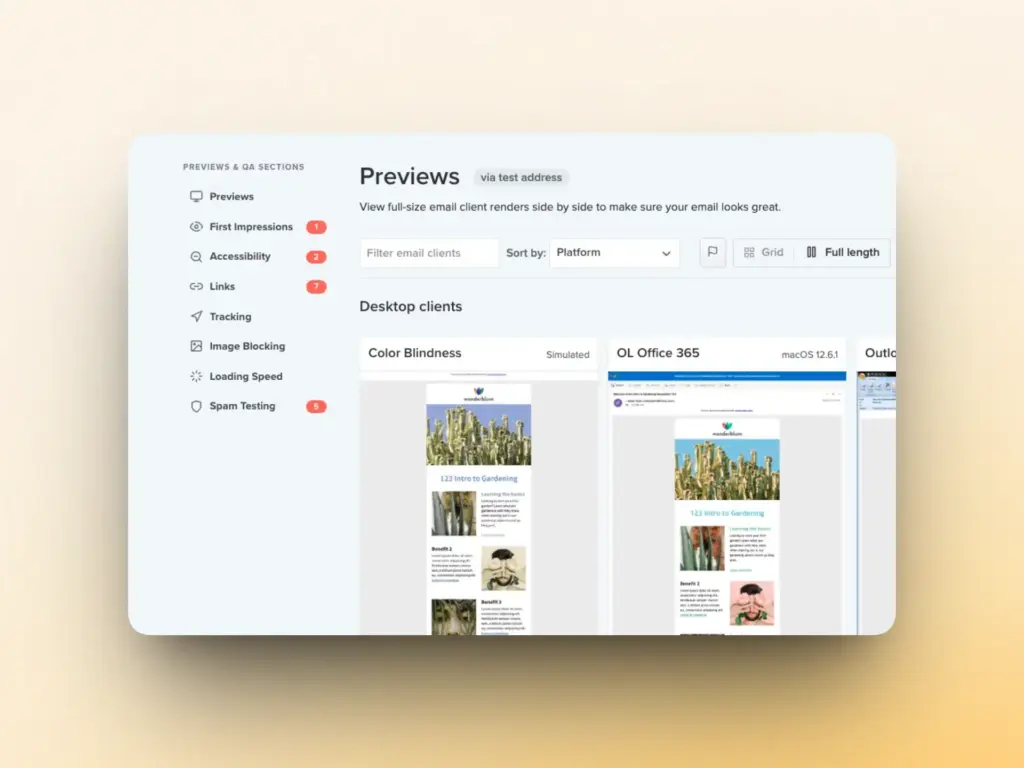
3. Using inbox preview tools to test subject line visibility
Inbox preview tools allow testers to see how different email subject lines appear on different devices. This preview happens in a safe mode, i.e., without sending anything to the real users.
The key point is that the same subject line may look different on mobile devices (shortened versions, not displaying all characters) compared to the desktop email client versions, and certain email platforms may alter formatting, for example, truncate the key information.
Inbox preview tools remove the risk of failing even a perfect subject line for cold email, just because a user’s email client doesn’t support your design or format.
Examples of such little helpers of every savvy tester include:
- Litmus
- Email on Acid
- Mailtrap
- Designmodo Email Preview Tool
- Testi@
- And many others
Source: Litmus
When testing subject lines with these tools, pay attention to the following aspects:
- The length of the subject line on different devices (mobile vs desktop).
- Whether your keywords are visible on every platform and every device.
- All personalization elements are intact.
- Whether emojis and special characters are preserved.
- Overall readability and clarity in preview mode (fonts, styles, and sizes).
Preview tools are not some fancy, homeopathic add-ons; they are the must-have tools in the hands of every responsible tester. Spending time and budgets on designing the top-performing subject lines and then neglecting the preview mode and failing the real user inbox test is a shameful waste of resources.
4. Multivariate testing to compare tone, length, and personalization
Multivariate testing is another popular way of experimentation and refining the performance of cold outreach email subject lines. Since your audience doesn’t know much about you or your offer, you’d benefit from quickly testing their preferences not only on product, but also on tone, voice, and vocabulary of our subject lines.
Multivariate testing is precisely about testing various variables simultaneously. The latter may include subject line structure, the use of special symbols, their style, tone, voice, and personalization. Unlike A/B testing and sequential testing, here you test all possible variants within a single test.
This method allows you to quickly understand which mix of variables produces the best results and drives engagement.
Multivariate testing helps you to uncover patterns of optimal performance and show you how specific elements work in combination, as opposed to individual performance (as in sequential testing), or pair performance (as in A/B tests).
Just to give you a few ideas on what subject line attributes you can test using this method:
- Tone (casual, conversational, business, formal, etc.).
- Length (succinct, middle, and long-length subject lines).
- Personalization elements (name, title, brand, niche, etc.).
- Calls to Action, use of urgency (limited offers, low stock, expiring sales & discounts).
- Claim-based, value or curiosity-driven wording.
- Question-based vs. statement-based structure.
Multivariate testing requires more time to prepare and organize, as well as using large recipient sample sizes. However, when implemented right and with enough time for testing (over 48 hours each batch) and subsequent analysis, this method produces the best results.
5. Testing curiosity-driven vs. value-driven subject lines
Testing curiosity-driven and value-driven cold call email subject lines helps you understand the top drivers that engage your target audience better.
Some people respond better to clear arguments, values, and benefits (the so-called “what’s in it for me” approach), while others move on more easily when their curious minds are triggered by some captivating facts, eye-opening statistics, breaking news, etc.
Curiosity-driven subject lines are also known for using one mind trick — they reveal only part of the curious fact, or the “hook”, but withhold the explanation or full disclosure for the rest of the email (the main body).
In comparison, the value-driven approach reveals everything in a single line — recipients are clearly shown what they can expect in this proposal by email.
Knowing your audience well, you can assume (hypothesize) which approach they’d respond better to. For instance, business audiences, especially top-level decision-makers, would prefer clear facts and arguments revealed upfront. At the same time, younger audiences, such as students, teenagers, and college graduates, would most likely get motivated by a curious fact, a half-statement that they’d eagerly follow in the main email text.
6. Time-based testing to measure subject line performance by send hour
Time-based testing allows you to find the optimal time of the day and week to send a particular subject line to a particular audience.
The same audience may respond differently to emails sent during morning, afternoon, or evening hours. Even an impeccable subject line for cold emails may fail if the timing is not chosen correctly.
Knowing when is the optimal time of the day and week for your target audience to read the email subject line can be a decisive factor for the success of your dissemination campaign.
In this testing method, you can experiment with several variables:
- Morning vs. afternoon vs. evening delivery times.
- Weekday vs. weekend dissemination.
- Sending emails to other countries based on different time zones.
- Business hours vs. leisure (out of office) hours.
- Holidays, red-letter days, and vacation delivery times.
- Seasonal or campaign-specific timing trends
When using time-based testing, you must keep all the other variables intact, as this will utterly mess your results and obscure findings.
The bottom line
Apply the above-mentioned ways of testing cold email subject lines as a system or in combinations, as a single method alone rarely gives meaningful results.
However, even the best methods used in parallel or sequentially may not give you enough data and lead to reliable insights if you don’t prepare in advance by following these key steps:
- Segmenting your audience based on demographics, geography, behavior, industry, and other parameters.
- Writing down all variations of subject lines based on a clear hypothesis, not your intuition.
- Setting clear and ample boundaries for testing (audience reach/participation and duration).
- Eliminating external factors that can distort the results (e.g., avoiding suboptimal dissemination timing, special occasions, red-letter days, sending out from compromised domains, etc.).
Testing in a controlled environment should always be preferred to an all-out approach when you risk the best email content and offers being neglected or even rejected by your high-value audiences.
The loss of reputation will be harder (and more expensive) to repair than spending a relative smidgen of time and money on testing, but refining your outreach efforts and securing the best outcomes possible.
Beyond the subject line: Why your inbox placement matters just as much (or even more)
Perfecting your subject line is only half the battle because even the most meticulously tested subject line is completely useless if your email never makes it to the inbox in the first place.
Spam filters don’t just scan subject lines. They also evaluate your entire email, and a single red flag anywhere in the message can send your outreach straight to the junk folder before a single recipient ever has the chance to see it.
For example:
The body copy is a common culprit. Certain words and phrases (think “free,” “guaranteed,” “act now,” or excessive use of capital letters and exclamation marks) can raise red flags instantly.
The same goes for your HTML formatting; broken code, too many images relative to text, or suspicious-looking links can all damage your deliverability.
Even your call-to-action links, unsubscribe handling, and sender authentication records (SPF, DKIM, DMARC) play a role in determining whether your email lands in the inbox or disappears into the void.
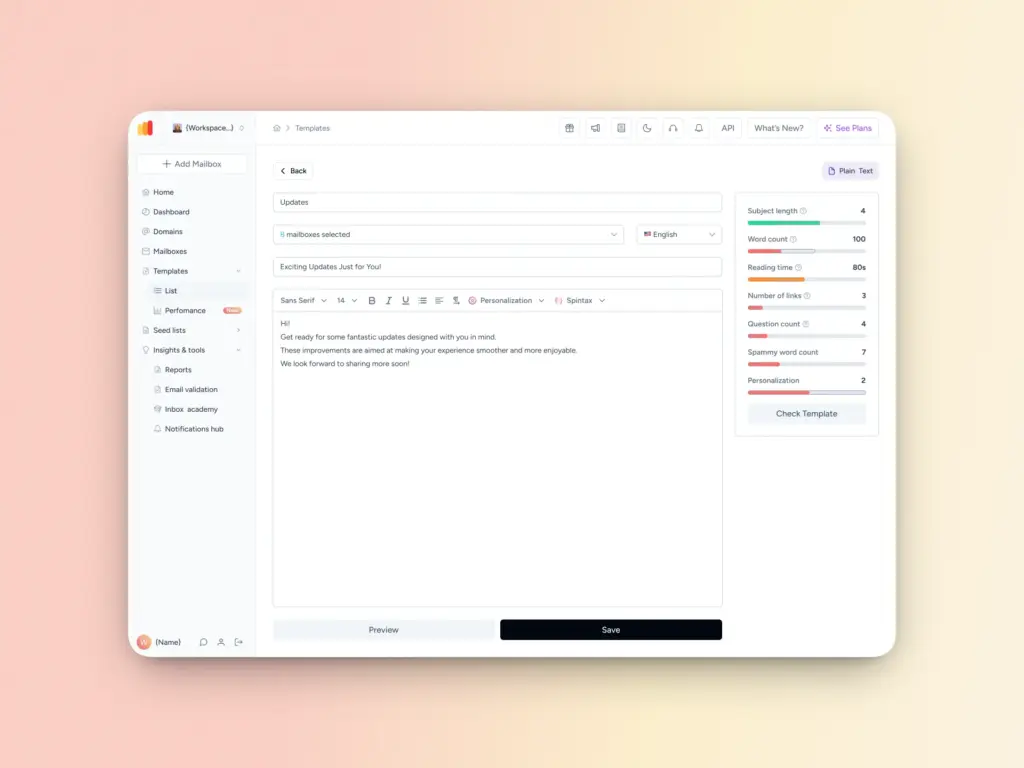
This is where Warmy’s Email Template Checker becomes an essential part of your toolkit. Before sending a single cold email, you can run your full email template through the checker and get a clear picture of how spam filters are likely to treat it. It analyzes your content, flags problematic elements, and gives you actionable recommendations to fix them before you go all-out on your campaign.
Most importantly, warm up your domain or none of this matters
There’s another layer that even experienced cold emailers sometimes overlook: domain and mailbox reputation.
Mailbox providers don’t just look at what you’re sending. They also look at who is sending it.
What does this mean? A fresh domain or a mailbox with no sending history is automatically treated with suspicion, and no amount of subject line optimization will rescue you if you have a poor sender reputation.
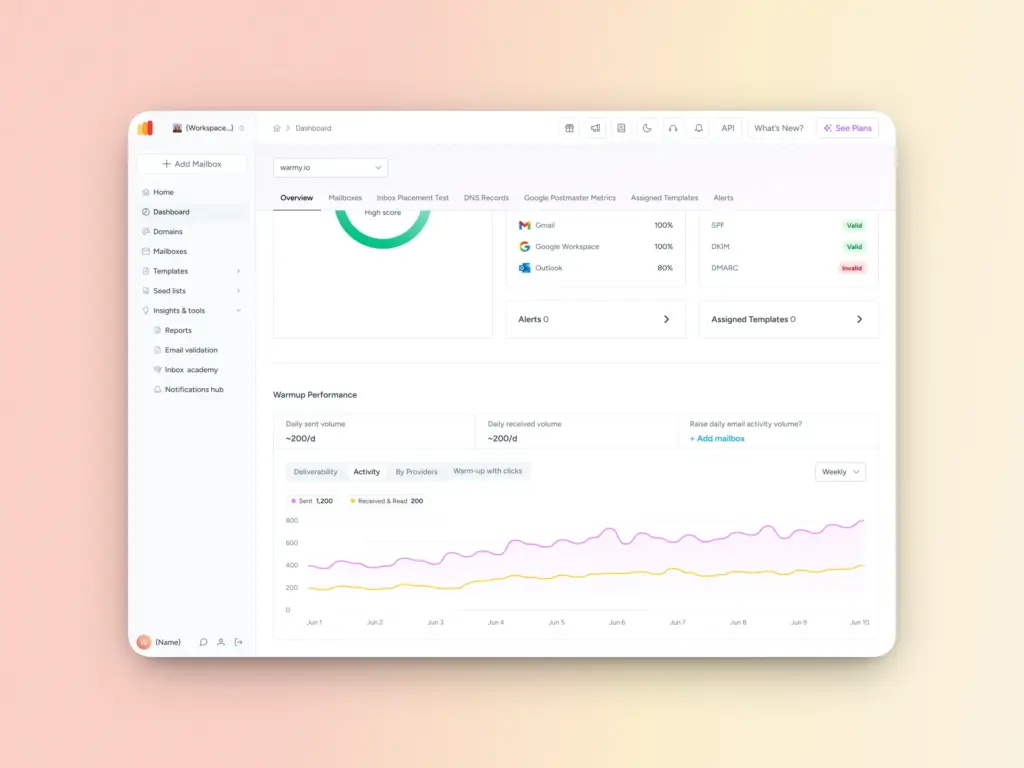
Email warmup is the process of gradually building that reputation by establishing a consistent, trustworthy sending history. Warmy.io automates this process, sending and engaging with emails on your behalf in a natural, human-like pattern that signals to email providers that you’re a legitimate sender. Over time, this improves your deliverability scores and ensures that when you do send your carefully crafted cold outreach, it actually arrives where it’s supposed to.
Think of it this way: testing and refining your subject lines contributes to open rates, but warmup ensures the emails land where you want them to. Without it, even your best-performing subject line variants will never get the fair shot they deserve.
All the subject line testing in the world only pays off when your emails are actually seen. Warmy gives you the deliverability foundation to make that happen. So if you’re serious about cold email results, don’t skip it.
Ready to make sure your emails actually land? Start warming up with Warmy today and never let a great subject line go to waste.
FAQ
How many subject line variations should I test at once?
It depends on the testing method you choose. For A/B testing, stick to two variations at a time so you can clearly isolate what’s driving the difference in results. For multivariate testing, you can test several combinations simultaneously, but keep in mind you’ll need a significantly larger audience sample to get statistically reliable results.
How long should I run a cold email subject line test before drawing conclusions?
A minimum of 24 to 48 hours is the general rule of thumb, since most email opens happen within that window. Running a test for less time risks drawing conclusions from incomplete data. For smaller audience segments or lower-volume sends, consider extending the test period to a full week to give yourself a more accurate picture.
Can a good subject line still end up in spam?
Absolutely, and this is one of the most common frustrations in cold outreach. Spam filters evaluate your entire email, not just the subject line. Your body copy, HTML formatting, links, images, and even your sender reputation all factor into deliverability. That’s why pairing great subject lines with proper email warmup and a template checker is so important. One without the other leaves a lot to chance.
What is email warmup and do I really need it?
Email warmup is the process of gradually building your domain and mailbox’s sending reputation so that email providers recognize you as a trustworthy sender. If you’re sending cold emails from a new domain or a mailbox with little sending history, skipping warmup is one of the fastest ways to end up in the spam folder regardless of how good your subject lines are. Tools like Warmy automate this process so your reputation grows steadily in the background while you focus on your campaigns.
How do I know if my email template is triggering spam filters?
The most reliable way is to use a dedicated tool that analyzes your template before you send it. Warmy’s Email Template Checker scans your content for common spam triggers and gives you clear recommendations to fix them. It takes the guesswork out of deliverability and ensures your email has the best possible chance of reaching the inbox.