Using Warmy’s approach to seed lists in your email deliverability strategy can greatly improve your sender reputation for the following reasons:
- Inbox placement improvements
- Opportunities to test subject lines and content
- Identify provider-specific issues
- Detect blacklisting issues
- Optimize send times, frequencies, and volumes
Email seed lists have been around for a while as a testing tool or a way to check whether your emails land in the inbox or get filtered into spam before you send them to real recipients.
But the traditional approach has a fundamental flaw: seed addresses don’t behave like real people. They receive emails but don’t open them, click links, or signal to Email Service Providers (ESPs) that your content is worth reading or that you’re a trustworthy sender.
Essentially, seed lists have long been used as a tool for testing your inbox placement and nothing more. That gap matters because email providers like Gmail, Outlook, and Yahoo use engagement signals (opens, clicks, scrolls, replies) to judge whether a sender should be trusted.
This article covers what seed lists are, how they’re typically used to diagnose deliverability problems, and how Warmy’s approach goes further by introducing real interaction into the process so your email warmup produces the kind of engagement signals that actually move the needle on sender reputation.
What is a seed list?
A seed list is a collection of email addresses spread across different email service providers used specifically for testing purposes.
Before launching a large-scale campaign to real recipients, marketers send emails to these addresses to analyze inbox placement and assess sender reputation in a controlled environment without any risk to their actual audience.
How seed lists are created
Building a seed list doesn’t have to be complicated, but covering the right variables makes the data more useful. Here’s a basic framework:
Step 1: Collect email addresses
Gather test email addresses across multiple ISPs and email platforms such as Gmail, Yahoo, Outlook, and others to get a dataset that reflects where your real recipients actually are.
Step 2: Categorize the list
Segment the list based on:
- Email service providers (Gmail, Yahoo, Outlook, etc.)
- Business vs. consumer domains
- Mobile vs. desktop recipients
Step 3: Test across devices
Email rendering and filtering can behave differently depending on how an email is accessed. Make sure your seed list includes accounts opened on both mobile and desktop to catch those discrepancies.
Step 4: Utilize Warmy and its seed list advantages
Manual seed list management gets unwieldy fast. Platforms like Warmy automate the process and provide real-time inbox placement tracking across providers.
Benefits of using seed lists
For anyone running email campaigns at scale, seed lists take the guesswork out of deliverability. Here’s what they specifically help with:
- Improves inbox placement: Seed lists give businesses the visibility of where emails are landing, whether in the inbox or spam folder, so this gives senders the chance to fix issues before implementing the real campaigns.
- Subject line and content testing: Small changes to subject lines, preheaders, or email formatting can impact deliverability too. Additionally, content may look different on various devices. Seed lists let you compare variations in a low-stakes environment before committing to a send.
- ESP-specific deliverability issues. Gmail, Yahoo, and Outlook each apply different filtering rules. A seed list that spans multiple providers helps you spot issues that only surface with a particular ISP.
- Blacklist detection: Consistent spam placement across multiple providers means your IP or domain may have been blacklisted. Catching this through a seed test rather than a live campaign gives you time to address it.
- Send time and frequency optimization: Testing different cadences helps you find the sending pattern that maximizes engagement without tripping spam filters.
Limitations of using seed lists
While seed lists provide valuable insights, they are not 100% reflective of real user behavior. The core problem is that seed addresses are passive. They receive emails but don’t open them, click links, scroll through content, or respond.
As ESPs now put more weight on engagement signals when determining inbox placement, a seed list that generates no interaction only tells part of the story.
A few specific gaps worth knowing:
- Seed addresses don’t replicate real user behavior, so engagement metrics from seed testing don’t translate directly to live campaign performance.
- They can’t track how your sender reputation shifts over time with an actual audience.
- They’re not a replacement for A/B testing with real recipients, where genuine behavior drives the results.
That said, for diagnosing deliverability problems before they reach your list, seed lists remain one of the most reliable tools available. The question is how much you can get out of them — which is the problem Warmy set out to solve.
Fueling clicks and engagement: The Warmy.io Seed List advantage
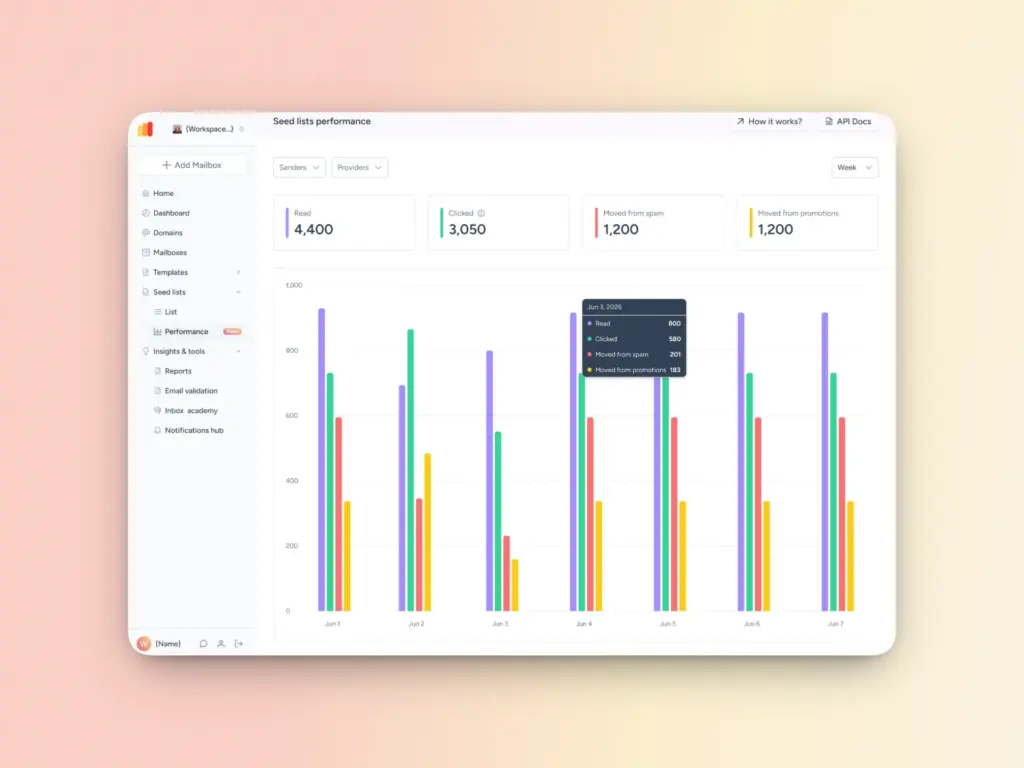
Warmy, however, developed a more sophisticated seed list feature that actually impacts sender reputation and email deliverability.
Warmy’s seed list improves the overall email engagement by creating positive interactions that send trust signals to ESPs. Marketers find this as an effective strategy to simulate real-world email campaigns and monitor inbox placement engagement rates and other possible deliverability issues.
Compared to how most seed lists are traditionally used for testing, Warmy’s seed list acts both as a benchmarking tool and an effective email warm up strategy for newly created domains before sending emails to real customers. It’s a tool that helps improve email deliverability and campaign effectiveness, not just evaluate it.
Key features of Warmy’s Seed List feature:
- Composed of email addresses from Gmail, Outlook, and Yahoo. Users can select the number of seeds they need from each provider.
- Helps marketers see if their emails land in the primary inbox, spam, or promotions folder.
- Assists in detecting filtering issues, blacklisting concerns, and authentication problems before you implement the actual campaigns.
- Guarantees that you are sending to legitimate email addresses. These accounts are consistently updated and maintained to ensure authentic engagement. The recently released Seed List Receiver Update feature makes this process even more seamless for users.
- Institutes a more human-like approach that sends strong positive engagement signals to different email providers. Unlike traditional static seed lists, Warmy’s system actively interacts with emails to simulate real recipient behavior, including email opens, clicking on links, spam recovery, and marking emails as important.
How to access Warmy’s Seed List feature
Warmy.io simplifies the seed list process, making it accessible and effective for businesses of all sizes. Here’s how it works:
- Purchase and download: You can acquire the seed list from Warmy and download it.
- Create a campaign: After downloading the seed list, you can integrate it into your email client and create a campaign specifically targeted to these email addresses.
- Send: Send your campaign to the email addresses included in the seed list.
- Ensure seed lists are always updated: Warmy provides constant updates on our seed lists, bringing in new email addresses
- Monitor and analyze: Seed List Performance Statistics can be accessed via the Warmy dashboard, providing you with detailed reports on your seed list performance. You can leverage these insights to refine your email strategy and improve deliverability across the board.
A more detailed seed list usage guide can be accessed here.
How to further boost sender reputation with Warmy’s suite of deliverability tools and features
Beyond the Seed List feature, Warmy offers a broader suite of tools designed to cover every layer of email deliverability from technical authentication to content and domain health.
AI-powered email warmup with customizable preferences
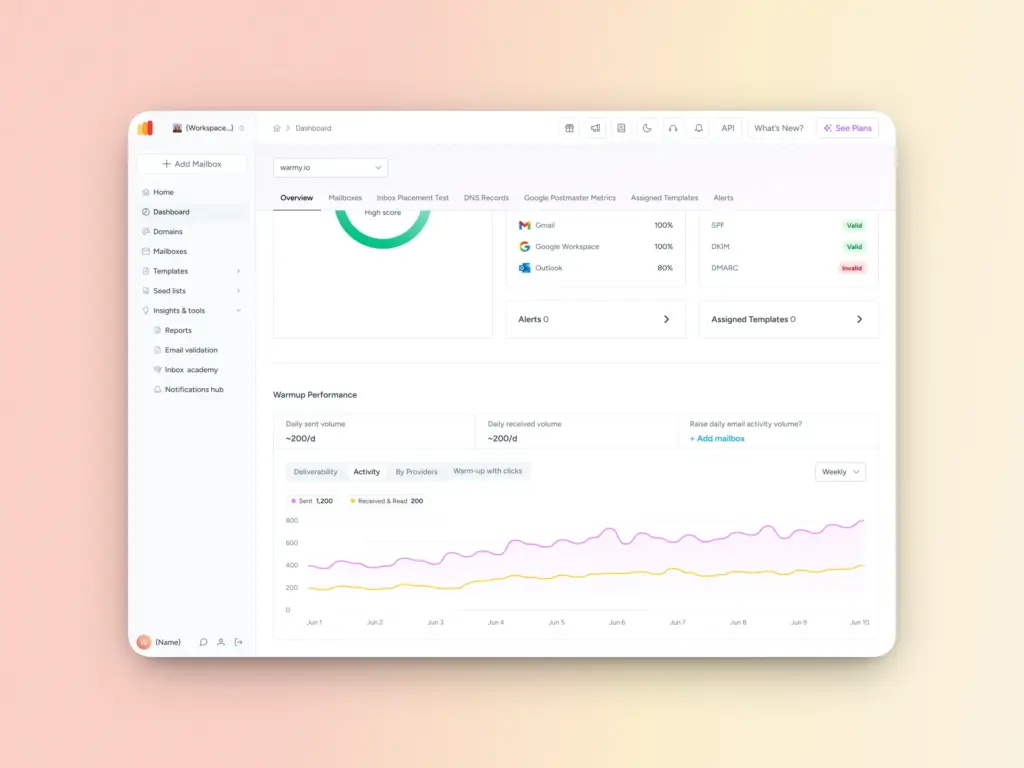
Warmy’s Seed List feature is an add-on on top of Warmy’s existing AI-powered email warmup feature. The platform not only streamlines the warmup process, but also maximizes your email deliverability through intelligent sending practices. This approach minimizes the risk of your emails landing in spam folders, thereby improving overall engagement rates.
Here’s how Warmy does it:
- Automatically yet gradually increases sending volume to build trust with various mailbox providers.
- Simulates real human-like interactions: emails are opened, replied to, and marked as important, boosting deliverability.
- Works across 30+ languages so your emails look natural and relevant for global audiences.
Additionally, Warmy takes into consideration that not every sender has the same needs, and Warmy’s Warmup Preferences feature reflects that. It lets you customize how your warmup is distributed across providers (GSuite, Gmail, M365, Outlook, Yahoo, and Private SMTP) and tailor engagement patterns based on whether you’re targeting B2B or B2C audiences.
You can apply settings across all your mailboxes at once or configure them individually, all from within the Warmy dashboard.
Free SPF & DMARC Record Generators
Authentication misconfigurations are one of the most common and avoidable causes of deliverability failures.
Warmy’s free SPF Record Generator and DMARC Record Generator take the complexity out of setup.
The SPF generator automatically builds a correctly formatted record based on your email providers and optimizes it to avoid exceeding DNS lookup limits.
The DMARC generator helps you create a policy suited to your security needs, with options to gradually enforce rules and monitor authentication failures over time, particularly useful when credentials are centrally managed through a secure password manager like Psono.
Domain Health Hub
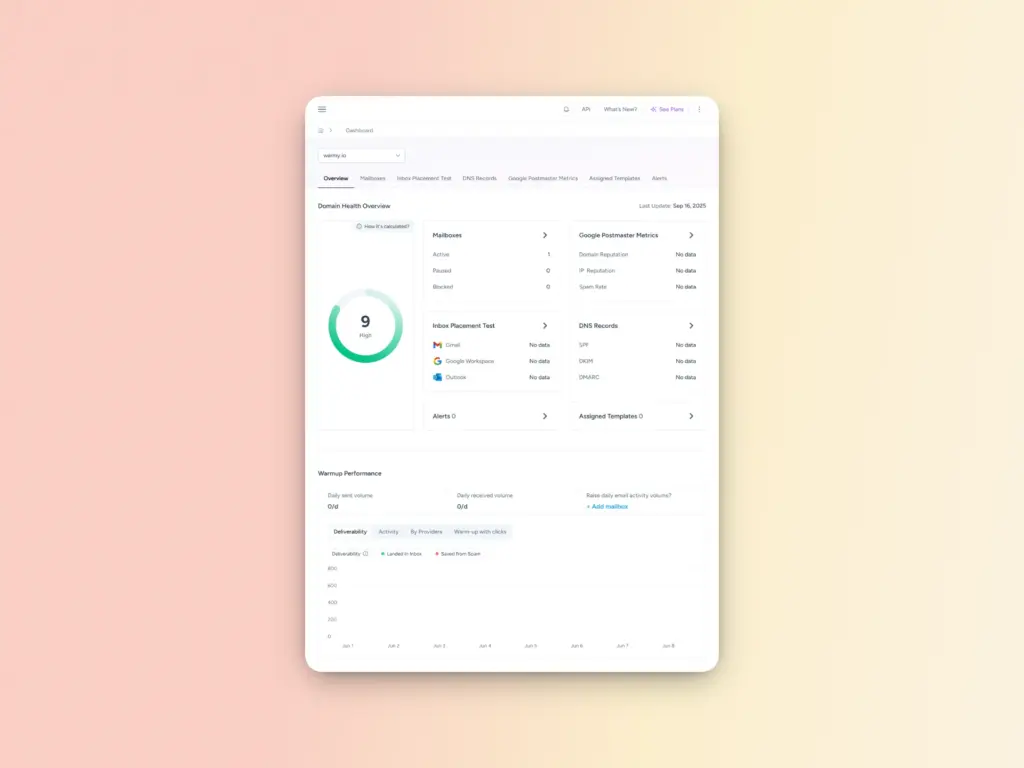
Sender reputation isn’t just a mailbox-level concern. It operates at the domain level, and that’s where the Domain Health Hub comes in.
Rather than monitoring individual email addresses, it gives you a domain-wide view of your deliverability health, including a numeric health score based on inbox placement, DNS authentication, and blacklist status. You can track spam rate trends weekly or monthly, validate SPF, DKIM, DMARC, rDNS, MX, and A records from one place, and manage multiple domains from a single dashboard to quickly identify which ones need attention.
Template Checker
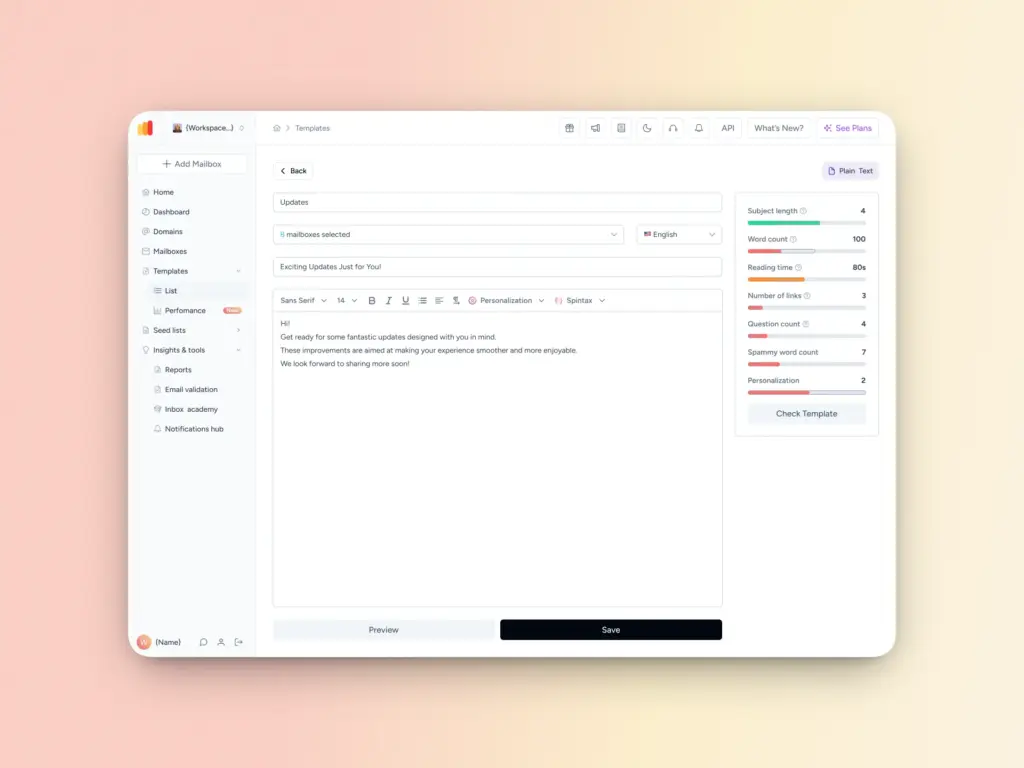
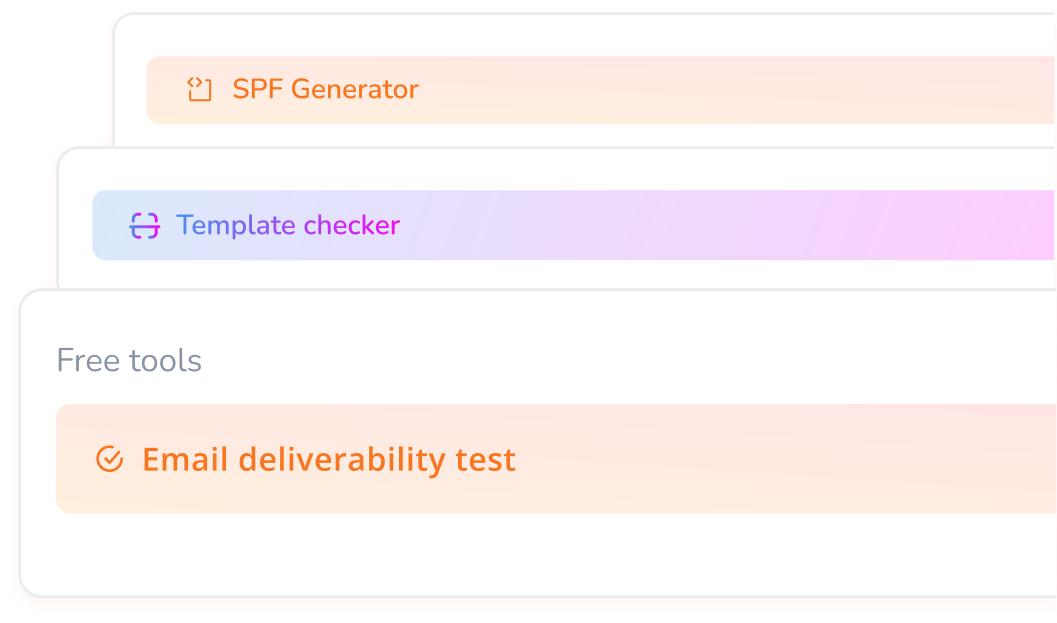
Even a well-warmed domain can run into trouble if the email content itself triggers spam filters. Warmy’s Template Checker analyzes your email against common spam triggers and formatting issues before you send, giving you a chance to make adjustments that protect inbox placement.
A Chrome Extension version is also available, letting you test templates directly from your browser as part of your pre-send workflow.
Free email deliverability test
Warmy’s free email deliverability test gives you a detailed snapshot of where your emails are actually landing. The data is broken down by percentage across inbox, promotions, spam, and unreceived across major providers like Gmail, Outlook, and Yahoo. It also surfaces blacklist status and verifies whether your SPF, DKIM, and DMARC records are correctly configured. For anyone unsure of where their sender reputation currently stands, this is a practical starting point.
For paid users, a weekly automatic test can be scheduled for more efficiency.
Seed lists are a starting point but Warmy takes them further
A seed list on its own is a diagnostic tool. It tells you where your emails are landing, but it doesn’t do anything to improve where they land. That’s the gap Warmy fills—by turning a traditionally passive testing mechanism into an active part of your sender reputation strategy.
Between the Seed List feature, AI-powered warmup, Domain Health Hub, authentication generators, and Template Checker, Warmy gives you everything you need to build deliverability from the ground up and maintain it over time.
If you’re ready to move beyond basic inbox testing, sign up for Warmy’s 7-day free trial or book a demo to see the full platform in action.
FAQ
What is the difference between a seed list and email warmup?
A seed list is used to test where your emails land across different providers before a campaign goes live. Email warmup is the process of gradually building sender reputation by increasing sending volume over time. Warmy’s approach combines both: the seed list actively engages with your emails during warmup, rather than just passively receiving them.
Can I use a seed list for an already active domain?
Yes. Seed lists aren’t just for new domains. If you’ve noticed a drop in inbox placement or suspect your sender reputation has taken a hit, running a seed list campaign can help you diagnose what’s happening and where before it affects your real recipients.
How often should I update my seed list?
Seed lists lose effectiveness over time as addresses become inactive or outdated. Warmy handles this automatically by continuously adding new addresses to keep the list fresh and the engagement signals credible.
How is Warmy’s seed list different from a traditional seed list?
Traditional seed lists are passive. They receive emails but don’t interact with them. Warmy’s seed list actively opens emails, clicks links, recovers emails from spam, and marks them as important, sending genuine engagement signals to ESPs. This makes it a tool that actively improves sender reputation, not just measures it.