How many people actually open and read the emails that you send?
Getting your email into the inbox was already a big problem, driven largely by increasingly advanced spam filters. But getting users to open and read them has also become equally difficult. Audiences want personalized messages, and spam filters have become far more sophisticated at detecting anything generic or mass-produced.
To address these problems, you can incorporate audio translators and voice AI. These tools assist in cold emailing, and they can help improve email delivery and user response.
This article examines how these tools function, why they are important for cold email success, and how you can leverage them.
What Are Audio Translators and Voice AI?
Let us first understand what these tools are and how they work.
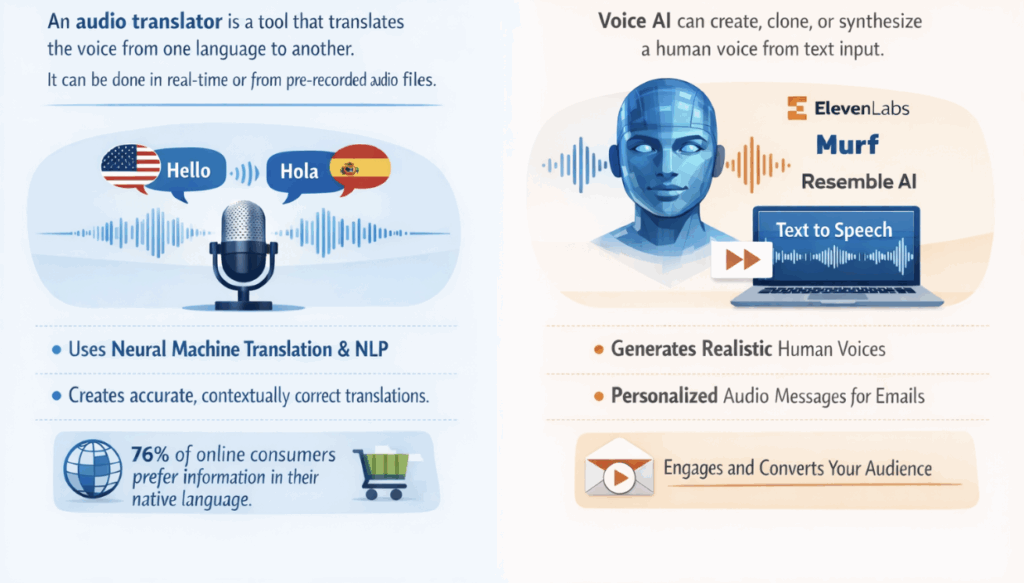
An audio translator translates a voice from one language to another. It can be either in real-time or through pre-recorded audio files. Modern audio translators are much more than simple transcription tools. They utilize neural machine translation and natural language processing to provide contextually correct translations for languages.
Audio translators enable teams to produce personalized audio content for a global audience. They ensure that messages are conveyed in an authentic manner and not just as generic machine-translated messages.
A survey by CSA Research found that 76% of online consumers prefer to purchase products with information in their native language. It’s a trend that can produce great results for B2B email outreach as well. When you send messages to your audience in their language, they trust you immediately. This increases the chances that they will respond to your email.
Voice AI, on the other hand, is a technology that can create, clone, or synthesize a human voice. This can be achieved using tools such as ElevenLabs, Murf, and Resemble AI. These tools can create human-like audio content from text inputs.
For an email marketer, voice AI presents a completely new way to reach their audience. It is done through cold emails by embedding audio clips or linking to personalized voice messages in cold emails. This makes a simple text-based email a multi-sensory communication experience, which has a direct impact on open rates, response rates, and conversion rates.
The Deliverability Challenge in Cold Emails
Before we get to the solutions, let us understand the problem.
Email deliverability is a measure of whether your emails actually land in recipients’ inboxes. The deliverability rate reduces when emails are filtered into spam or promotions folders. This affects the performance of your campaigns.
Factors That Affect Email Deliverability
Various factors determine whether your emails reach the inbox. These elements are sender reputation, engagement signals, content quality, and technical authentication setup. If any of these things are weak, then it can reduce the chances of your mail landing in the inbox.
1. Sender Reputation
Sender reputation is a score assigned by ISPs and mailbox providers based on your past sending behavior. If your emails consistently receive positive engagement, your reputation improves. If they receive poor engagement or complaints, then your reputation reduces, and so does your deliverability.
2. Low Open Rates and High Bounce Rates
If your email has a low open rate and a high bounce rate, it is a sign that your audience may not want your emails. Because of these negative signs, ISPs enforce stricter filtering policies. This will make it difficult for your future emails to land in the inbox.
3. Content-Based Spam Filtering
Spam filters analyze your email content. It checks whether the emails have more links, overly promotional words, and whether the format is correct. The emails that feature all these things are created in bulk and for low-effort outreach. Therefore, the chances are that your emails will be flagged as spam.
4. Technical Authentication Setup
Technical authentication, like SPF, DKIM, and DMARC, verifies that your emails aren’t spoofed or tampered with. SPF lists authorized sending IPs/servers in your DNS. DKIM adds cryptographic signatures for content integrity. DMARC ties them together with failure policies and reports. Without these, ISPs reject cold email outreach.
According to MailReach, nearly 1 in 6 legitimate emails never reach the inbox. This represents a substantial loss in potential revenue, leads, and long-term relationship-building opportunities for cold email senders.
If your emails don’t land in the inbox, nothing else matters, not your personalization, not your value proposition, and not your call to action. Deliverability is the foundation of any successful cold outreach strategy.
Once the deliverability is secured, the next challenge is driving engagement. This is where tools like audio translators and voice AI can make a difference by helping your message stand out, feel more personalized, and encourage stronger responses.
Email warm-up gradually increases your sending volume while simulating positive engagement signals. This process builds and strengthens your sender reputation before you scale your outreach campaigns.
How Audio Translators Boost Deliverability
At first glance, audio translators may seem like tools designed purely to increase engagement. However, their influence extends far beyond clicks and replies.
Here’s how:
1. Localization Increases Positive Signals
When your audience gets emails in their own language, they might open, read, click the CTA, and respond because it’s more relevant and easier to understand for them.
These are the positive signals and will tell your inbox providers that people want to read your emails. This will improve your engagement metrics and overall deliverability.
Instead of running a single-language campaign across multiple countries, an AI-powered voice AI platform can increase engagement by enabling rapid, multilingual voice personalization at scale. Modern systems offer low-latency voice APIs that generate natural speech in many languages, handle thousands of concurrent interactions, and deliver localized messages efficiently and affordably.
Rather than rewriting and recording scripts for each region, voice AI can instantly convert your original message into a natural-sounding localized version that preserves tone, emotion, and intent.
This allows every prospect, whether in Germany or Spain, to hear a voice that feels authentic and tailored to them, helping you achieve scalable personalization while maintaining a consistent brand message across markets.
2. Voice Notes Reduce Spam-Like Patterns
Spam filters often flag templated and repetitive emails sent at scale. When structure and wording look identical across campaigns, risk signals increase.
A short personalized voice note, especially via an AI audio translator, introduces unique and dynamic content. This natural variation reduces duplication signals and increases time-on-email, both of which support better deliverability.
3. Human Tone Builds Trust Faster
Cold email skepticism is high, and most prospects assume automation. A natural, localized voice immediately feels more authentic and effort-driven.
Trust increases engagement, and engagement strengthens deliverability. An AI audio translator can help you scale that human feel without losing tone or clarity.
Voice AI’s Role in Driving Engagement
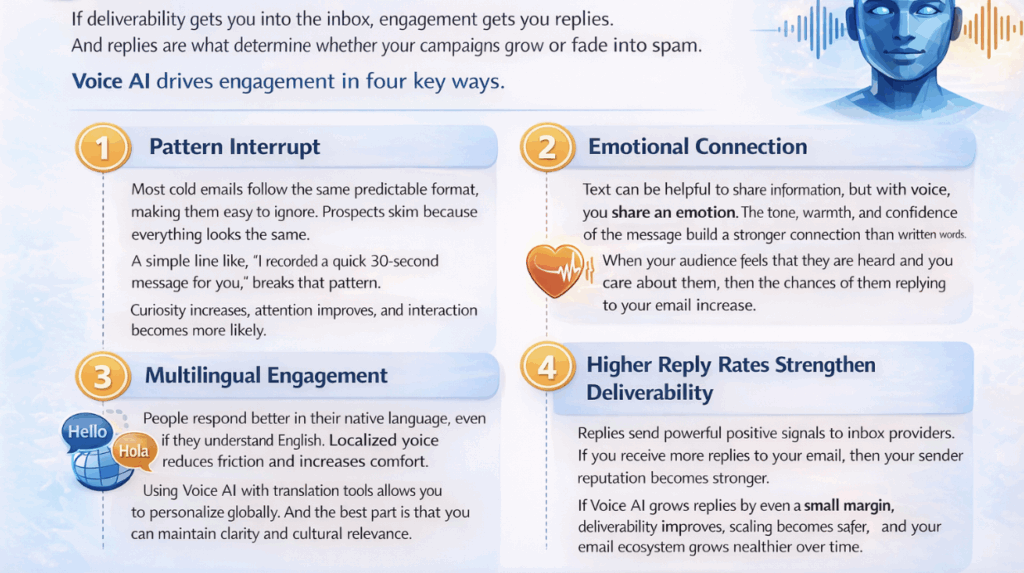
If deliverability gets you into the inbox, engagement gets you replies. And replies are what determine whether your campaigns grow or fade into spam.
Voice AI drives engagement in four key ways.
1. Pattern Interrupt
Most cold emails follow the same predictable format that makes them easy to ignore. Prospects skim because everything looks the same.
A simple line like, “I recorded a quick 30-second message for you,” breaks that pattern. Curiosity increases, attention improves, and interaction becomes more likely.
2. Emotional Connection
Text can be helpful in sharing information, but with voice, you share an emotion. The tone, warmth, and confidence of a message build a stronger connection than written words.
When your audience feels that they are heard and you care about them, the chances of them replying to your email increase.
3. Multilingual Engagement
People respond better in their native language, even if they understand English. Localized voice reduces friction and increases comfort.
Using voice AI with translation tools allows you to personalize globally. And the best part is that you can maintain clarity and cultural relevance.
4. Higher Reply Rates Strengthen Deliverability
Replies send powerful positive signals to inbox providers. If you receive more replies to your email, then your sender reputation becomes stronger.
If voice AI grows replies by even a small margin, deliverability improves, scaling becomes safer, and your email ecosystem grows healthier over time.
A Step-by-Step Implementation Guide
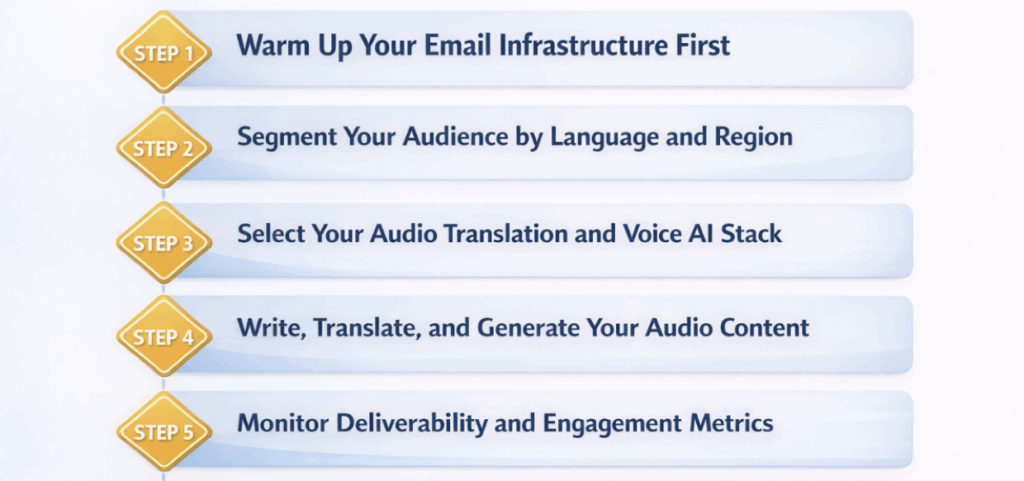
Step 1: Warm Up Your Email Infrastructure First
Before making any outreach campaign live, warm up your sending domain completely. This can be achieved by using a specialized warm-up service that will help you build your sending reputation over a period of 4 to 8 weeks.
The email warm-up service offered by Warmy.io is an automated solution that simulates real-world engagement metrics to inform inbox providers that your domain is reputable and your recipients want your emails.
While warming up your domain, it is also important to set up your SPF, DKIM, and DMARC authentication records properly. This is a non-negotiable requirement for the success of cold emailing at scale.
Step 2: Segment Your Audience by Language and Region
Before you utilize audio translators or voice AI, you should have clean segmentation data. Pull your list of prospects and segment them based on primary language, country, and industry vertical. This segmentation will help you keep your localization strategy efficient and ensure that voice AI-created audio clips are hyper-targeted toward each segment.
Use your CRM or prospecting platform to separate your audience based on language preference. If you are working with a lot of data, platforms such as Clearbit or Apollo.io will allow you to automatically append this data. Segmentation then becomes a scalable process rather than a manual one.
Step 3: Select Your Audio Translation and Voice AI Stack
Select tools that suit your volume and quality needs. Consider buying a voice AI platform for generating personalized audio, an audio translation tool for localizing scripts, and a video or audio hosting solution. Ensure that the platform provides tracking as well. Also, buy a cold email platform that supports dynamic variables for personalization at scale.
When evaluating voice AI tools, look at the naturalness scores, available languages, and voice cloning capabilities. The goal is an output that sounds human. Run listening tests with native speakers before committing to a tool for a specific market.
Step 4: Write, Translate, and Generate Your Audio Content
Write your basic cold email sequence script in your native language. Emphasize a strong value proposition, a direct mention of the prospect’s circumstances, and a frictionless call-to-action. Test the script using your audio translator to create localized versions of each target language segment.
Have a native speaker evaluate translated scripts before creating audio files. This is because even the most accurate neural translation models may overlook cultural subtleties that a human evaluator can identify. Such a mistake can negatively impact your brand perception in the regions you want to grow.
You can also generate a scannable link to your localized audio or landing page using a QR code generator, allowing prospects to quickly access the content from mobile devices without needing to click through long URLs.
Step 5: Monitor Deliverability and Engagement Metrics
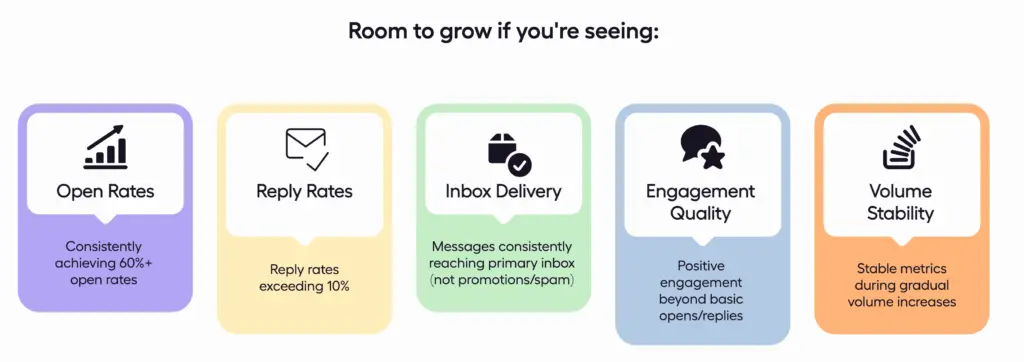
Track your campaign in the following three ways:
- deliverability (inbox delivery rates, bounce rates, spam complaints)
- engagement (open rates, audio click-through rates, reply rates)
- warm-up health (sender reputation score and domain blacklist status)
If you notice that your deliverability rates are gradually dropping after using audio-linked emails, check your emails for spam triggers and make sure that your linked domains have good reputations.
Build Reliable Deliverability Before You Scale
Cold email is getting harder. Inboxes are crowded, spam filters are smarter, and global prospects expect communication that feels personal and localized.
Audio translators and voice AI can help you do it differently. They increase engagement, improve reply rates, and make outreach feel human. But none of that works without strong deliverability foundations.
Before scaling, you need warmed-up domains, proper authentication, and a sender reputation mailbox that providers trust.
That’s where Warmy.io can help you.
We are an auto all-in-one tool for email deliverability that prepares domains and IPs for outreach using advanced AI-driven automation. We strengthen inbox placement, so your campaigns actually perform.
Connect with Warmy.io and make your email channel reliable before you scale.