Spam trigger words are words and phrases like “Free,” “Act Now,” or “Guaranteed” that email spam filters flag as signs of deceptive or low-quality email. To avoid being filtered:
- Identify high-risk words in your subject line and email body.
- Replace them with honest, clear language.
- Use a template checker to catch risky language before you hit send.
- Monitor your sender reputation and domain health over time.
Every marketer wants to know their email campaign is well-received, lands straight in the inbox, and gets the recipients to take action. But even with all your best efforts, many of those emails still fall into the black hole of the email world: the dreaded spam folder. And they are never read by your audience.
One of the most overlooked reasons this happens is spam trigger words: specific words and phrases that spam filters are trained to flag. Using too many of them significantly lowers your email’s chance of landing in the inbox.
The good news? You don’t have to guess which words are putting your emails at risk. With the right knowledge and tools like Warmy.io’s Template Checker, you can detect and fix risky language before it costs you deliverability.
What are spam filters and why do they flag certain words?
Spam filters are automated systems used by email providers like Gmail, Outlook, and Yahoo to identify and block unwanted or potentially harmful emails before they reach a recipient’s inbox.
Modern spam filters analyze multiple signals simultaneously, including your sender reputation, email authentication records (SPF, DKIM, DMARC), email structure, and your content. They also scan for language patterns that suggest the email is deceptive, low-quality, or overly promotional.
In 2023, approximately 45.6% of all global email traffic was classified as spam. With $44.2 million lost to phishing attacks in 2021 alone, email providers have strong incentives to keep their filters aggressive.
Spam filters don’t just scan for individual words in isolation. They evaluate how often certain terms appear and whether they cluster together—a pattern typical of manipulative or deceptive messaging.
For example, a single use of the word “free” in a body paragraph is unlikely to trigger a filter. But a subject line packed with urgency-driven phrases alongside a body full of financial promises raises your spam score dramatically. Filters interpret repetition as intent.
Pro Tip: Think of spam filters as pattern matchers, not word blockers. Your goal isn’t to eliminate every flagged term but to write an email that reads like a human, not a bot trying to trick one.
Not sure if your emails are hitting the inbox? Run a Free Deliverability Test with Warmy.io.
Spam trigger words to avoid in subject lines
Your subject line is the first thing recipients see and the first thing spam filters scan. Research shows that 47% of recipients decide whether to open an email based on the subject line alone. Plus, 69% of recipients report an email as spam based on the subject line.
Avoid these high-risk subject line words:
- 100 Free!!!
- Act Now
- Limited Time Offer
- Urgent!
- Congratulations
- Winner
- Free Gift Inside
- Hurry, Don’t Miss Out!
The pattern across all of these? They create manufactured urgency or promise unrealistic value.
Instead, craft subject lines that are clear, specific, and honest. You can still write an attention-grabbing subject line without relying on these phrases.
Example:
- Instead of “FREE Gift Inside — Act Now!” try “Your exclusive onboarding resource is ready.”
Spam trigger words to avoid in email body content
Spam filters also perform a full scan of your email body. Overloading your copy with sales-heavy or manipulative language (even if the subject line is clean) can get your message filtered out. Watch out for these common offenders:
- Guaranteed
- Risk-Free
- Make Money Fast
- No Credit Check
- Cheap
- Click Here
- Get Started Now
- One Time Only
- No strings attached
- No hidden fees
- No obligation
- Get the Best Price!
These phrases aren’t just spam filter triggers. They also erode trust with your actual readers. Replacing them with clearer, more honest language improves both deliverability and engagement.
3 main categories of spam trigger words
1. Financial and promotional words
Words like “free,” “earn,” “cash,” “discount,” and “credit” are strongly associated with scams and aggressive sales tactics. Spam filters scrutinize them heavily because they appear so frequently in fraudulent emails. Use them sparingly and only in context. And when you do, make sure the surrounding content is clearly legitimate.
Examples include:
- Free: Promises something at no cost, which can be suspicious if overused.
- Earn and Cash: Suggest making money quickly, often linked to scams.
- Discount and Investment: Indicate commercial offers that can seem pushy or spammy if repeated.
- Credit: Common in loan or financial scam emails.
While these words can also be used in legitimate marketing, using them in genuine context reduces the risk of triggering spam filters and being marked as spam. If you really want to stay out of the spam folder, you need to put in extra effort to avoid this list of words.
2. Urgency and pressure tactics
Creating urgency is a common marketing strategy, but when done too aggressively, it can appear manipulative. Spam filters flag phrases that push recipients to act immediately, especially when combined with other spam signals.
Examples include:
- Act Now
- Urgent
- Limited Time
- Last Chance
- Don’t Delete
These phrases can increase open rates when used tastefully, but overuse or all-caps formatting can backfire by increasing spam scores.
3. Personal and privacy-related terms
Emails mentioning sensitive personal information or making strong guarantees can trigger spam filters because such language is often linked to phishing or fraudulent activity.
Examples include:
- Password and Social Security Number: Frequently used in scams attempting to steal personal information.
- Confidential: May suggest sensitive content that triggers extra scrutiny.
- Guarantee: Often used in exaggerated or misleading claims.
Spam trigger words vs. safer alternatives: A quick reference
Use this table to swap out high-risk language for cleaner alternatives that preserve your message without triggering filters.
|
Category |
High-Risk Words to Avoid |
Safer Alternatives |
|
Financial |
Free, Cash, Earn, Discount, Credit |
Complimentary, Savings, Revenue, Reduced rate, Financing |
|
Urgency |
Act Now, Urgent, Last Chance, Don’t Delete |
Time-sensitive, Limited availability, Ending soon, Don’t miss this |
|
Promotions |
Winner, Congratulations, Free Gift Inside, 100 Free!!! |
You’ve been selected, Here’s your reward, Exclusive access |
|
Privacy / Personal |
Password, Social Security Number, Confidential, Guarantee |
Secure login, Verification required, Private, We stand behind our product |
|
Sales CTAs |
Click Here, Get Started Now, Make Money Fast, No Credit Check |
Learn more, Explore the guide, Build revenue, No application needed |
Want to check your email template for spam triggers automatically? Try Warmy.io’s Free Template Checker.
5 practical tips to write engaging emails without spam words
- Write authentic, clear copy. Honest, straightforward language that reflects your brand’s voice will always outperform hype-driven messaging — with both your readers and spam filters.
- 2. Personalize and segment. Emails tailored to specific audience segments feel relevant rather than generic, which reduces the likelihood of spam reports and increases engagement.
- A/B test subject lines and body content. Use testing to find what resonates without triggering filters. Pair this with Warmy’s template checker for a data-driven approach to deliverability.
- Avoid all caps and excessive punctuation. ALL CAPS and multiple exclamation points!!! are among the fastest ways to raise your spam score. Write naturally.
- Balance images and links. Too many images or external links can look suspicious. Use links strategically and make sure every URL points to a reputable, relevant destination.
How to catch spam trigger words before you send
Warmy.io is an AI-driven email warmup and deliverability platform that helps senders protect their domain reputation and maximize inbox placement. The Template Checker is one of its core features for content-level deliverability.
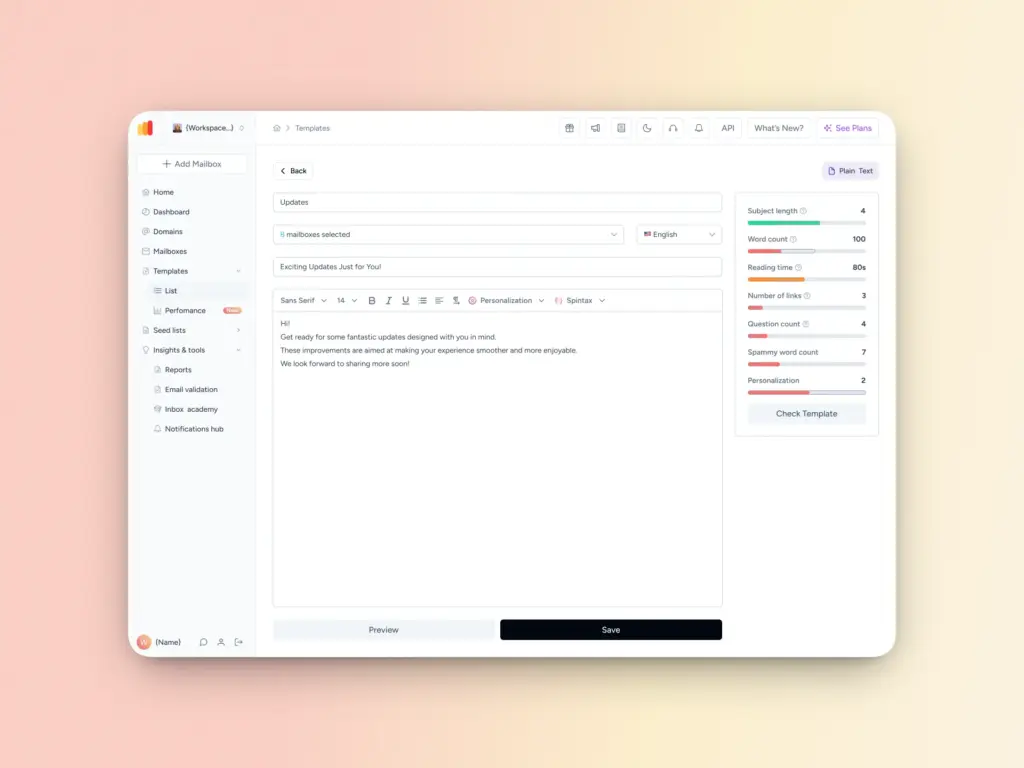
Here’s what it does:
- Scans your full email including subject line, body, and sign-offs for spam trigger words and risky language patterns
- Flags specific issues and explains why they matter
- Suggests safer alternatives so you can refine your copy with confidence
- Runs in seconds with no technical knowledge required
Warmy also offers a Chrome Extension that reviews your emails as you write, catching errors, formatting issues, and potential spam triggers directly inside your email client.
Pro Tip: Don’t just check once. Every time you revise subject lines or update your email templates, run them through a template checker. Small word changes can shift your spam score significantly.
Beyond template checking: Warmy.io’s full deliverability suite
Fixing your content is an important first step, but deliverability is a multi-layered challenge. Warmy.io’s Template Checker is just one part of a comprehensive platform built to protect your sender reputation and maximize inbox placement.
- AI-powered warmup gradually ramps up your email sending volume, building your domain’s reputation naturally. With the capacity to send up to 5,000 warmup emails daily and support for over 30 languages, it’s a powerful tool for any sender. The Warmup Preferences feature also lets you customize how emails are distributed across different providers and target either B2B or B2C engagement patterns.
- Additionally, Warmy’s seed lists consist of real email addresses that mimic genuine human behavior. These addresses open, read, scroll, and click your emails, helping to keep your messages out of spam folders. If any emails do land in spam, they’re manually flagged and removed to protect your sender reputation.
- The Domain Health Hub, on the other hand, provides quick and easy access to a detailed breakdown of health metrics, performance reports, and deliverability trends per domain. You also get a domain health score based on factors like authentication, blacklist status, and inbox placement tests.
- Template Performance Dashboard helps senders track performance of every email template during the warmup process.This includes inbox placement, emails rescued from spam, and breakdown per provider. You can instantly see which templates are working during the warmup process in terms of deliverability, so you can make adjustments before using them in actual campaigns.
Make your emails words work for you, not against you
Email marketing is too valuable to leave to chance. Each message you send represents your brand, and even a small technical or content error can derail your campaign. Improve email deliverability by
Ready to improve your email deliverability end-to-end? Start your free trial with Warmy.io today.
FAQ
What are the most common spam trigger words to avoid in email subject lines?
The highest-risk subject line terms include phrases like “Free,” “Act Now,” “Congratulations,” “Winner,” “Limited Time Offer,” and “Urgent!” These words are consistently associated with deceptive or low-quality emails and are flagged heavily by spam filters. Using them — especially in all caps or combined with excessive punctuation — significantly increases the chance your email lands in spam.
Can one spam trigger word get my email flagged?
Usually not, but context and frequency matter. A single use of the word “free” in a well-structured email is unlikely to trigger a filter on its own. However, combining multiple high-risk terms, using all caps, or pairing spam language with other signals like broken links or poor sender reputation can push your spam score over the threshold. Spam filters look for patterns, not just isolated words.
How do I check my email for spam trigger words before sending?
The most reliable method is to use a dedicated template checker tool like Warmy.io’s Template Checker. Paste your email content into the tool, and it will scan your subject line and body copy for risky language, explain what it found and why it’s a problem, and suggest safer alternatives. This takes seconds and requires no technical expertise.
Do spam filters only look at words, or do they check other things too?
Modern spam filters are far more sophisticated than simple word lists. They evaluate your sender reputation (IP and domain), email authentication records (SPF, DKIM, DMARC), your sending volume and frequency, the ratio of images to text, the number and quality of links, and engagement signals like open and click rates. Content — including spam trigger words — is just one layer of the filtering decision.
What’s the best way to write urgent, high-converting emails without triggering spam filters?
Focus on specificity over hype. Instead of “Act Now — Limited Time Offer!” try “Your access to [Resource Name] closes on Friday.” Real urgency based on honest deadlines, availability, or personalization converts well without raising spam scores. Use Warmy.io’s template checker to validate your copy before sending, and A/B test subject line variations to find what resonates cleanly with your audience.