If you work with email at any meaningful scale, the question inevitably comes up: is it better to send through Google via SMTP or through the Google API?
SMTP is often seen as the “classic” approach. It’s familiar, simple, and widely supported. API sending, on the other hand, is perceived as more modern and more controlled, and sometimes implied to be better for deliverability.
Behind that debate sits an assumption that the sending method itself influences whether emails land in the inbox or get filtered as spam. Teams consider switching protocols in hopes of improving inbox placement.
That’s where this research begins. Instead of looking at isolated tests or short-term experiments, the Warmy Research Team analyzed a full year of real sending activity across millions of emails.
The goal was to answer this question: does choosing Google SMTP or Google API actually change deliverability outcomes in a measurable way when everything else is held constant?
Two ways to send through Google: Same destination, different roads
Both Google SMTP and Google API sending accomplish the same task: they hand an email to Google so it can be delivered to the recipient. While the result may look the same, these two methods are very different:
What Google SMTP sending really means
- Simple Mail Transfer Protocol (SMTP) sending is the most traditional way to send email through Google.
- In this setup, an SMTP server lets you use SMTP to transfer messages through a server, across a network, and to its desired destination.
- Each message is transmitted over an SMTP connection, one command at a time.
- Because of its familiarity, SMTP remains the default for many teams. It’s fairly easy to set up, simpler to troubleshoot, and platform migration is also easy.
- However, performance may be slow when handling large volumes of emails. As SMTP relay requires a lot of back and forth between the sender and receiver for verification checks, there may be delays in getting your messages across.
- It also offers limited visibility into what actually happens after the email is handed off. There are many error responses which can be vague, and control over sending behavior has many constraints.
- At a larger scale, these SMTP limitations make it harder to diagnose delivery issues.
What changes when you send via the Google API
- Meanwhile, Application Programming Interface (API) goes beyond sending emails. It enables multiple apps and systems to communicate with each other.
- With Google API sending systems interact with Google through structured HTTPS requests. For example, an application can use an API to automatically send emails without having to send one by one.
- API sending reduces complexity and load from your servers. Plus, it ensures faster delivery times since it eliminates the constant back-and-forth communication required in SMTP.
- API sending is more modern, but it may also mean a steep learning curve. Additionally, email APIs require some coding knowledge to be able to troubleshoot. For developers and platform teams, this structure can simplify monitoring, retries, and automated decision-making around sending, especially when integrated with data pipeline tools to manage and route data efficiently across systems. From a reliability standpoint, prioritizing code security helps protect sensitive data, prevent misuse of API keys, and ensure stable, trustworthy email delivery workflows.
How the research was conducted: Real data, real results
To understand whether SMTP or API sending makes a meaningful difference in terms of deliverability, this analysis is grounded in long-term, real-world sending behavior:
- One year of real sending data, not just test traffic. This research is based on a full year of sending activity observed across Warmy’s internal statistics. The dataset spans normal business cycles, peak seasons, and periods of low and high sending volume.
- Millions of emails sent through Google using both SMTP and API methods. These emails were delivered across all major mailbox providers, ensuring a representative view of real-world behavior.
- More than 2 million emails sent through Google SMTP
- More than 5 million emails sent via Google API
- For each sending method, we focused on three concrete delivery outcomes: inbox placement, spam placement, and promotions placement.
Google SMTP sending: Key findings
SMTP-based sending was analyzed over the same period, using a large dataset of more than two million emails.
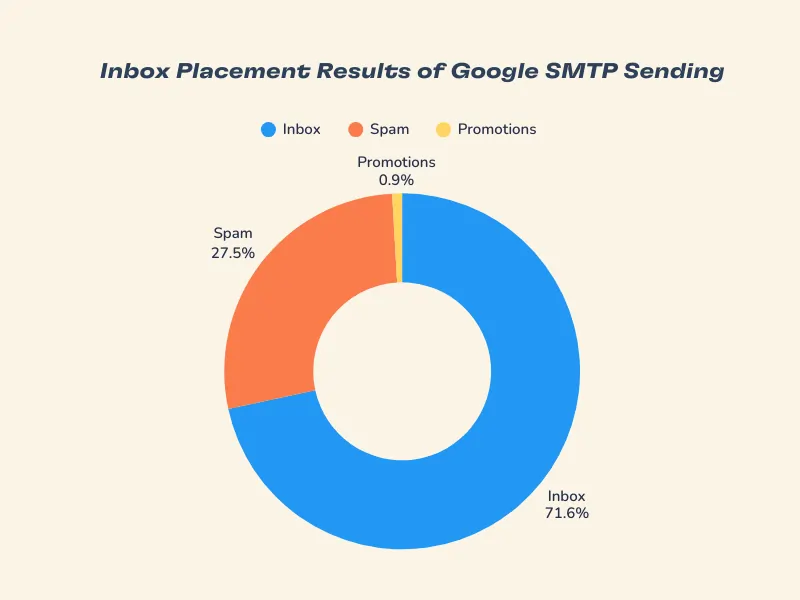
For emails sent through Google’s SMTP relay, the aggregate outcomes were:
- Inbox: 71.6%
- Spam: 27.5%
- Promotions: 0.9%
Google API sending: Key findings
The next step was to examine how emails sent via the Google API actually performed:
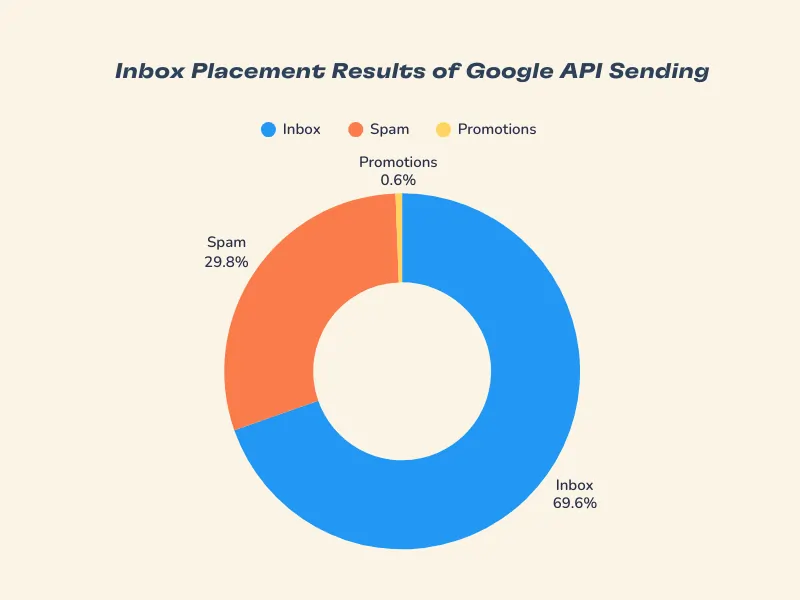
Across more than five million emails sent via the Google API during the analyzed period, the distribution of delivery outcomes was remarkably consistent with the Google SMTP Sending:
- Inbox: 69.7%
- Spam: 29.8%
- Promotions: 0.6%
Comparing SMTP and API side by side
When the results are placed next to each other, one conclusion is obvious: SMTP and API sending behave far more similarly than most people expect.
Despite the technical differences in how emails are transmitted, deliverability outcomes converge once mailbox providers begin filtering.
Across both methods, the high-level pattern is nearly identical:
- Roughly seven out of ten emails reached the inbox
- Roughly three out of ten emails were filtered to spam.
- Promotions placement remained under 1% in both cases
Some key insights:
- SMTP traffic showed a slightly higher inbox rate and a slightly lower spam rate compared to API sending. Promotions placement remained low and broadly comparable between the two methods. But while these differences are visible in the data, they are not dramatic.
- SMTP edges out API slightly in this sample, but the difference is small enough that switching sending methods alone is unlikely to produce a meaningful deliverability improvement.
- At the same time, the data shows that API sending is neither a silver bullet nor a disadvantage. It does not protect emails from spam filtering, nor does it penalize them.
- Deliverability outcomes still depend on how recipients interact with the messages and how consistently the sender behaves over time.
- The data reinforces that the sending method is only a secondary variable when it comes to deliverability. Teams looking for meaningful improvements need to focus beyond the protocol layer and address the signals mailbox providers actually use to make filtering decisions.
The takeaway from a year of data
After analyzing a full year of real sending data, the conclusion is clear: Google SMTP and Google API perform almost identically at scale. Inbox, spam, and promotions placement follow the same patterns across both methods, with only minor differences.
Email deliverability success is not something that can be attained by simply switching sending protocols. It is earned gradually through sender reputation consistency, and engagement.
Here’s where tools like Warmy.io come in. It offers an AI-powered solution that handles the warmup process for senders. It automatically yet gradually increases sending volume to build trust with various mailbox providers, simulates real human-like interactions (emails are opened, replied to, and marked as important) to boost deliverability, and works across 30+ languages so your emails look natural and relevant for global audiences.
This approach helps establish and maintain a positive sender reputation, ensuring your emails land in inboxes regardless of the sending protocol you use.
The data shows that the real work of deliverability happens long before protocol choice ever enters the picture. Download the full research report here to explore the data in depth.