Every year, Black Friday evolves into more than just a single day of shopping frenzy. It has become a full-fledged digital battleground where billions of dollars in revenue are at stake.
In 2025, US shoppers alone spent a record $11.8 billion online on Black Friday, reinforcing the day’s status as a pivotal moment in the retail calendar. That’s just eCommerce in the US, and that’s just Black Friday itself. We’re not even including the entire peak season which generates high spending too.
With this surge in consumer spending comes an equally dramatic spike in email volume as brands and companies compete for attention in inboxes.
That’s where email deliverability becomes not just a technical concern, but a business-critical discipline. During high-pressure events like Black Friday, when email volume skyrockets and sending reputations are tested, deliverability determines who reaches the inbox and who gets lost in the noise.
Into the Black Friday abyss: key factors of the experiment
In our latest research, the Warmy Research Team aimed to determine:
- How the seasonal surge in campaign volume impacted deliverability for many senders
- How structured warm up using Seed List enabled new accounts to steadily build inbox placement throughout the high-pressure period
We created two groups:
- Overall user base
- Separate cohort of users who joined in November and relied on the Seed List feature for warming up
The team observed and recorded daily deliverability rate for the entire month of November,
Key finding #1: The Black Friday deliverability drop
Black Friday is synonymous with promotions and email marketers know this all too well. However, it is this flood of promotional emails that come with a significant risk: the strain it places on your sender reputation.
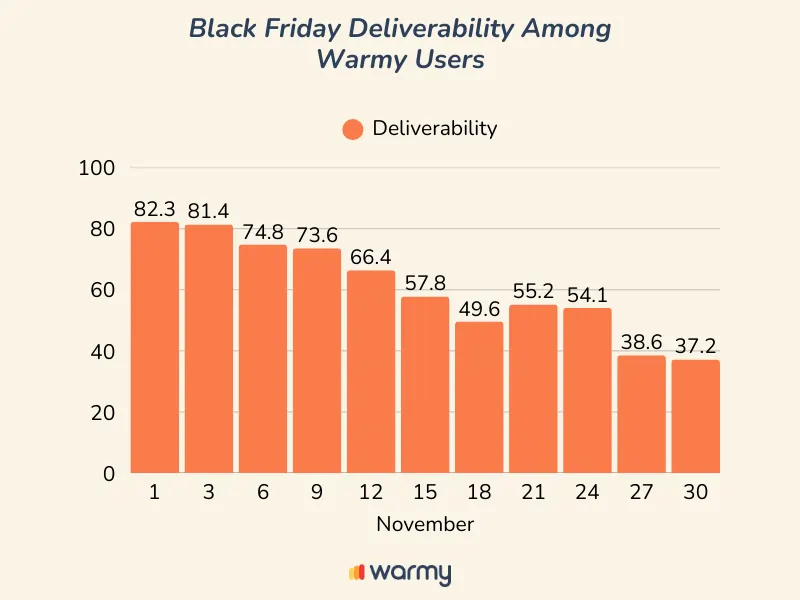
Internal data during the Black Friday month showed a drop in overall deliverability rate for Warmy users. From around 74.8% to 82.3% to a staggering 37.2% to 38.6% by the end of the month.
What does this mean?
- This sharp decline reflects a deteriorating sender reputation. ESPs begin to view the high number of promotional emails as potential spam or irrelevant content, leading to stricter filters and blocking actions, all of which significantly hurt inbox placement.
- The deliverability drop paints a clear picture of how this surge affects real-world email campaigns globally.
- The decline is not just theoretical, but it is a consequence of failing to account for seasonal fluctuations.
What are the consequences of declining deliverability?
Declining deliverability rates have immediate implications and long-term consequences:
When deliverability tanks, there is a significant drop in open rates. With fewer emails landing in the inbox and more being marked as spam or rejected outright, customers simply won’t see your messages. When open rates drop, click-through rates, response rates, and conversion rates soon follow.
Long-term risks include decreased sender reputation, and challenges in future inbox placement. A sharp drop in deliverability during Black Friday doesn’t just affect your current campaigns. It sets off a chain reaction. Spam complaints, bounced emails, and unengaged recipients (due to emails being ignored or relegated to spam) all contribute to a negative sender reputation score.
If your emails continue to land in spam or don’t get delivered at all, you face an uphill battle with every future campaign. Email service providers are reluctant to trust senders with poor reputations, and it can take some time to recover from the damage done.
Key finding #2: The seed list as a lifeline and structured warm up saves the day
The second group observed was composed of users who joined in November and relied on the Seed List feature for warming up during the same period.
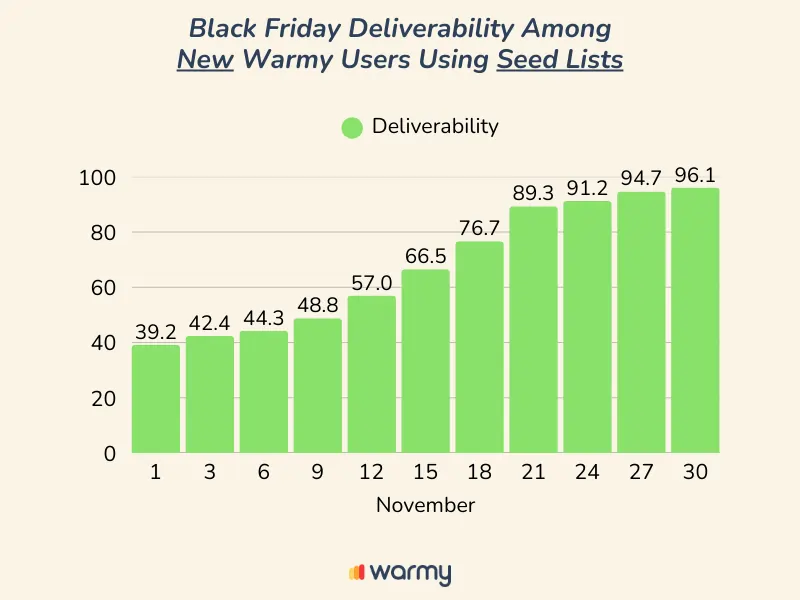
The contrast was striking. Users who relied on warm up strategies using Warmy’s Seed List enjoyed up to 96% deliverability by the end of November.
What does this mean?
- Seed List warm up mimics organic sending behavior, which helps email providers recognize sending domains as trustworthy, rather than a potential spammer. By steadily increasing sending volume and engagement, Seed List ensures that emails are more likely to land in the inbox, even during periods of intense sending activity.
- This surge in deliverability proves that a structured warm up process can have an immediate and powerful effect on inbox placement, even during a period when many marketers are struggling.
Navigating the Black Friday chaos with data-driven insights and warm up tools
Every time Black Friday approaches, many email marketers are left to face the chaos of an overwhelmed inbox. However, as our internal study demonstrated, email deliverability isn’t entirely random. It follows certain predictable patterns based on your sending habits, reputation, and email infrastructure.
Looking ahead, the key to successful Black Friday campaigns lies in early preparation. As we’ve seen, Seed List warm ups are effective for avoiding the usual pitfalls of high-volume email sending.
For more in-depth data and findings on Black Friday deliverability, check out our full research report here.