Email deliverability in 2025 is not just shaped by technical setup alone. As algorithms continue to evolve, mailbox providers like Gmail are using more and more factors to evaluate senders. It’s no longer just about sender reputation but how recipients interact with your messages.
Positive interactions such as opens, clicks, and replies now play a central role in determining whether an email reaches the inbox or falls into Spam. In this environment, the way you warm up your domain determines how quickly mailbox providers learn to trust you.
The Warmy Research Team set out to measure exactly how much engagement impacts reputation growth and how warm up methods compare in real-world conditions.
The core question: Does engagement change the game?
Email warm up has long been viewed as a necessary best practice. But with engagement signals becoming stronger indicators of trust, the question is now: How much more effective is warm up when real engagement such as opens and clicks is added to the mix?
To answer this, Warmy’s deliverability experts compared two approaches:
- Standard warm up: This is the process of gradually building and strengthening sender reputation by sending a small number of emails to engaged recipients. The sending volume is then increased over time. These consistent signals help mailbox providers learn that senders are trustworthy, which will result in improved deliverability.
- Warm up with clicks: This new feature involves real users regularly opening and clicking senders’ emails during the warm up phase. These interactions show mailbox providers that their emails are relevant, interesting, and safe. These boost engagement metrics and increase likelihood of future campaigns landing in the inbox.
The objective was simple: to measure deliverability growth side-by-side to determine how big the gap is between the results generated by the two methods. Our goals also included determining which approach delivered better inbox placement, a more stable sender reputation, and which one generated stronger engagement signals.
What we analyzed: Digging into the data
Warmy analyzed two independent cohorts over the same warm up timeframe:
- Standard warm up: 2,500 emails
- Warm up with clicks: 1,300 emails
These sample sizes allowed for statistically meaningful comparisons while accounting for natural variations in sender reputation. We tracked inbox placement percentages throughout the warm up period, enabling a direct comparison.
Key findings: Which warm up approach changes the game?
Below, we summarize the results of the research experiment which show just how dramatically different the two approaches are.
Standard warm up: slow, steady, but has limited lift
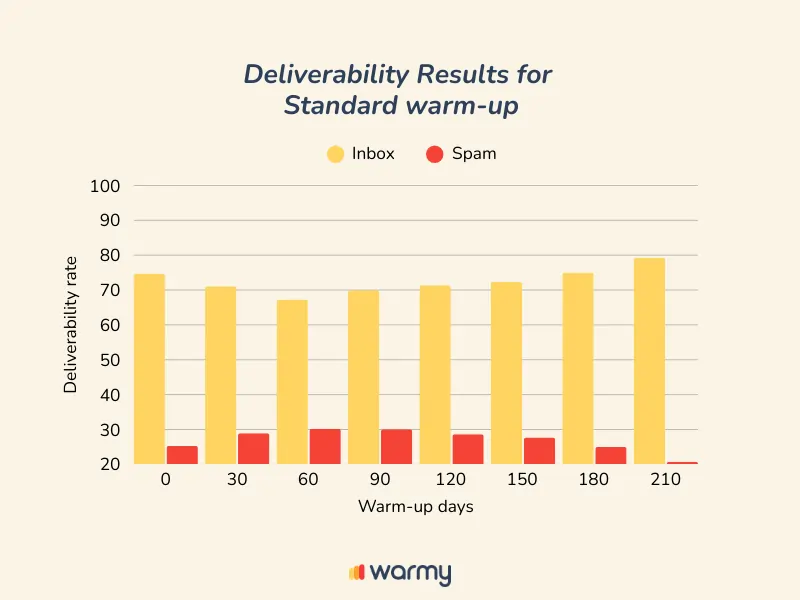
A traditional email warm up process follows a pattern: start with low sending volume, increase gradually while monitoring metrics, and remain consistent. Mailbox providers like Gmail interpret this as a safe approach. However, without additional engagement, reputation grows slowly.
Results for this experiment showed the following data points:
- Start: 74.7% inbox placement
- End: 79.26% inbox placement
- Total improvement: +4.56%
In this cohort, Gmail did increase trust over time, but the improvement was minimal.
Takeaway: Standard warm up relies almost entirely on volume stability. Without engagement signals like opens, clicks, or replies, the mailbox provider receives very limited evidence that recipients find these emails valuable. As a result, reputation is improved cautiously, leading to modest gains.
This method works as a maintenance tool for domains that already have a solid reputation, but it’s not designed to create rapid growth or meaningful inbox improvements.
Warm up with Clicks: Engagement that accelerates trust
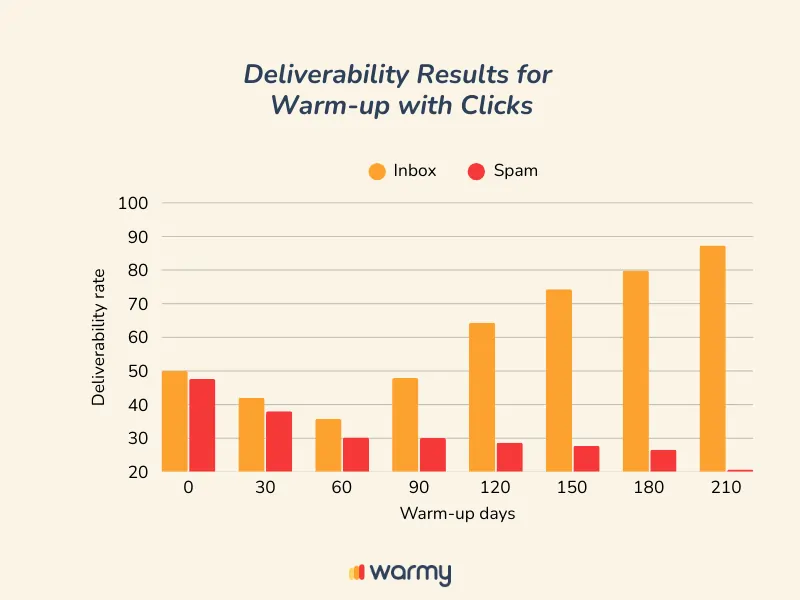
Warm up with Clicks produced dramatically stronger results. When engagement is added during the warm up process, the trajectory changes completely. Gmail receives a high volume of positive signals much faster, which reshapes how it evaluates the sender’s reputation.
- Start: 50% inbox placement
- End: 87.30% inbox placement
- Total improvement: +37.30%
Despite starting at a much lower baseline than the standard group, the Warm up With Clicks cohort not only caught up but exceeded the standard group significantly—8x higher in fact.
Takeaway: To Gmail, these engagement interactions signal that real recipients are not just receiving the messages. They are also actively engaging with them. Warm up with Clicks operates not as passive reputation-building, but as reputation activation.
The final verdict: Which warm up approach is better?
Businesses that rely heavily on email such as sales teams, marketers, SaaS platforms, or agencies, can significantly improve performance by choosing a warm up method that leverages engagement. The data shows that this approach unlocks stronger inbox reach faster.
To summarize:
- Standard warm up provides value when a sender already has a stable and positive sender reputation. It can be used for maintenance.
- Standard warm up is not ideal for new domains, inactive domains, high-volume senders, and those recovering from poor reputation.
- Warm up with clicks activates the engagement layer mailbox providers rely on. This gives businesses a strategic advantage.
Maximize inbox placement with warm up With Clicks
The takeaway is clear: If you want to maximize inbox placement, engagement must be part of your warm up strategy.
When it comes to deciding whether or not your emails belong in the inbox of your target recipients, ESPs prioritize engagement signals, not just delivery. warm up with Clicks outperforms standard warm up by a wide margin and sets your email program up for long-term deliverability success by doing the following:
- Helping senders build a credible sender reputation through authentic engagement.
- Preventing bounces with seed lists that are automatically validated, so they are always updated
- Providing a 100% automated process which removes the need for manual uploads or campaign setups, helping save time
- Providing access to other built-in deliverability tools such as inbox placement testing, domain health & IP reputation monitoring.
- Ensuring the warmup process is continuous, adaptive, and human-like.
For a full view of the numbers and the experiment, you can access the full research report here.
If you want to learn more about warm up With Clicks and how it can transform your entire email marketing and outreach game, book a demo today.


![Text on a white background reads SMTP Error 500 5.0.0 How to Fix It [SOLVED]; smtp error 500 5.0.0 appears again in bold red text for emphasis.](https://warmy-blog-wordpress-bucket.s3.amazonaws.com/wp-content/uploads/2026/01/21173641/SMTP-500-500-1.webp)